Eighteen months, $1,680 in replacement equipment. Two steamers, one ultrasonic cleaner, one e-file handpiece. The second steamer died eleven minutes into a 75-minute facial. I finished with a warm towel and a rebooking text the client answered with “maybe next month.”
Replacement cost was the small number. The expensive part was the supply-store Tuesday and the client who did not rebook.
What the failures had in common
The first steamer had a heating element coated in Denver tap water scale. The ultrasonic tank had run on the same solution for nine days. The e-file handpiece had dust packed into the collet because I stored it without a blank pin. Each one was a task I had postponed.
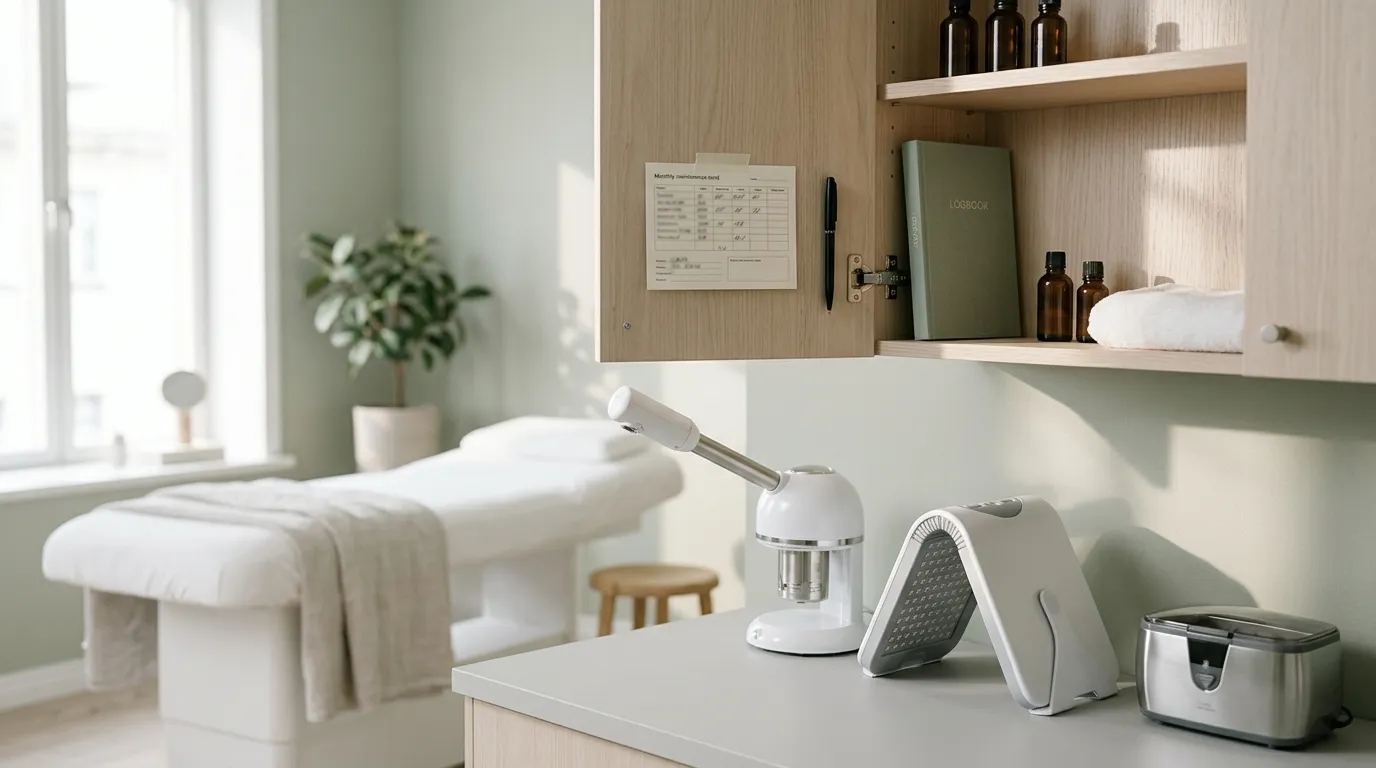
In a one-room studio, the maintenance department is a card inside a cabinet door. The card took 40 minutes to write.
The monthly card: an esthetician equipment checklist
First Monday, before the first client. Five minutes of inspection, then the steamer descale runs after the last appointment while I chart.
Most of the card is inspection. The steamer descale is the only long task, 20 minutes a cycle. Distilled water keeps the descale at 20 minutes instead of a teardown. Denver tap water leaves calcium on the heating element and thermal cutoff sensor; a Universal Companies steamer manual warns that tap water minerals shorten the life of both, and the company’s care guide recommends distilled water, a daily empty-and-dry, and a monthly descale.
Check your manual for the water specification. A few sensor-equipped models are built for tap water and will alarm on distilled. White vinegar or 5% citric acid is common for descaling; the VEVOR DT-318 cleaning guide specifies those two agents and a monthly cleaning.
The quarterly facial machine maintenance schedule
Block 45 minutes on the first Monday of the quarter. Phone off, no clients.
Steamer. Descale with citric acid if your water is hard. Inspect the gasket, replace it if hard or leaking, change any inline filter, and run a tank of distilled water through.
LED panel. Check every mode and diode, plus the cord and strain relief. Clean the face with the product named in the manual. Celluma’s warranty excludes moisture damage and damage from incorrect cleaning or disinfecting materials.
Ultrasonic. Run a foil test to confirm the tank is cavitating evenly. Midmark uses it to check efficiency and recommends it when performance drops. Change solution daily; L&R says daily or as needed and caps temperature at 160°F. Debris left in the tank acts as an abrasive and can wear pinholes.
E-file. Send the handpiece for service at the manufacturer’s interval or at the first wobble, smell, or power drop. Kupa says dust is what damages it, a crimped cord can snap internally, and techs should not repair e-files themselves.
Prevent facial machine breakdowns with one spare
Every solo studio needs one backup for its critical device. Mine is a second steamer. When the main unit went down in February, the backup turned a cancelled day into a repair window.
✅ The $12 rule
Order the wear part when you notice the wear. A gasket, a fuse, a set of brushes, a spare cord. The part costs less than the rush shipping when it fails on a Friday.
What changed after fourteen months
| Check | Before | After |
|---|---|---|
| Steamer descale | When steam got weak | First Monday, monthly |
| Ultrasonic solution | Topped off until cloudy | Changed daily, foil test quarterly |
| E-file care | Ran until it seized | Brushed monthly, serviced yearly |
| LED check | When a client mentioned it | Every diode, every quarter |
| Emergency equipment spend | $1,680 in 18 months | $0 in 14 months |
| Mid-service failures | 2 | 0 |
Fourteen months is a short test. The parts bill is the proof: one gasket, one set of e-file brushes, one bottle of descaler. The steamer runs quieter, the ultrasonic tank looks new, the e-file has not lost power mid-set.
Esthetician studio setup: where the card lives
Print both sides of one card. Tape it inside the cabinet door you open every day. Keep the logbook beside the steamer. A schedule you have to find is a schedule you skip.
The card belongs in the same 30-minute weekly prep as the rest of the admin, next to the sanitation system. Both are built for the edges of the workday, when the work is cheap. A machine that dies mid-service turns an 8-minute room turnover into a 40-minute apology.
Setup: 40 minutes, $38. The card gets five minutes on the first Monday, a descale cycle while I chart, and 45 minutes four times a year. What disappears: the emergency supply run, the half-finished facial, the four-figure replacement year.