A client books a peel, arrives on a new medication, and now you are mid-treatment realizing her skin cannot take it. The intake form is the container. This is the decision layer inside it: a facial contraindications checklist that sorts what you hear and see into modify, postpone, or decline, with the words to say in your room so the answer costs you the service, never the client.
Esthetician contraindication screening: the three verdicts
Every screening decision lands in one of three buckets. Decide which one you are in before you touch her face, and you will never improvise again.
| Verdict | What it means | When to use it |
|---|---|---|
| MODIFY | The facial happens with something taken out | Blow-dry out facial waxing; light peel goes gentle; extraction goes minimal |
| Verdict | What it means | When to use it |
|---|---|---|
| POSTPONE | The facial waits on a fixed clock | Skin needs to heal or the medication needs to clear a set window |
| Verdict | What it means | When to use it |
|---|---|---|
| DECLINE | No service today, and rebook only after clearance | Active disease, broken skin, or a medication her prescribing doctor owns |
Modify and postpone keep the money and the relationship. Decline sacrifices both on purpose.
Facial contraindications list: medications first
Medications drive the hard lines because they change how skin responds to friction, acids, and heat.
Isotretinoin (Accutane). The strongest line on the list. The AAD instructs patients not to wax while taking it and for six months after stopping, because waxing can cause permanent scarring. The isotretinoin package insert carries the same guidance for waxing, chemical peels, and dermabrasion. While she is on it, I do not wax, peel, extract, or exfoliate. Gentle, hydrating, product-free-of-actives facials can happen; anything aggressive is a six-month clock from her last pill, and I confirm that date, never estimate it. A 2022 study in the Journal of Cosmetic Dermatology questions how rigid that six-month rule needs to be, which is exactly why the prescription clock belongs to her dermatologist and my list stays conservative.
Topical retinoids. Tretinoin, adapalene, Differin. Any strong acid, peel, or wax means a week off the product first, and if her skin looks raw, flaky, or reactive in person, the service postpones anyway.
Blood thinners. Warfarin, daily aspirin, high-dose fish oil. No deep extraction. Bruising is guaranteed and looks like damage I caused.
Oral antibiotics plus sun exposure. Tetracyclines, doxycycline, and anything sun-sensitizing: skip the aggressive acids until she confirms tolerance.
New prescription in the last two weeks. Unknown skin reaction equals postpone. Ask what it is, look it up between appointments, then decide.
Conditions: what postpones and what stays home
- Active cold sore or herpes lesion. Decline anything on that area. Peels over a lesion can spread it across the whole face.
- Active eczema, psoriasis, or dermatitis flare. Postpone the facial entirely. Flared skin is already inflamed; adding actives makes it worse.
- Broken or sunburned skin. No exfoliation, no acids, no wax. Heals first, then rebook.
- Sunburn from the last 48 hours. Postpone. Heat over freshly burned skin deepens the damage, and the AAD treats sunburn as injured skin that needs moisture and cooling, definitely nothing applied to it.
- Uncontrolled rosacea mid-flare. Postpone heat, steam, and aggressive extractions. A cool, calm version can be modified if the flare is mild.
- Waxing over the above. Waxing has its own hard stop: no wax over broken skin, active irritation, or while she is using retinoids or isotretinoin, which the AAD’s waxing guidance calls out specifically.
Day-of observations that change the answer
The form says she is clean. The face in front of you can say otherwise. Six checks, every client, before the first product touches her skin.
⚠️ The five words that protect you
I do not treat what I cannot identify. I do not need to know what a mark is to know it is outside my scope. I just need to refuse to work over it and hand the referral with the same calm I hand a price list.
When not to perform a facial: how to say not today
Declining is a script, and running a solo chair you only need four. The same beats every time: what you see, what you will not do, what she gets instead. My acne phone screen uses the same shape on the phone; these are the versions for the moment she is already on the bed.
Accutane, active flare, or anything medical: “I cannot safely do the peel while you’re on Accutane, and your skin needs to come first. What I can do today is a gentle hydration facial, and I’ll take your peel the moment your dermatologist clears you.”
Active flare-up: “I’m seeing active inflammation today, and treating over it will set your skin back. Let’s rebook for two weeks out. If you come back calm, I’ll add the steam and extractions for free.”
Cold sore or broken skin: “I can’t work over that today, but I don’t want you to lose the appointment entirely. Let’s do the hands and a scalp massage, and I’ll credit the facial difference toward next time.”
The pushback: “I hear you, and I wish I could. My license stops me at this line, and working past it puts your skin at risk. Two weeks from today, same time, and I’ll make it worth the wait.”
Two weeks is the follow-up window I use because it is long enough to heal, short enough that she has not mentally written me off. If the reaction is worse than expected and she pushes back anyway, the escalation is my allergic reaction protocol, and the answer is always stopping the service, not finishing it.
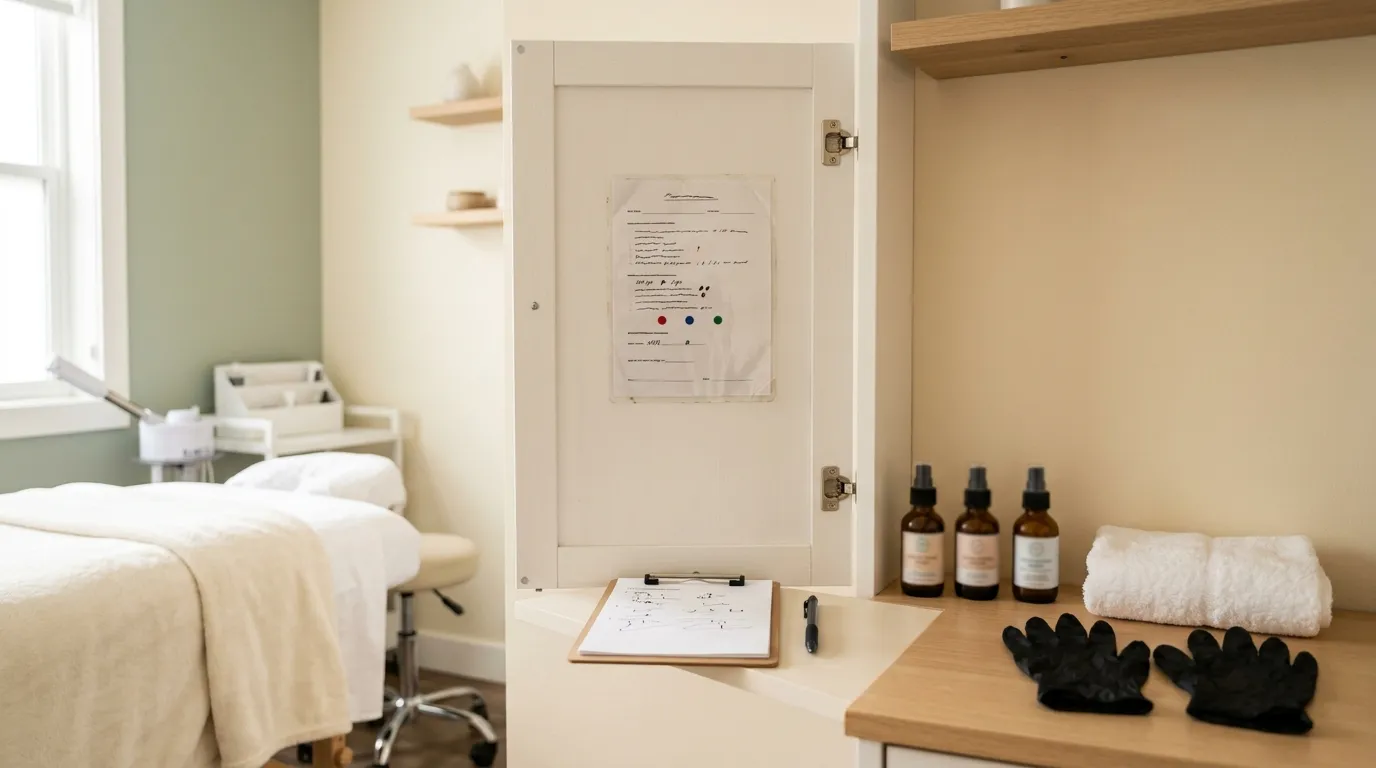
The full screening system lives on one laminated card taped inside my cabinet: the three verdicts, the five medication lines, the six day-of checks, the four scripts. Two minutes per new client before they arrive, and every “not today” ends in a rebook instead of a refund.