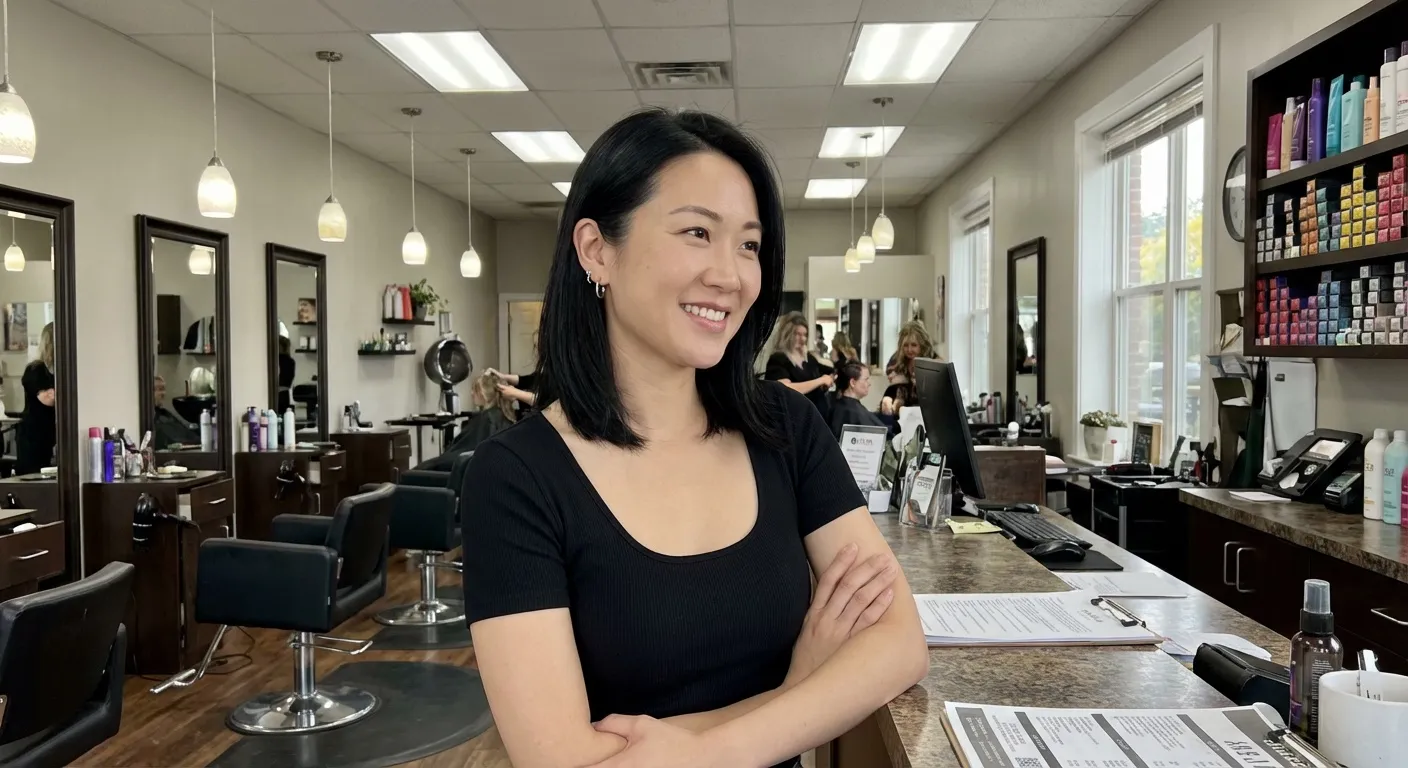
I found my first one-star review while locking up on a Tuesday night. A client I liked, a balayage I was proud of, and three sentences saying I’d wrecked her hair. I stood in my dark salon reading it on my phone and typed four different furious replies before bed. Thank goodness I deleted all four, because I had misremembered the appointment. She’d asked for something my consultation notes said she didn’t ask for. If I had posted reply number two, my rebuttal would still be sitting under her review, contradicting my own paperwork.
That review taught me the thing I wish someone had told me: the reply matters less than the sorting. Not every bad review is the same thing. Some are fair. Some are wrong. Some break the platform’s rules. Each one gets a different response, and two of the three barely deserve a fight. The system I use now is a two-minute sort, then one of three salon review response examples: a script for the unfair ones, a script for the legitimate ones, and a report-plus-script for the ones that break platform rules. The offline step comes first, every time.
That number comes from BrightLocal’s 2026 Local Consumer Review Survey, and it gets worse for anyone tempted to pretend the review isn’t there. Half of consumers say a templated or generic reply makes them less likely to choose a business, and 80% say they’re likely to use a business that responds to every review. Future clients read your reply as a preview of how you handle problems. But a panicked reply is worse than a careful one, and the sorting comes before any of it.
Sort the review before you type anything
When I find a bad review now, I don’t draft a reply. I spend two minutes sorting it into one of three buckets.
Unfair means the reviewer was really in your chair and is describing a real experience, but their account is wrong or the standard is unreasonable. The color matches the formula they approved. The stylist they’re blasting was 10 minutes late once. These hurt the most because they’re indefensible in your own head and defensible in public.
Legitimate means the complaint is fair and you’d agree with it if a friend described it. The blowout didn’t last two days. The front desk double-booked and made her wait 40 minutes. A stylist was short with her. Nothing to argue. Something to fix.
Policy-violating means the review breaks the platform’s rules, so your job changes from reputation management to report filing. Google’s prohibited and restricted content policy draws a clean line here: fake engagement (reviews not based on a real experience), conflict of interest (a former employee or a competitor), harassment, offensive content including unsubstantiated allegations of unethical or criminal behavior, personal information, profanity, off-topic rants, and spam. A review written by someone who was never a client is fake engagement. A review calling you a scammer without describing any experience is an unsubstantiated allegation.
Nobody tells you this part: your reply to a policy-violating review is almost beside the point. The review may come down. What decides that is your report and your evidence, not your prose. And the report is the one place where being emotional actively hurts you; people who file these appeals for a living consistently give the same advice: state the policy, cite the evidence, skip the feelings.
The offline step that makes your reply honest
Before any public reply, check what actually happened. This is the step I skipped on my balayage night, and it’s the difference between a reply you can stand behind and a rebuttal you’ll regret.
- Open your booking software and pull the actual appointment. Date, time, service, who performed it.
- Read the consultation notes and the formula record.
- Read the text thread with the client.
- Ask the stylist for their version of the appointment, the same day, while it’s fresh.
If your salon keeps proper client records, this takes ten minutes. If it doesn’t, that’s the gap the review just exposed, and fixing it matters more than the reply. My client notes system exists partly because of that night; without a record of what she approved, I would have either caved publicly or argued publicly, and both options were worse than the review.
Two outcomes are possible. The record backs the client’s account, and your reply needs to own it. The record contradicts the review, and your reply stays calm and specific because you know exactly what you’re defending. Either way, you write it from documents instead of memory. Memory at 10 p.m. after reading a one-star review about yourself is not a reliable narrator.
✅ The 24-hour rule
BrightLocal found 19% of consumers now expect a same-day response to a review and 81% expect one within a week. So you have time to be right. Draft the reply, sleep on it, check it against your records in the morning, then post. A calm reply posted tomorrow beats a defensive one posted tonight.
Unfair salon review: what to do first
An unfair review feels like an invitation to argue. Take the case to the reader instead of the reviewer; the reviewer is not your audience. Future clients scanning your profile are.
The structure I use: acknowledge, state your standard briefly, invite them offline, no rebuttal of specifics. Correcting the details point by point reads as defensive to everyone watching, and it turns your profile into a he-said-she-said.
“Hi Dana, thank you for the feedback. I take color accuracy seriously; every formula is written down and approved with the client before we mix. I’d genuinely like to understand what fell short, because it doesn’t match what we have on record for your visit. I’ve sent a note to the contact info we have on file. If you’d rather talk directly, I’m reachable through the salon any day this week.”
What you lose by staying short: the satisfaction of being right in public. What you gain: 37% of consumers told BrightLocal that a business owner’s response is a factor they weigh when judging a review, and a composed reply to a hostile review reads as competence. I’ve had one of these come back and amend their review after a calm reply and a genuine offer. I’ve had others stay angry. Either way, the reply wasn’t for them.
One warning: keep the invitation specific. “Contact us anytime” reads as a brush-off. “I’ve reached out through the number on your file” shows the offline step happened before the reply went up.
Reply for a legitimate review
A fair review gets the shortest reply of the three, because the fix is the message. Acknowledge the specific failure, say what you changed, and let the record show it.
“Hi Priya, you’re right that the wait was unacceptable, and I’m sorry. Our Saturday double-booking was on us. We’ve capped Saturday bookings per stylist and moved check-in earlier so a running-behind morning can’t pile up at the desk. I’d love a chance to show you the difference. The first hour is on me.”
The offline step does the heavy lifting here. What changed? If nothing changed, the reply is a lie, and the next review will say so. So fix first, then reply. In my case the Saturday fix was real within two days, which is why the reply above could name it.
What I don’t put in these replies: refunds. Offering “come back and we’ll make it right” is fine. Negotiating compensation in a public thread invites a second review about the negotiation. I wrote the whole refund and redo policy down so that conversation happens at the desk or over the phone, under a policy I chose calmly, not in a comment section under pressure.
Reply for a policy-violating review
Here the sequence inverts: file first, reply second, and keep the reply nearly content-free.
Document before you report
Screenshot the review with its date and URL. Check the reviewer's public history. Note anything concrete: never a client in your booking records, a name matching a former employee or competitor, profanity, an accusation of criminal behavior with no experience described.
Report through the platform's tool
Use Google's Manage Reviews tool in your Business Profile and pick the closest violation category, then match the exact policy language in any follow-up. Most reports get processed within a few business days.
Appeal with policy, not feelings
If the report comes back 'no policy violation,' appeal. Cite the specific policy line and the specific evidence. Batch report review attacks, multiple one-stars landing in a day, as a set.
Reply for the audience reading later
The review may take days to come down, or never. The reply is for everyone who reads the thread in the meantime.
Then the public reply:
“We take feedback seriously and we investigate every claim. After checking our records, we can’t match this account to any client visit or service on file. We’ve reported the review to the platform and remain available to help any actual guest.”
Keep it that dry on purpose. The point of the reply is the record it leaves for future clients: the salon has a process.
A note on expectations: a bare one-star rating with no text is nearly impossible to remove, because there’s no text to violate a policy. Proving someone was never a customer is hard too, since platforms don’t require purchase to review. File anyway, but spend your emotional energy on the reply and on the steady stream of fresh reviews that pushes the old one down.
When responding to a bad review makes it worse
Sometimes the strongest move is a short reply or none at all. Three cases from my own floor.
An extortion attempt. The review arrives, then a message offering to make it disappear for money, or a cluster of one-stars followed by that offer. Never pay and never negotiate. Google blocked 240 million fake or policy-breaking reviews in 2024, and it runs a dedicated form for extortion reports. Report it, save the evidence, reply once with the dry template above.
The pile-on after a viral moment. If someone’s video sends a wave of one-stars from people who’ve never sat in your chairs, replying to each one feeds the algorithm and the mob. One pinned reply addressing the moment, batch-report the reviews, let the stream of real client reviews bury it.
The fight you can’t win. A reviewer who answers your calm invitation with more fury does not want resolution. One reply, offered sincerely, is your side of the story for readers. The second reply is for your own ego, and readers can tell.
Save this as your negative salon review response template
This whole topic sits at the unglamorous end of reviews. Everyone covers collection: the automated review requests that keep fresh five-stars flowing, the math on why reviews drive local growth. But collection is a system you build once. A bad review arrives on a random Tuesday night, when you’re tired, and the system that matters then is a two-minute sort, ten minutes with your records, and three scripts you don’t have to invent under pressure.
The three scripts are above. Save them as your negative salon review response template, in the notes app on your phone, before you need them. Responding to bad reviews well is mostly decided before the review exists: the records you keep, the policy you wrote, the template you saved on a calm day. That’s the whole move. The reply you write when you’re calm is the one that holds up when you’re not.