A bride sat across from me in the consultation room last spring, phone in hand, three quote emails open. She had asked every salon the same question: what do you charge for bridal party hair? One salon said $95 a head. Another said $120. Ours quoted $110, and my front desk had let her do the rest of the math herself.
“Eight of us,” she said, tapping the screen. “That’s eight hundred and eighty dollars before my trial.”
I watched her multiply. That quiet moment in the chair is why I stopped quoting wedding parties the way I quote everything else.
The multiplication problem
For years I priced bridal parties per head, because that is how the menu works. An updo is $75 on a Tuesday. On a wedding Saturday, the same work becomes bridal styling and the price jumps. I did what most salons do. I added a bridal line, raised it enough to cover the extra time, and called it done.
The bride never sees any of that reasoning. She sees a number, remembers what the same salon charges for a regular updo, and thinks the word this industry has trained her to use: wedding tax.
She has reason to. Wedding pricing research keeps finding a real gap between event and non-event quotes. A guide to hidden wedding fees found wedding quotes running 20 to 50 percent higher than the same service priced for a non-wedding event, and CNBC’s reporting on the wedding tax documents how couples feel that premium. A bride comparing three per-head quotes is doing exactly what the market taught her to do.
The problem: per-head quotes all look the same. Same shape, same multiplication, same ending. The cheapest number per head wins, so you compete over $5 and lose the $800 party.
The group total is the headline
I spent five years in hotel management before beauty school, and hotels solved this exact problem decades ago. When a couple came in asking about a wedding, the sales team never quoted a room rate and multiplied. They sold a package: ceremony space, reception, a room block, one total. Nobody asked what the florals cost per guest. There was no line item to question.
The package did two things. It set one anchor instead of eight. And it gave the couple a deal to feel good about, because buying the whole thing at once looked cheaper than it felt.
That is the psychology of the group total. Behavioral economists call it transaction utility, and it explains why people evaluate a deal against a reference point rather than in absolute terms. When you hand a bride a single number for the whole party, she stops comparing your per-head rate to the salon next door. She compares your total to the number sitting next to it in her wedding spreadsheet. The Knot’s Real Weddings Study puts the average wedding party at eight people, and the average party member’s hair at about $110. Eight hundred eighty dollars feels like a line item. It feels normal next to the photographer and the venue.
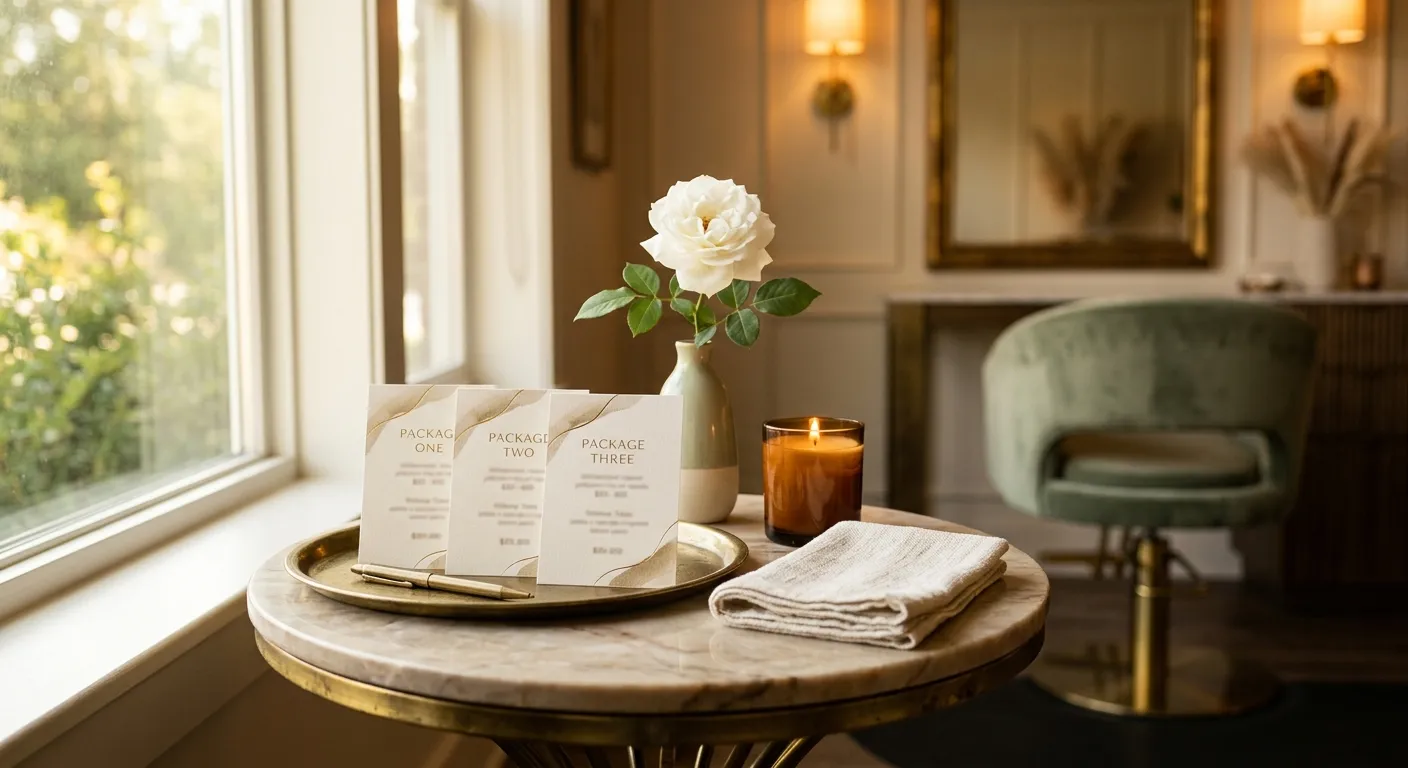
Salon wedding party packages: the three tiers I quote now
I built a three-tier structure the same way hotels build banquet menus. Every tier leads with the group total and what it includes. The per-head rate exists on my pricing sheet, never in the conversation.
The Bride. $195. Trial styling plus day-of bridal hair. For the bride who has her party arrange their own hair. It is the smallest ticket and it plants the anchor for everything else.
Bride + Party. $795 flat for the bride plus up to five. One price for the whole group, styled at my station, staggered so nobody sits around. This is the tier most brides book.
The Full Morning. $1,295 for the bride plus up to nine, with two stylists, a touch-up kit, and mimosas. The bridal suite version of a hotel package.
Watch what changed. A bride who reads those three numbers never once divides $1,295 by ten. She reads the tiers the way she reads the venue’s packages: which one fits my day. The middle tier does the selling, the menu anchoring effect I wrote about when we redesigned our service cards. And because the numbers stay in the realm of “one wedding purchase,” the comparison that kills per-head quotes never starts.
The quote shape is the strategy
The wedding spreadsheet is the reference point for a bridal party quote. A bride compares your total against the photographer and the venue, numbers that already feel normal. Give her one number and a reason, and the wedding-tax alarm stays quiet. Hand her eight numbers and a calculator, and you lose to whoever quoted $5 less.
The bridal party price quote that protects the bridesmaid
The group total fixes the bride’s math, but the bridesmaid has her own version of the problem. A bridesmaid usually pays her own way, and she is making a price decision for hair she did not ask for. Quote her $110 and she hears “the wedding version of a blowout.”
Our party pricing includes the bridesmaids in the tier, so the only number she ever sees is her share of the group total, which reads smaller than any standalone bridal price. One of my stylists put it the best way I have heard: “We stopped selling hair by the head and started selling the morning.” That line, more than anything I have read on pricing, is the perceived value principle applied to a whole party instead of a single chair.
The bride who sat in my chair with three quotes open booked the middle tier that day. She skipped the per-person math entirely and asked whether her mom could add on, which is the exact question every salon owner wants to hear. If you are building a service bundle for the first time, start with the group that already buys together. Weddings are the easiest bundle you will ever sell, because the bride was already comparing totals before she walked in.
Next time a wedding inquiry lands in your inbox, do not answer with a number and a multiplication sign. Send three tiers and one total. Watch what happens to the conversation when there is nothing left for her to calculate.