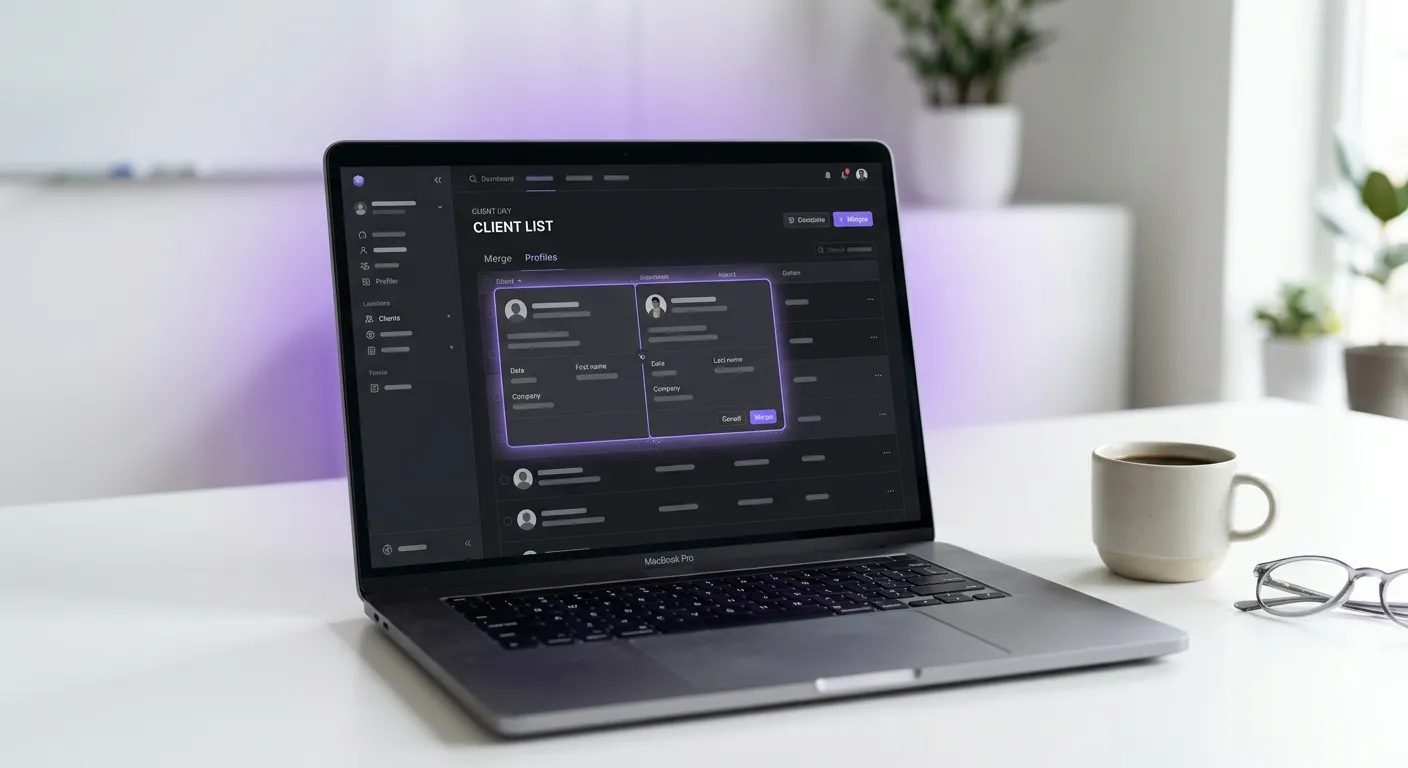
Most salon databases carry a 10 to 30 percent duplicate rate. That figure comes from Landbase’s 2026 duplicate-record research, which tracks the same problem across CRMs in every industry. For a salon with a thousand clients on file, that is a hundred to three hundred records that look like two people and are actually one.
It sounds like a tidiness problem. It isn’t.
What duplicate salon client profiles actually cost
The cost shows up in the numbers you trust most. Client retention rate. Lifetime value per client. First-visit-to-second conversion. All three are computed the same way: you count a client, then check whether that client came back.
When the same person is in your system twice, the math stops working. A client who booked under her phone number in January and joined the waitlist under her email in March reads as two different clients, each with one appointment and no repeat visit. Your retention rate drops. Your “first visit to regular” conversion drops. The salon next door with a cleaner database looks like it is running circles around you, and the gap is not real.
It gets worse when you are trying to make decisions. Industry research on bad CRM data puts the revenue cost at more than 12 percent. A salon clearing $400,000 a year is looking at somewhere between $25,000 and $50,000 of revenue decisions made on inputs that are quietly off. Which stylists are best at retaining new clients? Who is due for a rebook text? Which regulars have gone quiet? Every one of those questions reads wrong when half your clients exist twice.
Why duplicates keep showing up
Salon databases collect the same person through different doors. A client books her first cut through the website and enters her phone number. She joins the waitlist six months later from a different device and types in her email. She books again in May with both, but from an incognito tab. Three records, one person.
The front desk makes it worse. Someone types “Sara” one week and “Sarah” the next, or misses a digit in a phone number, and the system writes a new row because it does not know any better. Rosy Salon Software’s data-quality guide identifies inconsistent entry as the single biggest driver of duplication in salon CRMs.
Most platforms handle this reactively. You notice a duplicate, you open a merge tool, you pick which record to keep, you move appointment history across by hand. Mangomint’s merge documentation, Phorest’s support guide, and Vagaro’s cleanup tool all document the same three-to-five-click process. It works. It also assumes someone has the time to run it.
The fix has two layers
Cleaning up duplicates is the obvious layer. Preventing them at the moment a record is created is the one that matters more.
The prevention layer has two working mechanics.
The first is normalization. Before a new client record is written, the system standardizes what it has. Phone numbers get stored in E.164 format (+15551234567) so that “555-123-4567” and “(555) 123-4567” collapse to the same key. Email addresses get lowercased and trimmed so that [email protected] and [email protected] collapse to the same key. Without this step, a match lookup finds nothing, and a duplicate gets written.
The second is the lookup itself. When someone submits a booking or a waitlist signup, the system checks whether a client with that phone or that email already exists in the salon’s database. If one does, the new booking attaches to the existing record instead of creating a new one.
✅ The booking-waitlist gap
The most common duplicate pattern in salon databases: one client books under phone, then joins the waitlist under email, then books again with both. Three records, one person. A preventative merge has to know that phone-only and email-only records can belong to the same person.
How Lutily handles it
Every time a client books an appointment or joins the waitlist, Lutily runs a match against the salon’s existing client list. The match looks at both phone and email. If either matches an existing client, the booking attaches to that record.
The less obvious case is when phone and email each match different existing records. That happens when someone joined the waitlist with email in January, booked with phone in February (which created a second record because the system had no phone on file for the email record), and now comes back with both. Lutily detects the overlap, transfers the appointments, notifications, and waitlist entries from the email-only record to the phone record, then deletes the empty duplicate. One person, one history.
This runs on every booking and every waitlist join. There is no dedupe screen to remember to open, no weekly cleanup task, no list of duplicates to review at the end of the quarter. The record stays correct as the data comes in. You can read more about the waitlist side of this in why we delay waitlist notifications by five minutes and how the client account page lets clients sign in with their phone.
What you get back
A retention rate that reflects reality. A rebook list that does not call the same person twice. A revenue-per-client number that is not silently inflated by 15 percent because every third client is counted as two.
The first four items happen automatically in Lutily. The fifth is the only one that still takes a few minutes, and only once, on the records you brought in from somewhere else.