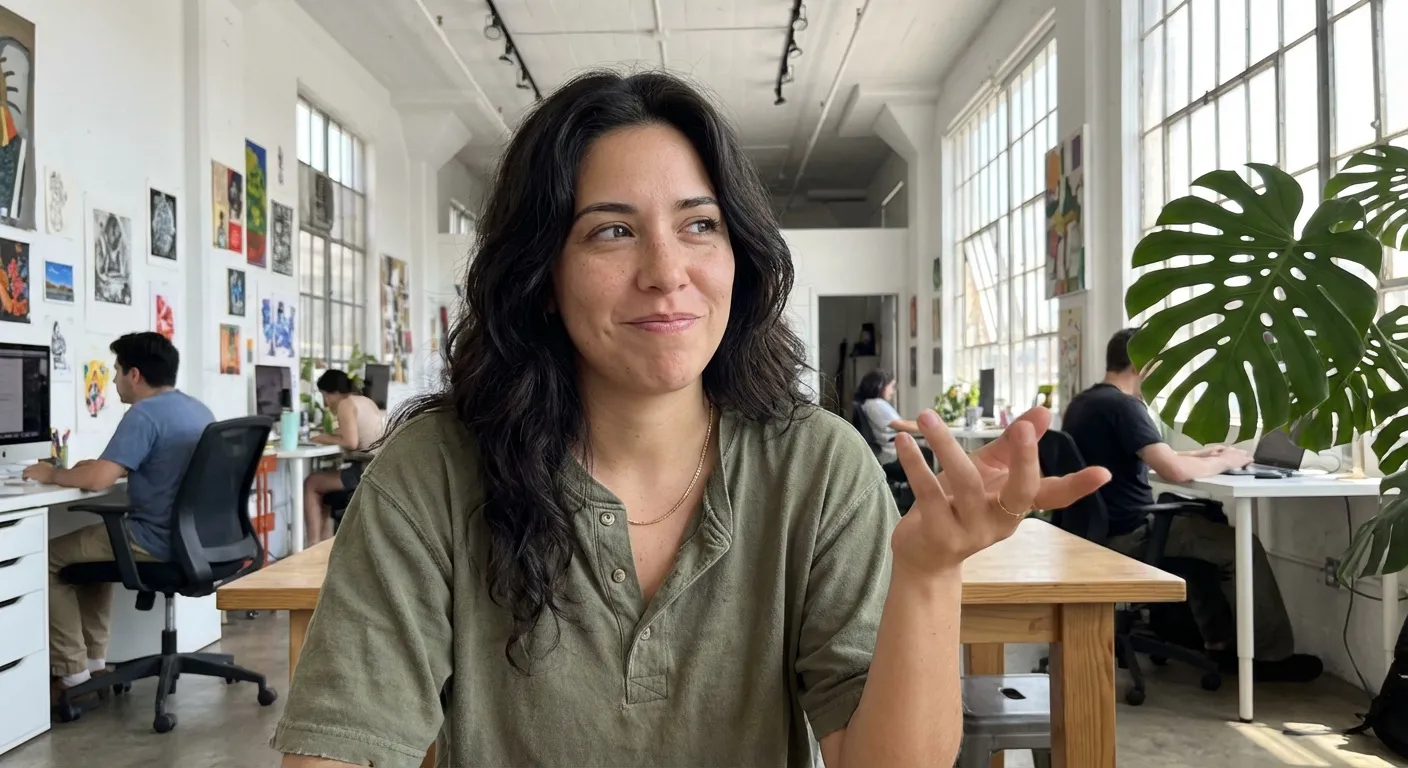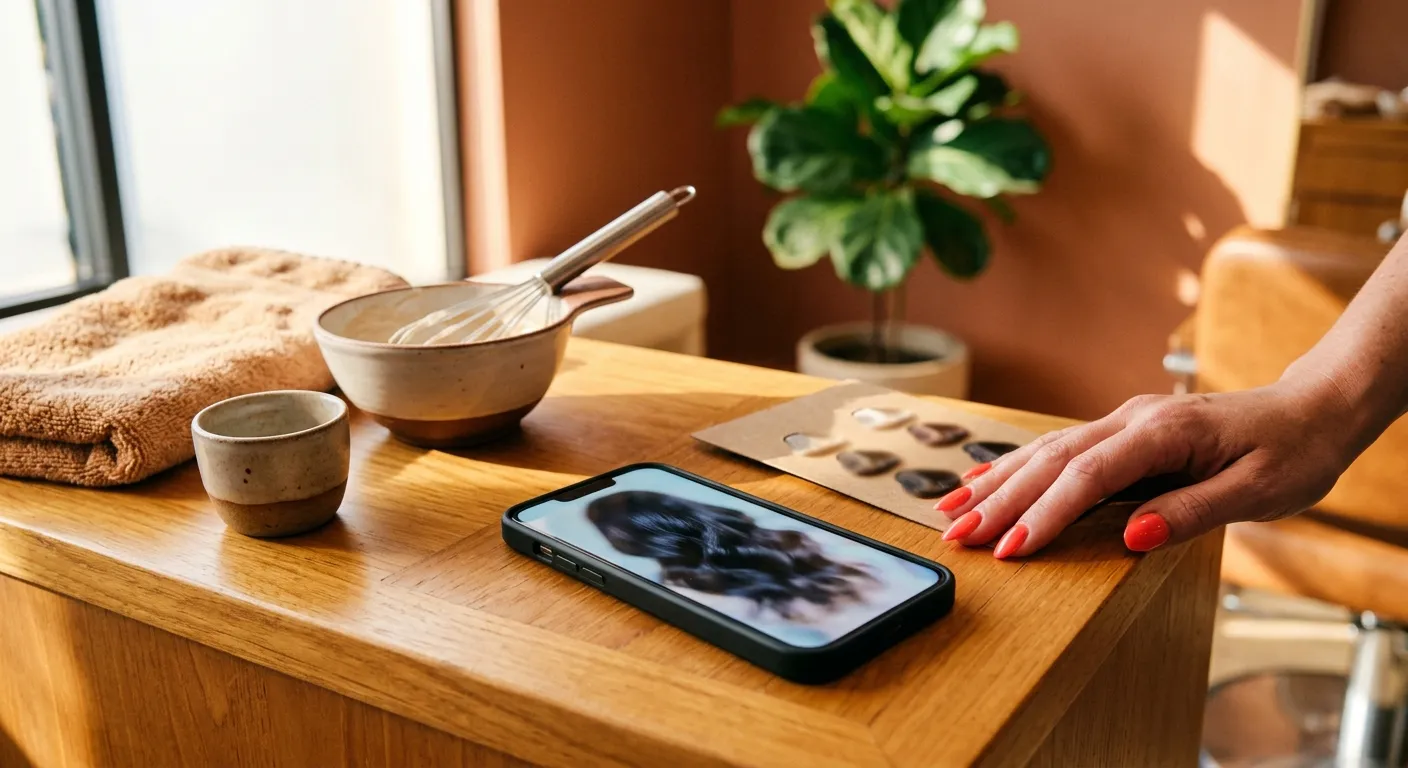
A client sat at my table in Silver Lake two Thursdays ago, gel curing under the lamp, scrolling with her free hand. She turned the phone toward me and asked what I thought of the hair. Honey blonde, waist-length, waves with density so uniform it read almost solid, no scalp showing through, no flyaways anywhere. I zoomed in on the ear. The helix dissolved into strands that trailed off into nothing. “That woman is made of math,” I told her. “You can still want the hair. Just say the right things when you sit down in the color chair.”
She laughed, typed three sentences into her notes app, and an hour later I watched Renata, the stylist who shares my suite, run the easiest big-color consultation of her month. That exchange is routine now. My ninety-minute appointments have quietly turned into a pre-consultation, because clients using AI hair photos in the chair next door were sitting at my table first, and most had no idea what those images were asking of the person about to mix their formula. The reference photo was already changing what a first salon consultation has to accomplish, and nobody handed us a memo.
AI generated hair inspiration reaches my table before the color chair
The first generated reference I remember was a curiosity: a haircut photo in early spring that felt slightly airless, and neither of us thought much about it. By July the references had a signature: shine with no texture variance, partings that switch sides between photos, faces with an olive-skin smoothness no filter quite achieves. Now I count at least one every week, and Renata sees more, because hair is where the gap between picture and chemistry is widest.
The volume behind this is industrial. Everypixel’s analysis of AI image generation put the run rate at 34 million images created per day since DALL-E 2 opened to everyone, over 15 billion in the first year and a half alone. My clients didn’t go looking for most of them; the images arrived through search results, Pinterest boards, and the feeds of extension and wig vendors who post generated looks because they cost nothing and engage everything. Renata’s folder of saved salon consultation photos held campaign shots three years ago; the screenshots collecting in it now include faces no camera ever captured. Gen Z clients were the first wave, since their discovery loop runs through those feeds, but I’m hearing the same references from women in their forties now.
Unrealistic hair goals clients bring me now
The impossible requests sort into three families. Density is the loudest: extension-level volume rendered root to end with zero scalp visibility, when a real head holds somewhere between 80,000 and 120,000 strands and every one of them casts a shadow. Color is the second: a seamless jump from a level-four brown base to creamy platinum with no banding and no exposed warmth. Texture is the third. Renée Gadar, Aveda’s former global artistic director of texture, told InStyle about a client who brought in a braid pattern that simply vanished in spots. “This is physically impossible,” she told her. “The braid would have to go somewhere.”
The scale is no longer anecdotal. Axios reported in April that Mehry Schmitt, founder of a Northeast bridal glam company, sees 40 to 50 brides a year and at least half of their inspiration is AI-generated. Celebrity stylist Mark Townsend told InStyle this shift is worse for him than the filter era ever was. “It’s not real hair. It’s not real movement. Nobody has that much hair on their head.” And the pressure lands even when people know the image is fake. Dove’s 2024 State of Beauty Report found 2 in 5 women feel pressure to alter their appearance because of online images, including ones they know are AI, and knowing does not dissolve the standard. That’s the part stylists inherit.
Ear and jewelry edges that melt into hair, partings that contradict themselves, identical curl loops repeating like wallpaper, shine with no flyaways. I treat them as conversation starters, never proof, because heavy retouching produces some of the same artifacts and nobody wins a forensics argument in a salon.
Generators trained on the most-engaged beauty photography online, which means editorials, filters, and extensions baked in twice. Extension and wig vendors generate their own posts to feed the algorithm, and clients save the results believing a camera was involved. Some models are even composited from real stylists' work: LA stylist Sal Salcedo told InStyle he recognizes his own color formulas inside his clients' AI references, down to a client's freckles.
This happens more than you'd think, and it's the clearest signal to stop debating the image. If she knows the woman is generated and still wants the feeling, the conversation moves to which part of the feeling is real. A reference can be mostly fiction and still contain one fully achievable idea worth building.
Why the reference images are chemically impossible
The lift math is where the fantasy breaks fastest. Professional lightening moves virgin hair roughly four to five levels in a session and previously colored hair three to four, the safe ceiling that professional bleaching guides describe. The honey-blonde in my client’s photo implied a level-four base going to a level ten. That’s six levels: two sessions minimum, a strand test, a toning plan, and the shade would still carry warmth her rendered model doesn’t have, because the generator never simulated underlying pigment at all. The image shows a destination. Chemistry charges you for the road.
Density has its own ceiling. Cut and styling can fake movement at the perimeter, but nothing mixed in a bowl creates follicles, and porosity decides how any color takes and fades. What makes this era harder than the celebrity-photo era is that Gisele at least obeyed biology: six pounds of extensions and two wind machines, as Townsend put it, but real hair doing real things. A generated model obeys nothing. The gap between her picture and the client’s head is a physics problem, and skill never enters into it.
The expectation script I run before any color starts
I use a version of this at my own table before mixing a custom gel color, because AI nail inspo arrived in my chair the same season it arrived in Renata’s. The script does one job: it names the gap out loud, before the money does, and converts the image into a brief. Praise the specific thing first, say what the image can’t do, then hand back a choice.
✅ The three sentences I hand clients
“That woman is generated, so parts of that photo can’t exist on a real head. Tell the stylist which two things you love most, the brightness or the length, and let her tell you what those cost in sessions and upkeep. Then ask for the version of this that your actual hair can hold.”
When a client walks ten feet to the hair chair, I tell her to run the same structure there. Renata’s version runs longer because color has more chemistry to disclose, and she now opens every big-color consultation with the image audit before touching a swatch book. Neither of us polices inspiration. The job is finding the achievable idea inside the image and pricing the road honestly. What the script buys is a client who hears the limits from a person instead of discovering them in a mirror. The consultations that skip this step are the ones that end in a technically excellent result that still felt like a failure, because the benchmark was synthetic. A structured consultation was already the biggest retention lever before any of this; generated references just raised the stakes of the first five minutes.
AI hair color preview tools are the honest version of this
AI can be the most honest tool in the room when the input is real. I covered the salon side in my piece on virtual hair color try-on: apps that render a shade onto a live video of the client’s actual head, texture and lighting included. That’s a preview with physics in it. A generated stranger is a preview with the physics deleted. When a client asks whether she can generate her look at home, that’s the version I point her toward, because an AI hair color preview of her real head starts the consultation from evidence.
What I’m watching next
Whether platforms start labeling generated beauty content matters enormously; a federal labeling bill was proposed in 2024 and went nowhere, so the burden sits on whoever holds the scissors. I’m also curious whether generated references get more plausible as models improve, making the audits harder and the scripts more necessary, or whether clients tire of chasing faces that don’t exist. This could go either way. What I’m sure of is smaller: the clients who arrive with a feeling instead of a fantasy leave happier, rebook sooner, and trust the chair more. That part isn’t going to trend away.