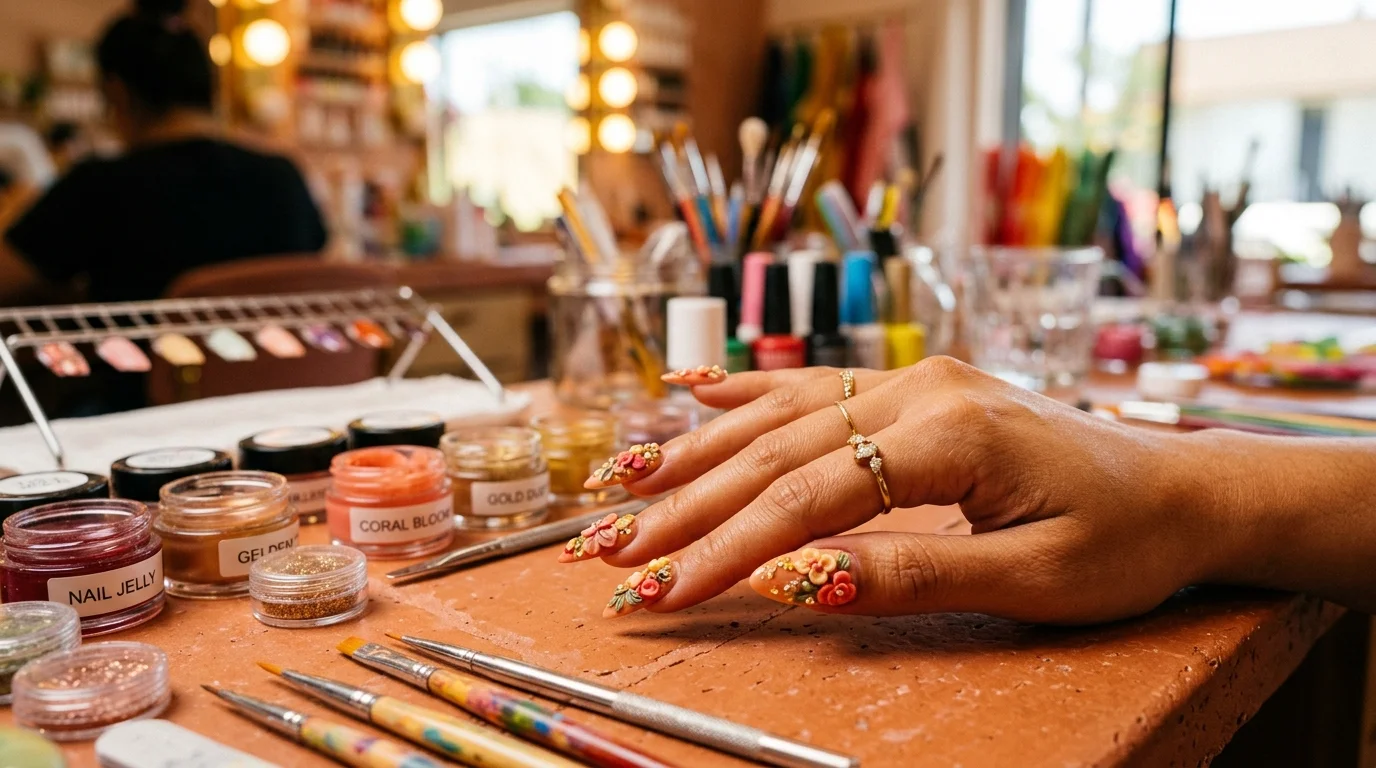
A woman sat in my chair last Thursday morning with her phone angled toward me, scrolling through a Pinterest board called “NAILS INSPO SPRING.” Every single pin was sculptural. Raised florals in soft pink acrylic. Tiny gel bows sitting up off the nail plate. Crystal clusters that caught light from three directions. She looked at my hands while I prepped her cuticles and said, “Can you do the 3D ones?” She wasn’t the first person that week to ask.
I’ve been a nail tech in LA for eight years, and I can track demand shifts by what comes through in the reference photos. Two years ago it was chrome everything, glazed donuts on every other screen. Last year, Korean-style mismatched sets started replacing the uniformity. Now the reference photos have gone fully dimensional. Clients want texture they can feel with their fingertips, elements that rise off the surface, sets that look like miniature sculptures. The flat nail is losing its hold on the mainstream, and that transition is reshaping what I charge and how I schedule my days.
The shift from flat to sculptural
Three-dimensional nail art is not new. Japanese nail salons have been building elaborate sculptural sets for over a decade. But what’s changed is accessibility and demand. Pinterest searches for “3D nails” rose 35% year over year in 2024, and the momentum has only accelerated into 2026. Who What Wear named 3D embellishments one of the biggest nail art trends of the year, alongside textured finishes and dimensional details. The gummy nail look, where the entire surface takes on a raised jelly-like quality, has become its own subcategory. Chrome cat eyes layered with 3D charms. Velvet textures paired with crystal accents. The average Pinterest reference photo my clients bring in today has more topography than anything I saw five years ago.
What makes this different from past nail art cycles is who’s asking. It used to be a niche request from clients who followed nail artists on Instagram and knew what they wanted down to the brand of gel. Now it’s coming from first-time clients, from women who’ve never had anything beyond a solid color, from people who saw one TikTok and decided they wanted roses on their ring fingers. The audience widened, and it widened fast.
What it actually costs to offer this
Here is where the business reality gets interesting. A standard gel manicure at my station runs about 45 minutes. A set with 3D elements adds anywhere from 20 to 45 minutes depending on complexity, because you’re building structures that need to cure properly, stay bonded, and look intentional from every angle. That’s real time, and time is the only inventory a nail tech has.
I charge a $30 add-on for sculptural work on two to four accent nails, and $50 or more for a full set of 3D designs. Industry pricing data shows 3D nail art ranges from $10 for a simple single-nail accent up to $150 for elaborate full sets with Swarovski crystals and multi-layer sculpting. The sweet spot for most independent techs is somewhere in the $25 to $50 add-on range, which represents a meaningful ticket increase on a service that might otherwise cap at $65.
The material cost is modest. Sculpting gel, a good set of fine detail brushes, charms and rhinestones in bulk, maybe $200 to $300 to stock up initially. The real investment is skill. Building a 3D rose that looks like a 3D rose and not a blob of gel takes practice, and it takes a different hand than flat nail art does. I spent weeks on practice tips before I offered it to clients, and I’m still refining. Some techs are taking dedicated 3D gel courses to build that muscle memory faster.
Why this trend has staying power
I’ve seen plenty of nail trends peak and fade within a season. Builder gel replaced acrylics gradually over years. Cat eye nails surged and then settled into a permanent menu item. The 3D sculptural movement feels more like the latter pattern to me, a service category that expands what clients think is possible and then stays on the menu once they’ve experienced it.
The reason is partly cultural. Social media rewards visual novelty, and flat nails don’t stop a thumb mid-scroll the way a set with raised florals and crystal drops does. Refinery29 called the 3D maximalist wave one of the reimagined trends defining 2026, noting that the aesthetic balances bold creativity with thoughtful execution rather than excess for its own sake. Clients aren’t just chasing drama. They’re chasing craft, and they can tell the difference between sculpted detail and a charm glued on carelessly.
The other reason is economic. The nail salon market is projected to grow at 6.5% annually through 2033, and the growth is driven significantly by premium services and custom work. Average ticket values for nail salons are climbing toward $106 per visit, powered by exactly this kind of add-on layering. When a client who came in for a $55 gel set leaves having paid $85 because she added 3D florals to four nails, that margin matters.
I’m watching a few things from here. Whether the gummy nail subcategory holds through summer or fades as the novelty wears off. Whether more clients start requesting full sculptural sets or keep it to accent nails. Whether the techs who invested in training see enough return to justify the time they put in. I don’t know how any of those questions resolve yet. But every week, someone new sits down and angles their phone toward me, and the photos keep getting more dimensional.