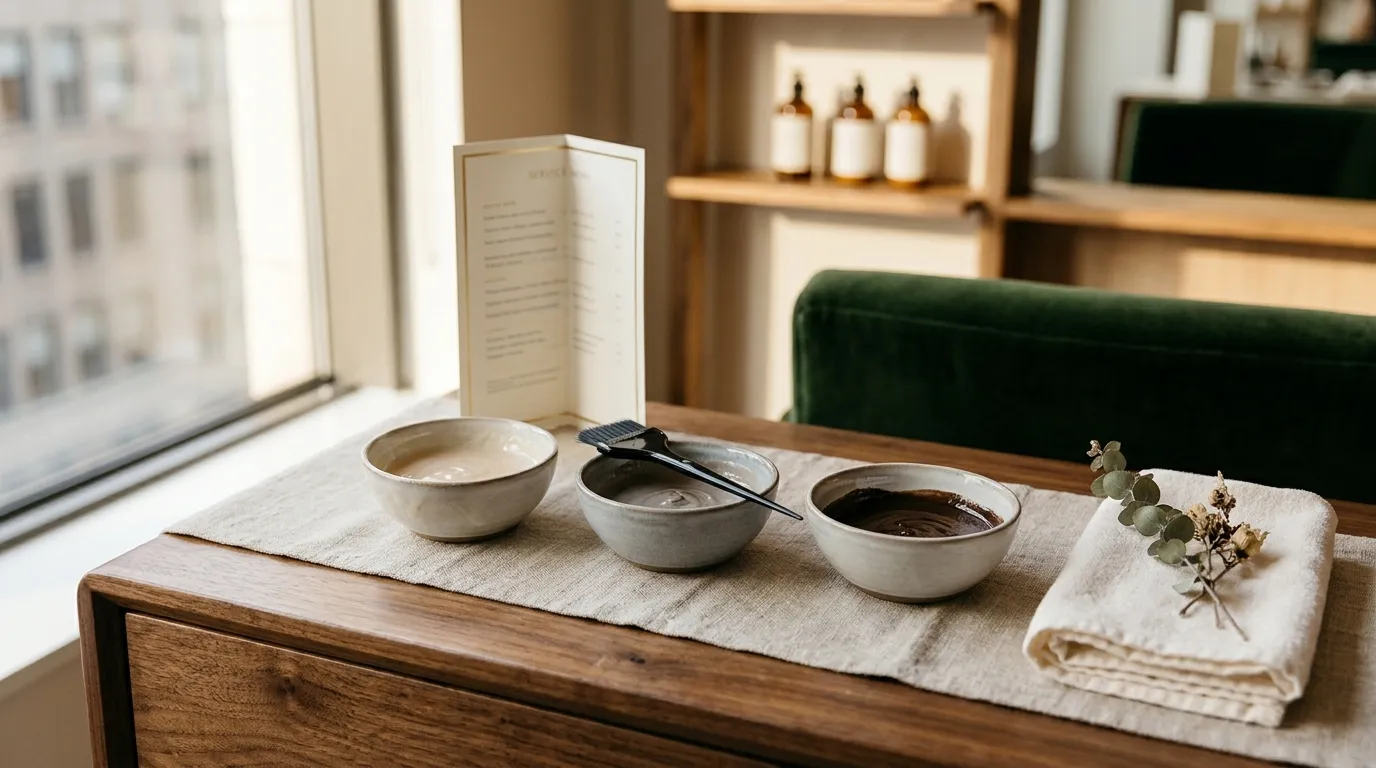
On a Tuesday morning last spring, my front desk put a new-client call on speaker: “I’m about fifty percent gray, I’m done with all-over color every five weeks, what do you charge for gray blending?” Dana looked at the menu on her screen and then at me, because the menu had no line to read. We had a price for cuts, for single process, for foils, for glosses. For the exact service this caller was asking for by name, the answer at my desk was a shrug.
The caller knew the service by name because the market had already taught it to her. Yelp searches for salons offering gray blending jumped 905% in 2025. Marcus Webb documented that shift from the classroom and the chair when the trend went mainstream. What the coverage never mentions is that “how much to charge for gray blending” has no honest single answer, because the name covers three different services that take three different amounts of time. I spent that week answering it the only place an answer sticks: the menu.
What the market says about gray blending pricing
The spread is enormous, and it is diagnostic. NewBeauty’s cost rundown puts gray blending between $150 and $600, and notes that a specialist’s full transformation can run upwards of $7,000. Meanwhile a salon in New Jersey lists blending at $61 next to $76 single-process color, and a salon in Texas prices a four-hour “Blend It In” service at $275 to $365. Same words, four different products.
That scatter exists because most menus never defined the service. When the line is missing, the desk lowballs to be safe, the stylist absorbs the extra hour, and the client compares your verbal quote to the cheapest number she saw online. The fix is the same one I applied when I split my color service into three tiers: decide what the name means at your chairs, then print it.
Gray blending service menu: the three tiers I built
I tier by how much silver the client brings in, because coverage percentage is the single variable that changes my time, my formula, and my rebooking rhythm. The client can self-select with one question she already knows the answer to.
First Blend, $95, 45 minutes. For the client with scattered silver at the temples and part. A sheer demi blended through, gloss finish included. She has never paid for blending before, so this is the on-ramp tier, priced under my $125 Essential coverage. The menu line reads: “A sheer, tone-matched blend that softens new growth. Grows out without a line. Rebook in 6 to 8 weeks.”
Signature Blend, $150, 90 minutes. For a quarter to half gray. Fine, scattered foils with lowlights for depth, gloss on the line. This is the workhorse and the tier I expect most gray clients to choose. The line reads: “Softens the line between your silver and your color with fine, placed foils. Grows out without a hard edge. Rebook in 8 to 10 weeks.”
The Transition, from $300, consultation priced. For the client leaving color behind entirely. This is correction territory, four hours and up, and no responsible stylist can price it sight unseen. The line says “consultation required” and means it.
| Line item | Price | What it actually says |
|---|---|---|
| Single Process Color | $125 | gray handled whenever a client asks |
| Gray blending | not listed | quoted verbally, usually low |
| Toner for gray clients | not listed | absorbed into the color price |
| Line item | Price | What it actually says |
|---|---|---|
| First Blend | $95 | sheer demi blend, gloss included, 45 min, rebook 6-8 weeks |
| Signature Blend | $150 | fine foils, lowlights, gloss included, 90 min, rebook 8-10 weeks |
| The Transition | from $300 | consultation priced, 4+ hours |
| Between blends | $45 Tone Tune-Up | the same 30-minute tone reset every color client can book |
✅ The 'breakfast included' rule
Hotels print what comes with the room because the guesswork is what kills the booking. A gray client reading your menu does the same math a traveler does: what does this cost all-in, and what renews sooner? Anything she needs to judge whether you did your job belongs inside the price, printed on the line. Anything that wears out before the blend does gets its own name and number.
Toner and gloss: inside the price or on the add-on line
Charging for gray coverage color was solved decades ago; clients have paid for roots their whole adult lives. Blending is the new purchase, and gloss is where owners freeze. Two tests settle it.
The result test. If the client cannot evaluate your work without it, it is inside the price. My gloss finish sets the final tone of every blend; without it the result reads unfinished, so it rides on the line. Both blend tiers print “gloss included.”
The clock test. If it fades before the blend needs redoing, it is an add-on with a name. The silver client’s tone softens around week five, well before her foils have grown out. She books the same $45 Tone Tune-Up my color clients book, and the menu already lists it.
Salon Willow in Texas runs exactly this split on a real menu: their blend package carries an optional translucent root color “for $45 more.” The base service holds its price; the enhancement stands beside it, named and numbered. That is the whole architecture. The one move that leaks money is the fourth option, toner “when needed,” which is the mistake I documented when I finally started charging for toner out loud.
Nobody was upsold into those tiers. The menu did the selling, which is what a menu is for.
Gray blending pricing salon owners can defend
A client who has never paid for blending needs the number justified in the language of time, because time is what she is actually buying. Three sentences do it, and every one belongs in the menu description, not just the consultation.
“Coverage puts you in this chair every four to five weeks. This blend grows out soft, so you come back in eight to ten.” That is the value proposition, printed under the price.
“This is $150 today, and your between-visit reset is $45 whenever the tone softens.” All-in pricing, no checkout surprise.
“If you ever want to stop coloring altogether, we have a plan for that too, and we’ll price it at a consultation.” The door to the high-ticket tier, opened without a hard sell.
Notice what the descriptions never do: apologize. The number is defended by the interval, the grow-out, and the included finish. A price standing next to a duration and a rebooking window reads like a product. A price standing alone reads like a dare.
Gray blending vs full color price: the math clients run anyway
Your gray clients are comparing two annual calendars whether you help them or not. Coverage at $125 every five weeks is eleven visits and about $1,375 a year. My Signature Blend path is six blend visits plus two Tune-Ups, roughly $990 a year, three fewer chair visits and about $385 back in her pocket. Blending clients pay more per visit than a root touch-up and fewer visits overall, and both of you can say that out loud.
The tier most salons leave unpriced is the one at the end. The client who is done with color entirely is a consultation-priced, four-hour transformation, the kind of ticket that runs into four figures at salons that bother to name it. With no line item, that client quietly stops booking anywhere.
“But my clients already know the old names”
Two of my stylists raised this before I printed the section, and one client asked it in the chair: “Is gray blending new? I thought that was just… my color.” The menu answered before anyone had to. First Blend sits right under Essential Color, so the entry point reads as an invitation rather than a rebrand. Nobody’s existing service disappeared; the gray clients simply stopped being an asterisk inside someone else’s line item. In the first month, exactly one client asked why her old price was gone, and she booked First Blend when I explained it came with the gloss finish now.
Named services get chosen deliberately. A client who books “the Signature Blend” owns a product. A client who books “my color, but lighter coverage I guess” owns nothing she can rebook, compare, or recommend to the friend who just went silver.
The caller from that Tuesday came in the following month. She read the gray section once, chose Signature Blend on her own, booked her Tone Tune-Up at the desk, and never asked for “the cheaper option,” because the menu never offered her one. Tonight, pull up your color section and decide what gray means on it. Right now it means whatever your desk says under pressure. Three lines with prices and printed intervals mean it always says the same thing.