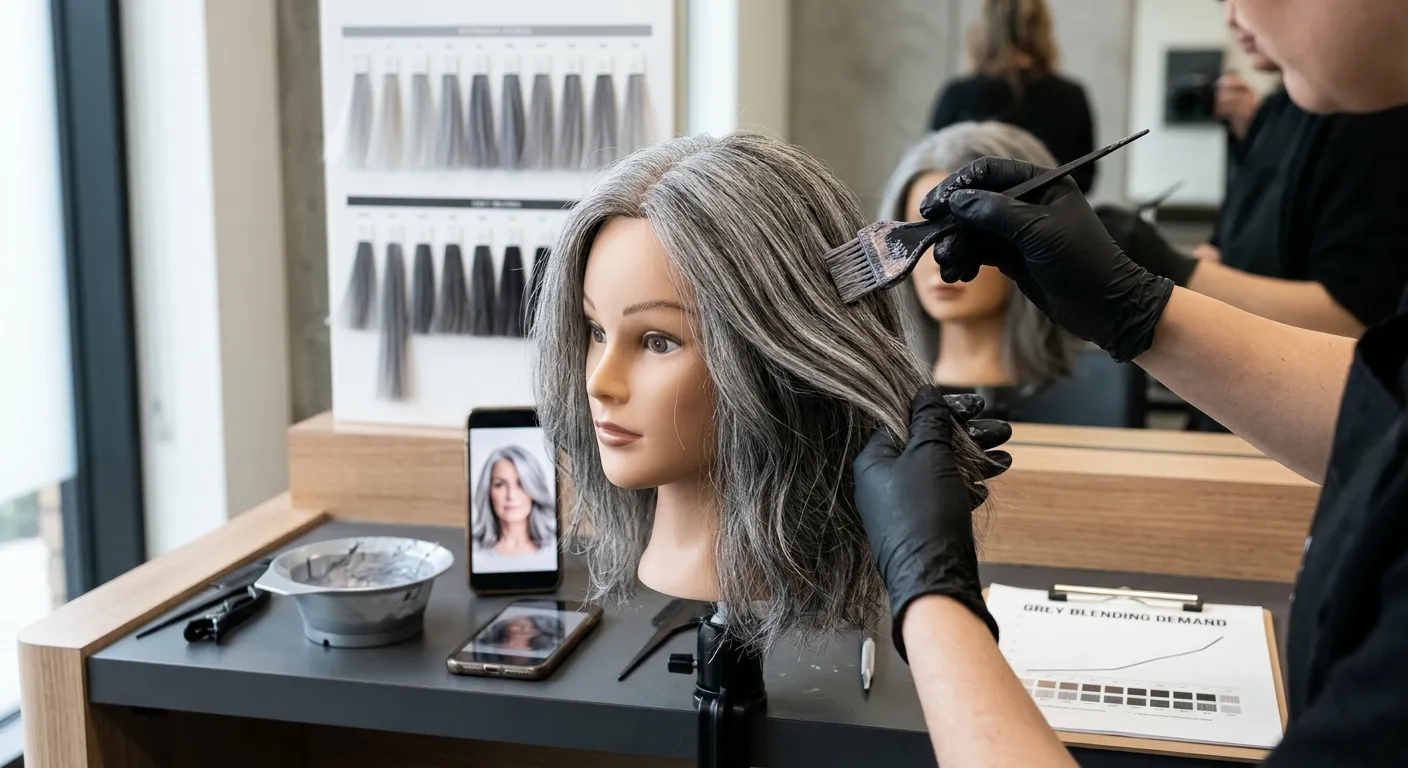
Twelve of my nineteen color students asked to learn grey blending before midterms this semester. Last year, two did. It is the largest single-year jump in a technique request since I started tracking student demand in 2022, and it matches what I hear in my Brooklyn chair: clients asking to blend their grey instead of covering it.
The grey blending hair trend has moved past early adopters. Yelp searches for salons offering gray blending jumped 905% in 2025, according to data the platform shared with Axios, and inquiries for gray hair specialists rose 276%. Blending has crossed from a niche technique into mainstream client demand.
Coverage is not disappearing. Blending is joining it as a first-choice request, and the two services pull in opposite directions: different products, different chair time, different rebooking rhythm. Most salons built their color menus and their training around coverage. The shift toward blending is the story I am watching from both the classroom and the chair.
How Grey Blending Hair Went Mainstream
2020-2021: Specialist territory
Grey blending lives with a small group of educators, mostly in the UK, posting transformation work. Clients discover the option on social feeds, not at the salon.
2022-2023: The grow-out category forms
Going-gray content becomes its own genre. Colorists like Jack Martin and Rosie Baylis build followings on blending transformations that skip the harsh grow-out line.
2024: Curriculum demand appears
Requests for grey blending in my classroom move from near zero to a handful per semester. Salon menus start listing grey blending as a named service.
2025: Search demand accelerates
Yelp searches for salons offering gray blending jump 905% year over year. Gray hair specialist inquiries rise 276%. Trade press calls grey blending one of the most in-demand color services in salons.
2026: Mainstream requests
Blending arrives from clients with 20% grey and clients with 70% grey. Some stylists now cap blending appointments to protect space for the rest of their book.
The Evidence That This Is Structural
A single platform’s search numbers can spike and fade. What makes this shift different is that three separate data streams point in the same direction at the same time.
Discovery first. The Axios report on Yelp search data is the cleanest signal: 905% growth in searches for salons that offer gray blending, plus 276% growth in inquiries for gray hair specialists. People are searching for the service by name, not just by shade.
Yelp search growth, 2025 vs. 2024
Second, the professional side. Hairdressers Journal International wrote in September 2025 that grey blending “has rapidly moved from a niche service into one of the most in-demand colour solutions across salons.” Trade press reports on a technique like this only when the category has revenue attached.
Third, the education pipeline. The New Knew’s gray hair community reports more stylists positioning as gray specialists, because clients keep asking where to find one. My classroom data is the same signal a few years early. Students request what their part-time clients are already asking for.
Why Clients Ask to Blend Instead of Cover
Grey blending is a coloring technique that diffuses grey hair into the rest of the hair instead of covering every strand. L’Oréal Professionnel’s comparison calls it the lower-maintenance option, and the maintenance math is what closes the conversation. Numi Hair’s breakdown puts coverage touch-ups at every 4 to 6 weeks and blending visits at 8 to 12 weeks. For a client who has spent years on a four-week root cycle, that is the difference between owning their calendar and their calendar owning them.
The motivation is generational. Yelp’s trend expert describes grey blending as part of a broader “high maintenance to be low maintenance” movement, and the Austin salon owner Axios quoted says clients now want to showcase their greys rather than hide them. The New Knew reports the same from the client side: women with no grey at all are requesting silver on purpose.
Silver Blending for Grey Hair: Who’s Asking
The silver-client side is structural. Baby boomers control 70% of U.S. disposable income and are increasing salon spending faster than any other generation, and they respond to services that address aging hair directly, as our guide to the silver generation details. A blending client who books every 10 weeks instead of every 5 is half the appointments for roughly the same annual revenue, and that client is easier to retain and more likely to refer.
Men’s Grey Blending Leads the Wave
The fastest-growing slice is men. The men’s hair color market was valued at $2.8 billion and is projected to reach $4.6 billion by 2034, with the professional salon segment growing fastest at 7.2% annually, per Emergen Research. A grey blending appointment for men runs 30 to 45 minutes and reads as grooming, which fits the men’s grooming shift that is already filling salon books with clients who would not have booked color five years ago.
What Grey Hair Color Services Should Look Like Now
Most color menus still treat grey as a coverage problem. The shift asks for three changes.
Name the service. “Grey blending” as a standalone line item captures search traffic and signals competence. It also supports a transformation price instead of a per-appointment rate, which is how the educators who built this category position it. Structuring your color tiers with blending as its own level is the practical first step.
Retrain for the technique. Blending is not easier coverage. It requires foil placement that breaks up the grey pattern, lowlight depth to keep the silver from going flat, and formulas that handle coarse, resistant grey strands. Most stylists trained on full coverage never learned that sequence. It belongs in continuing education now, before the requests peak.
Change the rebooking logic. Coverage clients book at week four. Blending clients come back at week eight or later. Reminder cadence, service descriptions, and product recommendations all shift with them, and so does the retail conversation. Grey hair needs toning products and heat protection more than it needs root concealer.
What the Classroom Teaches the Market
I am adding a dedicated grey blending module to my color curriculum this fall. I am also logging how many new consultations in Brooklyn mention blending before I raise it. The number I am tracking is the crossover: the share of grey-haired clients choosing blend instead of cover for the first time.
My honest read is that coverage demand holds for a long time, because it always has. The open question is whether blending becomes the default first offer in consultations for clients over 40, with coverage reserved for clients who want zero grey. If the search data keeps compounding, the salons and stylists who trained early will be the ones clients name, the way they already ask for gray hair specialists.
That is the shift I see in class. I used to treat my students as a lead indicator. This time the market is already here.