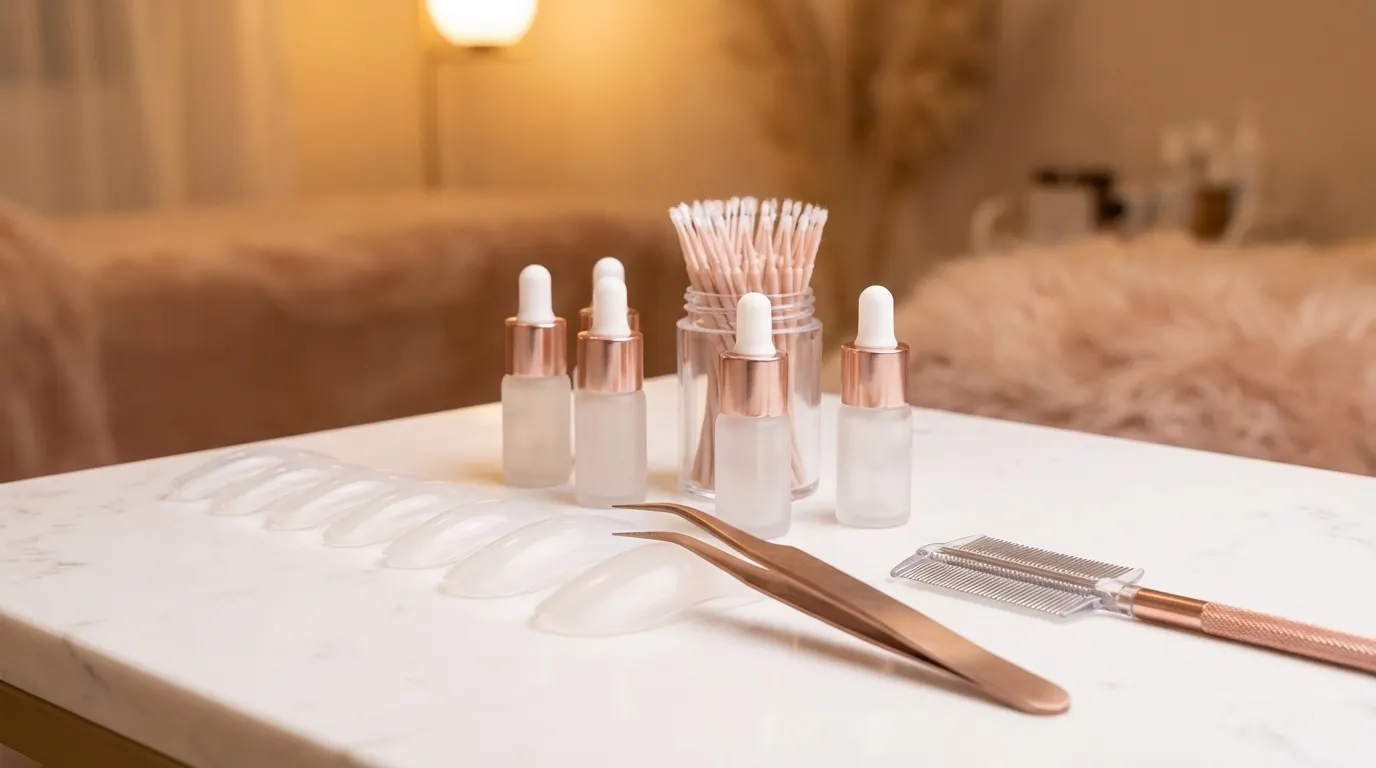
Every lash tech I follow on Instagram has posted about the Korean lash lift in the past three months. The coverage frames it as a category-defining shift. The search data supports the excitement: 3,695% year-over-year growth in U.S. searches and a 20,082% spike in the UK. Those are real numbers. But search volume and salon bookings are different things, and the gap between the two is worth examining before you invest in new training and supplies.
What the Korean Lash Lift Actually Changes
The technique is not just rebranding. There are genuine differences from traditional lash lifts.
Traditional lifts use thioglycolic acid (TGA) to break disulfide bonds in the lash. The Korean method uses cysteamine hydrochloride, an amino acid derivative that works at a lower pH and processes more slowly. The result is less structural damage per session. The Korean method also skips adhesive in favor of a double-shield system and viscosity-controlled lotions that hold lashes in place during processing.
The aesthetic difference matters too. Traditional lifts aim for a pronounced curl. Korean lifts prioritize a straight-from-the-root elevation with a softer sweep at the tips. Clients describe it as “puppy eye” or “doll eye” rather than the tight curl of a conventional perm.
| Feature | Detail |
|---|---|
| Active agent | Cysteamine HCL |
| Adhesive | None (glueless) |
| Processing speed | Slower, gentler |
| Curl result | Soft lift, natural sweep |
| Lash feel after | Soft and flexible |
| Duration | 6-10 weeks |
| Price range | $75-$150 |
| Feature | Detail |
|---|---|
| Active agent | Thioglycolic acid |
| Adhesive | Lash glue on rod |
| Processing speed | Faster, stronger |
| Curl result | Defined, dramatic curl |
| Lash feel after | Can feel dry or stiff |
| Duration | 8-12 weeks |
| Price range | $65-$120 |
These are meaningful differences in chemistry and technique. The Korean method is genuinely gentler, and for clients who get lash lifts frequently, reduced cumulative damage is a legitimate selling point.
Where the Hype Outruns Reality
The 3,695% search growth sounds enormous. Context: Korean lash lift U.S. search volume is roughly 5,400 per month. For comparison, “lash extensions” pulls over 100,000 monthly searches. “Lash lift” without the Korean qualifier pulls around 40,000. The percentage growth is high because the baseline was nearly zero.
Monthly U.S. search volume (approximate)
That does not mean the trend is fake. It means the audience is still small relative to the broader lash services category. The people searching for “Korean lash lift” specifically are early adopters and beauty enthusiasts. Most salon clients booking lash lifts are not yet distinguishing between methods. In my conversations with lash techs in Manhattan, the consistent report is that clients ask for a lash lift, and the technician decides on the technique.
The Economics
Korean lash lift kits cost more than traditional supplies. Brands like Elleebana and Curacoro sell professional kits in the $80-$200 range for 10-20 applications, compared to $40-$80 for traditional kits at similar volumes. Product cost per client runs roughly $8-$15 for Korean versus $4-$8 for traditional.
The service price is higher too: $75-$150 versus $65-$120. But the time commitment is similar or slightly longer, with Korean lifts typically running 60-90 minutes. The per-hour revenue math works out close to a wash, especially once you factor in the higher product cost.
Training Is the Real Bottleneck
The technique requires different muscle memory. The glueless application, viscosity control, and shield placement are distinct skills. Online certification courses run one to two weeks for self-paced learning, with in-person intensives available as two-day workshops. You need an existing cosmetology or esthetics license to enroll in most programs.
For salon owners considering adding this to their menu, the training path is straightforward. For lash techs already doing traditional lifts, the transition involves learning new product handling rather than an entirely new service category. That is a much smaller investment than, say, adding a color service line from scratch.
My Read
The Korean lash lift is a legitimate technique improvement that has been packaged in hype-cycle marketing. The chemistry is gentler. The results suit the current preference for natural enhancement over dramatic transformation. The search interest is real but still small.
If you already offer lash lifts, learning the Korean method is worth the training investment. The gentler formula means fewer complaints about post-treatment dryness, and the ability to market a “Korean” technique gives you a search-friendly differentiator. If you are starting a lash services menu from zero, build your fundamentals first.
What I am watching: whether Korean lash lift demand stays concentrated among beauty enthusiasts or crosses into general salon client requests. The lash lift kit market is projected to grow at 7.8% CAGR through 2033, and the Korean segment is growing faster than traditional within that. But “faster than traditional” from a small base does not guarantee mainstream adoption. The search data says interest. The booking data, so far, says patience.