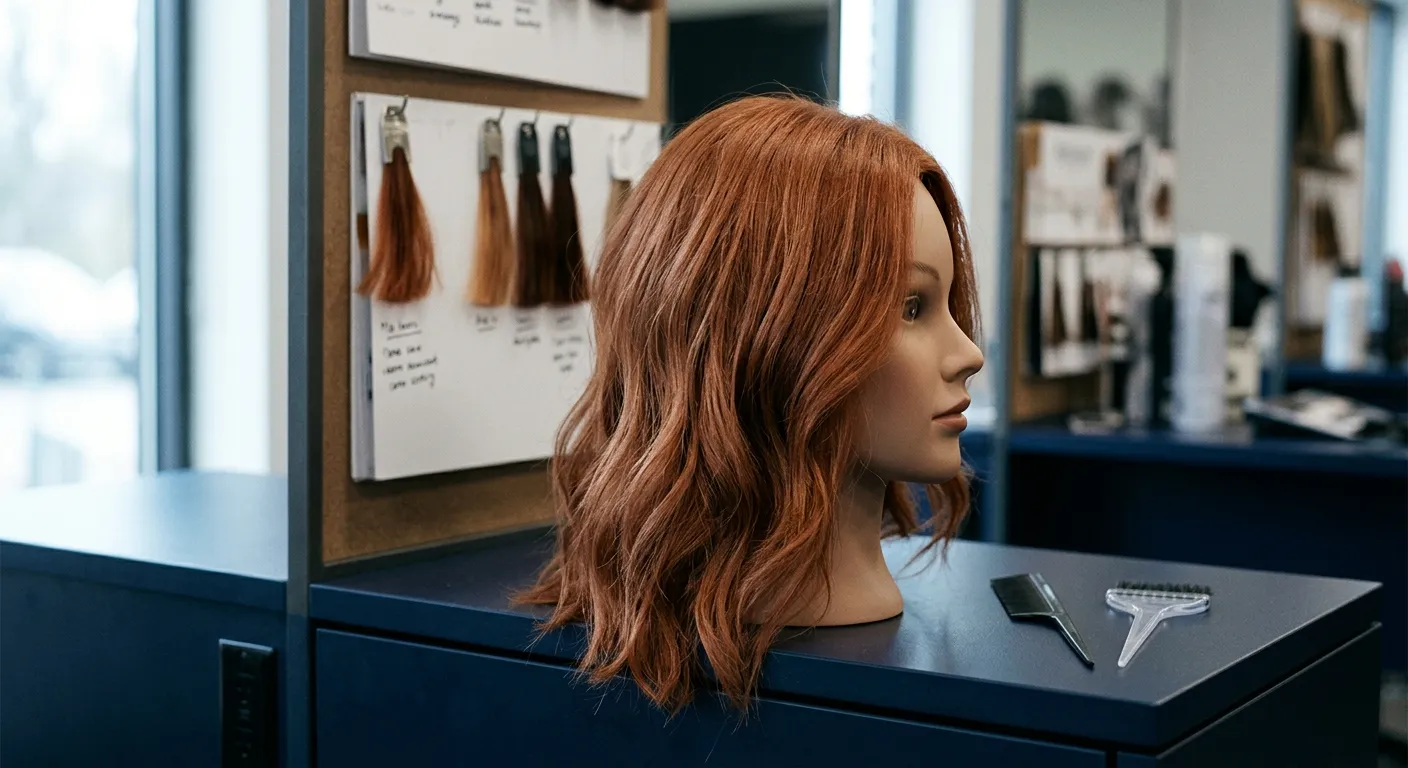
Copper hair color is in its third sustained year of demand and moving from late growth into early majority. That placement is unusual for a color trend. Most warm-toned color cycles peak inside eighteen months and then drop hard. Copper is compressing differently, and the reason matters for anyone pricing a color menu this spring.
I track color requests in two places: my own chair in Brooklyn and the cosmetology classroom where I teach in Manhattan. Copper shows up in both, which is my baseline test for whether a trend has crossed from stylist-adjacent social feeds to actual client demand.
Where Copper Sits on the Curve
The early adopter phase for copper hair color ended in late 2023. Search volume, celebrity adoption, and classroom requests all crossed the same threshold in roughly the same quarter. What followed was not a peak but a plateau, and then a second wave of growth under a different name.
Fall 2023
Cowboy copper breaks out on TikTok. Hairstylist Emily Grace Vandergriff's transformation video hits 6.5 million views. Emily Ratajkowski's muted copper seeds the celebrity wave.
2024
Mainstream salon adoption. Copper becomes a named service category at independent salons. Wella and Redken expand their copper shade libraries.
2025
Secondary growth. Copper searches rise 34% year over year per salon trend analysis. The color shifts from saturated orange-copper toward muted, bronzed variations.
2026
Early majority phase. Clients request copper without referencing TikTok. Cowgirl copper becomes a wearable default. New variations appear: blushed copper, apricot copper, muted cinnamon.
The #CowboyCopper hashtag on TikTok has accumulated over 20 billion views according to Refinery29’s coverage, with Vandergriff’s original transformation video alone pulling 6.5 million. That is the kind of sustained social signal that usually flames out inside a year. Copper has held it for nearly three.
The Evidence Behind the Placement
The data I trust most is from POZA Salon’s 2025 red hair trend analysis, which found copper hair searches up 34% year over year, strawberry blonde up 31%, and dark cherry red up 265%. That last figure tells you where the energy is moving: copper is the gateway, and clients who liked it are now pushing further into the red spectrum.
Red-Spectrum Color Search Growth, 2025
The broader color market context matters here. The 2025 KIM Report on salon performance showed total color service volume down 2.16% for the year, but average color ticket up 3.2% and overall color revenue still positive. Clients are stretching time between appointments. They are also spending more when they do come in. Copper services fit that pattern because they are technique-heavy and maintenance-conscious clients will pay for gloss services between full color appointments.
Why Copper Compressed the Curve
Most color trends follow a predictable arc: influencer seed, celebrity adoption, mainstream request wave, saturation, replacement. Copper broke that pattern by evolving instead of peaking.
The first wave in 2023 was saturated cowboy copper. Bright, warm, high-impact. That version ran for about fifteen months before clients started asking for something softer. Stylists responded with muted variations: bronzed copper, cinnamon copper, cowgirl copper. By 2026, W Magazine’s coverage of the year’s biggest hair trends describes the current default as softer, more lived-in, more blonde-adjacent than the original.
That evolution is what kept the trend alive. Each variation pulled in a new client segment without losing the previous one. The 22-year-old who asked for bright cowboy copper in 2024 is now asking for a muted refresh. The 40-year-old who watched from the sidelines is now asking for the softer version as her first color move in five years. I see both in my chair on the same Saturday.
What the Classroom Tells Me
Copper formulation is the most-requested elective in my color curriculum this spring. It was not even on the list two years ago. Students want to learn red pigment theory specifically, which is a nerdier request than they usually make.
The reason is practical. Red and copper pigments behave differently than other color families. The molecules are larger and fade faster, which means the client’s maintenance cycle looks different from a blonde or brunette client’s. My students know they are going to be asked for this color by clients who have never had red hair before, and they want to know how to set the maintenance expectation correctly from the consultation forward. That readiness on the education side is the clearest signal I have that the trend has stopped being a fad.
This pattern tracks with what happened around color melting techniques a couple of years ago. The request density in the classroom predicted the menu additions on the floor by about six months.
Salon Strategy at Early Majority
Early majority is the highest-margin phase of a color trend. Demand exists, but the technique is not yet commoditized. Here is how I would price and position.
Charge for the consultation and the maintenance plan, not just the service. A copper color service without a documented fade schedule is a future complaint. Copper hair fades in visible stages: first the brightness drops, then the tone shifts warmer orange, then toward a brassy blonde. Clients who do not know this in advance think you did something wrong. Build a four to six week gloss service into your menu and sell it at the first appointment, not the third.
Carry at least three copper tiers on your menu. Muted cowgirl copper, saturated cowboy copper, and a blended copper-brunette option. These cover the softer default, the bright statement, and the grow-out-friendly version. More than three gets confusing; fewer than three loses bookings to salons that offer the variation a client saw on Instagram.
Price it above your standard single-process. A full copper application takes longer than a standard deposit color because of the toning and the need to balance underlying warmth. A $30 to $50 upcharge over your standard single-process is defensible and clients expect it for a named shade. If you have not audited how your menu handles named color services, structuring your color tiers before the summer rush is worth the morning.
Track the grow-out. The copper client who books at week four for a gloss is worth two to three times the one-time-only client. Your scheduling system should flag copper clients for a maintenance reminder at week three. If you are already doing this for root retouches, the logic transfers directly.
What Closes the Window
Copper will not stay in early majority forever. When the color shows up as a stock option in every chain salon’s bookable services, the premium pricing window closes. The early signals of that transition are already visible in the shift toward “blushed” and “apricot” copper variations, which are what happens when a trend needs to reinvent itself to stay fresh.
For now, the window is open. The technique is learnable, the demand is sustained, and the client who asks for copper in 2026 is often the same client who comes back for a full red transformation in 2027. Price and position accordingly.