When you book a client for a full head of highlights, you also book every phone call that rings during those three hours. Nobody is answering it. In 2024, researchers at 411 Locals placed test calls to 85 small businesses across 58 industries and found that only 37.8% of calls were answered live. The rest went to voicemail or rang out entirely.
At a salon, those unanswered calls are disproportionately booking requests, because that is mostly what the phone carries. The caller is ready to spend money. When nobody picks up, the majority of them never leave a voicemail and never call back. They book somewhere the phone got answered.
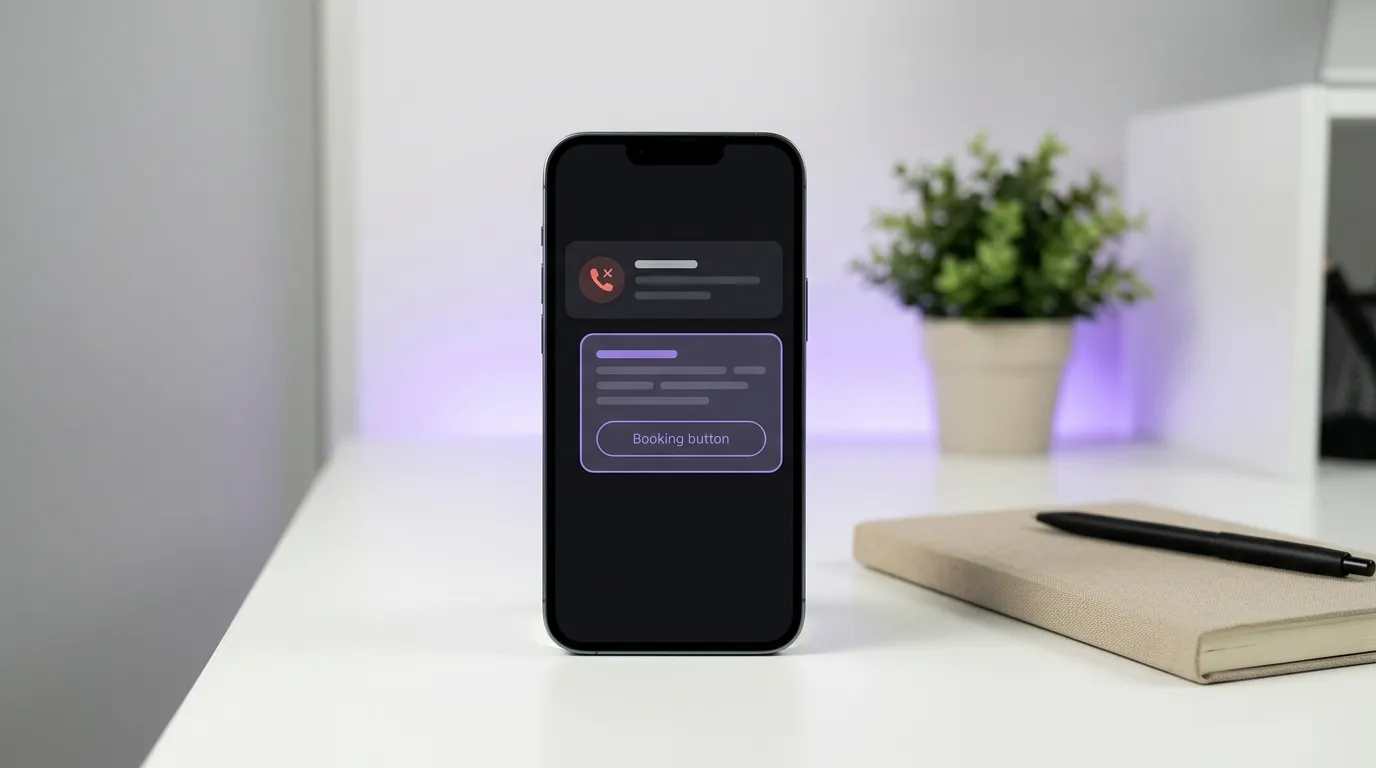
Missed call text back is the automated answer for that moment: the caller hangs up, and within seconds their phone buzzes with a text from your salon that includes your booking link. It is an inbound workflow, and it behaves nothing like the outbound text automations most salons already run. Setup takes an afternoon and one well-written reply.
Why an auto text for missed calls matters when your chairs are busy
A missed call at a salon is rarely random. The phone rings most during the hours the salon is most alive: Saturday morning walk-in chaos, back-to-back blowouts, the three-hour color client, the front desk mid-checkout. The best hours for revenue are the worst hours for answering.
So the caller lands on voicemail. Most never leave a message. Hiya’s State of the Call data puts the hang-up-without-a-message rate at roughly 80%, and the callers with the most urgent intent abandon fastest. The client who needs a wedding updo this weekend is the client least likely to wait for a callback.
The salon’s standard recovery move is calling back from the front desk an hour later. A 2024 TransUnion/Toluna survey of 1,556 US adults found that 74% of consumers won’t answer a call from an unknown number. Your diligent callback goes straight to voicemail on the other side too. The caller was interested once. By the time both voicemails have played, they booked with the salon that answered on the second ring.
This is the gap the text-back workflow closes. The reply fires in seconds, while the caller is still looking at their phone. Texts get read immediately: SMS open rates sit near 98%, with about 90% of messages read within three minutes. The booking link arrives at the exact moment the person is deciding where their next appointment happens.
The demand on the other side is real. Zenoti’s 2025 survey found that 77% of salon and spa regulars still believe calling is the easiest way to change an appointment, even as 81% say they need to manage bookings outside business hours at times. People keep calling. The workflow just makes sure a call no longer dies in voicemail.
Salon two-way texting: why a reply beats a blast
Every other texting automation on this blog runs outbound: reminders, confirmations, birthday offers, win-backs. Those messages go to a list you already have, on a schedule you control. A text-back workflow runs inbound: it is triggered by a person you may have never met, who is asking your salon for something right now.
The difference shows up in what each message has to do.
An outbound blast carries information: “Your appointment is tomorrow at 2.” If the client ignores it, nothing breaks. A text-back has to carry a decision: it acknowledges the miss, hands the caller a way to complete the booking, and promises a human follow-up if the link doesn’t finish the job.
That is why the reply has to be two-way. A caller who texts back “do you have anything Thursday for balayage?” is asking a salon question, and the win condition is a real answer, from a person, in the same thread. The automation opens the thread. Yours finishes it. Blast tools have no mechanism for any of this, because a list of opted-in clients never calls you in the first place.
What a salon phone system text back does mid-service
The mechanics, as the caller experiences them:
The call rings out
Nobody can pick up. The call ends or hits voicemail.
The trigger fires
The system sees the missed call and looks up the number against your client list, so a known regular and an unknown new lead can get different treatment.
The text lands
Within seconds, the caller gets one short reply: apology, booking link, promise of a human follow-up.
The caller books or replies
Most book themselves through the link. The rest reply in the thread, which pings the front desk like any other message.
You follow up on your terms
Anyone who didn't book shows up on a follow-up list with the number and the missed-call time, so the callback is warm instead of cold.
Two design details carry most of the value. The first is speed. The reply is only recovering the booking if it arrives while the caller is still standing in the decision. The second is the booking link itself. “Sorry we missed you, we’ll call you back” just schedules the failure for later. The link lets the caller finish the booking in sixty seconds without another phone call from either side.
💡 Where this sits in Lutily
The text-back works alongside the automations salons already run. Reminders, confirmations, and rebooking nudges handle clients already on the calendar. The text-back covers everyone the calendar never met. If a caller’s number matches an existing client, their reply lands on a profile your team already knows; new callers get pulled in when they book.
A first-week rollout to stop losing phone bookings
Setup is an afternoon. The rest of the week is watching how callers actually use it and fixing what the first reply got wrong.
Day 1: write the reply. Three sentences maximum: apology, booking link, human follow-up. Keep it in your salon’s normal voice. If your texts never use exclamation points, the automation doesn’t get any either.
Day 2: set the triggers. Decide what counts as missed: every unrung call, plus voicemails where nothing was left. Add quiet hours so a 10:40pm call gets the text at 8:00am instead. Bookings at midnight are fine; booking links at midnight are not.
Day 3: test on your own phone. Call the salon line from your cell, let it ring out, and read the reply the way a stranger would. Does it sound like your salon? Is the link one tap to a bookable calendar? Is the follow-up promise something the desk will actually honor?
Day 4: brief the desk. The team needs to know the workflow exists and what it does not do: it never quotes prices, never confirms specific stylist availability, and never promises a time. Anything beyond the link is a human conversation, and the thread is where that happens.
Day 5: check the first real week. Count triggers, texts delivered, bookings that came through the link, and replies that needed a person. The reply that felt perfect on day one usually needs one edit after real callers touch it.
The exact reply templates
Templates fail when they promise what the salon won’t deliver, so each one below has a matching obligation on the human side.
✅ Template 1: the default reply, known caller
Hi [First Name], sorry we missed your call, we’re with clients right now. You can grab a time here: [booking link]. If you’d rather talk to someone, reply to this text and we’ll get back to you within [2 hours].
✅ Template 2: the default reply, new number
Hi, thanks for calling [Salon Name]! We’re with clients and couldn’t pick up. Book yourself in here: [booking link]. You can also reply to this text with any questions and a real person will answer.
✅ Template 3: after-hours caller
Hi, thanks for calling [Salon Name]! We’re closed right now. You can book any time here: [booking link], or reply to this text and we’ll answer when we open at [time].
Three rules apply across all of them. Reply to every incoming message yourself, because the thread is now a client conversation. Never let the automation quote a price or promise a stylist; those answers belong to a person with the menu in front of them. And honor the follow-up window you printed, because the promised “within 2 hours” is the part of the template clients actually test.
What to expect in month one
The honest baseline: a text-back recovers a share of missed calls. Some callers were price-shopping five salons and the text just lost faster. Some wanted an answer no link can give. Expect the workflow to convert the callers who already wanted to book and needed a door, which is most of them.
Bookings from the link are the headline number. The quieter metric decides whether the workflow holds: follow-ups honored on time. A text that promises an answer in two hours and gets one in four teaches callers to ignore the next text. A desk that answers every thread inside the printed window trains clients that texting your salon works, and the next caller with a question texts instead of dying in voicemail.
One workflow, one trigger, one template edited once after the first week. The phone keeps ringing during the busy hours. Now the busy hours don’t cost you the bookings that called in.
If you’d rather have a person on every call, the front-desk version of this problem is covered in our phone answering script, which picks up where the text-back hands off. The after-hours side of the same problem lives in why nearly half of bookings happen outside business hours, and the cancellations that open slots after a booking is made belong to the waitlist that fills them.