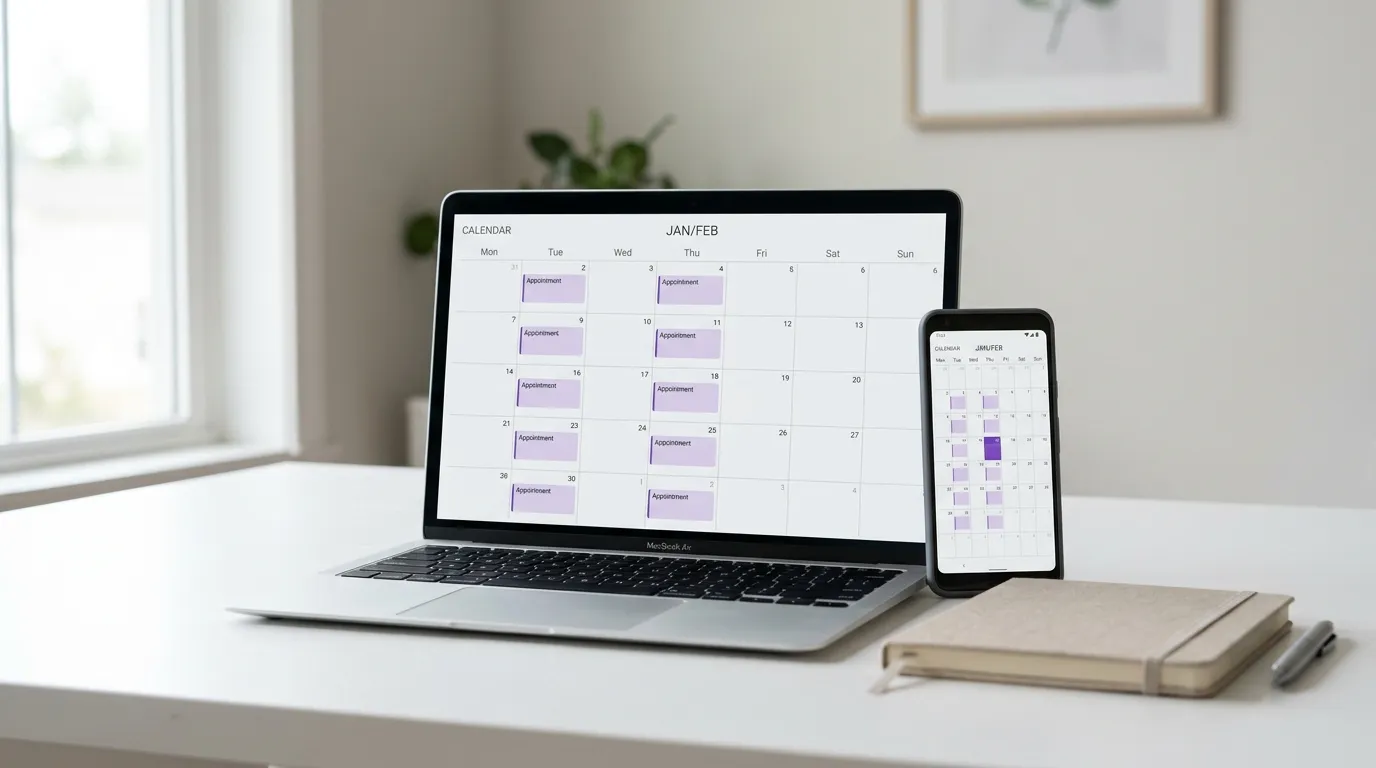
Only about a third of salon clients book their next appointment at checkout. Industry benchmark data puts the average rebook-at-checkout rate at 30-35%, which means two out of three clients walk out with no appointment on your calendar and a vague intention to text you “sometime in the next few weeks.” Some of them do. Many find a different stylist first, because the slot they wanted filled up while they were thinking about it.
Recurring appointments attack that gap directly. Instead of rebooking one visit at a time, the client books a standing series: the same service, same stylist, same slot, repeating every 2, 3, or 4 weeks. The chain goes on the calendar once, and neither side has to remember to make the next call.
The feature page version of this story is “book once, repeat forever.” The mechanism has more failure points than that, and they’re worth knowing before you offer a series to your best clients.
What a recurring appointment series actually creates
A series is a chain of independent appointments linked by a shared rule. A client books every second Tuesday at 4pm for gel fills, and the system generates each future visit with its own date, service, duration, and price, tied together by a series reference. Three things follow:
The slots are reserved immediately. Every appointment in the chain occupies real calendar space from day one. Nobody else can book into those windows. That’s the point.
Each occurrence behaves like a normal appointment. Reminders fire per visit. Cancellation policies apply per visit. Payment happens per visit. A series is a scheduling shortcut, not a contract or a prepaid package.
The series has a horizon. Chains don’t run forever. Boulevard’s recurring appointment documentation, for example, caps a series at 52 appointments.
The horizon matters. An open-ended booking that rolls forever is how calendars fill up with slots nobody will use. A defined end forces a renewal conversation, which is a feature.
How to set up recurring salon appointments
Setup is short, whether the front desk books it or the client does:
The confirmation step is the one salons skip and then regret. A client who sees all six dates can say “I’m away the third week of December” before that visit ever needs a cancellation. A client who sees one date at a time learns about each visit from the reminder text.
What breaks the chain
The series looks clean on setup day. Then life happens. Four events break standing bookings, ranked by how often they cause silent damage.
1. Holidays and closures
A Monday series collides with every Monday holiday. Something has to move: skip a week, shift to Tuesday, or push a week. If the shift becomes the new normal without anyone deciding that, the series drifts; six months later the client thinks it’s Tuesdays and the calendar still says Mondays. A moved occurrence meant to be temporary should sit outside the series so the original slot keeps its pattern.
2. Price changes
The chain was priced when the client booked it. Raise prices mid-series and the calendar holds a mix: past visits at the old price, future visits at whatever the system carried forward. The client expects one number and checks out at another, or you eat the difference. The clean rule: a price change resets the series. Rebook at the new price with a fresh chain.
3. A missed visit
The client no-shows one occurrence. Offer the freed slot to someone else as a one-time booking while the standing client keeps their slot, or let the missed visit end the chain and rebuild from the next date. Never silently shift every future occurrence to “make up” the missed one. One bad week becomes a permanent schedule change the client never agreed to. And a client who cancels half their standing visits is holding prime time at 50% utilization. That’s a conversation, easier to have when the series has a defined end.
4. A stylist leaves
This breaks the chain for a whole book at once. Every series attached to that stylist needs a decision: reassign or cancel and let the client choose. Mass-transferring without asking produces clients booked with someone they never picked. Handle departing-stylist chains the way you’d handle their other future appointments: list the conflicts, then resolve them one client at a time.
What auto-fills and what doesn’t
Here’s the honest part about recurring appointment booking software: a series automates the booking, and almost nothing else.
Automatically: slots appear on the calendar, standard reminders go out per visit, the booking record carries the same client, service, duration, and staff member each time, and the client can check their own upcoming dates by signing into your client account page.
Not automatically: price updates mid-chain, holiday adjustments, availability re-checks after a schedule change, reassignment when staff change. If the team treats the series as self-managing, drift does the managing instead.
⚠️ The drift check
Once a month, filter the calendar for recurring series and scan for three things: occurrences landing on closed days, occurrences assigned to staff who no longer work that slot, and chains older than a year without a renewal conversation. Fifteen minutes catches most silent drift.
When standing salon appointments help your schedule
A series earns its place when three conditions hold:
- The service has a fixed regrowth cadence. Gel fills every 2-3 weeks, root touch-ups every 4-6, lash fills every 2-3. When the client needs the same service on a rhythm, the rhythm is the product. The industry’s 60-70% annual retention rate runs higher for color clients precisely because roots don’t negotiate. Standing bookings formalize that loop.
- The slot is protected time. A reliable 4pm Tuesday held for a client who always shows converts your best regulars into a predictable revenue floor.
- You can afford the locked capacity. The book isn’t starving for new clients.
When recurring booking hurts your schedule
The same mechanism, aimed at the wrong book, does damage:
- You’re still filling the calendar. Prime evening and weekend slots locked up months ahead leave nothing for new demand. The book looks full and isn’t growing.
- Attendance is unreliable. A standing slot for someone who cancels half the time is unavailable to book and unavailable to bill. High-churn services don’t support the commitment.
- Your schedule changes seasonally. Every staff-hour edit now collides with a stack of future reservations. That’s the exact problem we block schedule changes over, and long chains multiply it.
A middle path works for most salons: standing series for proven regulars, off-peak slots first, defined horizon, renewal conversation at the end of every chain. The booking features that move revenue, reminders, waitlists, online booking, work for everyone. Standing series are the specialist tool for the top of your client list.
The common questions, answered
Depends on the platform, so test before you offer the feature. Good systems treat one visit as a one-off cancellation and leave the chain intact. If the only option is 'cancel the series,' a client with a dentist appointment will delete six months of bookings to skip one Tuesday.
They should. A standing booking is easier to forget, not harder, because the client never performs the act of booking it. Reminders showing the specific date and time also catch drift when a past occurrence was moved.
The chain runs to its horizon and the calendar goes quiet unless someone renews. Treat that as a feature: the end of a chain is the natural moment to confirm the day, time, and price still work, then start a fresh series.
The mechanism is simple: one booking creates the whole chain, and the chain holds the slots so nobody has to remember to ask. The discipline is in the edges. Keep each chain on one price, keep temporary changes temporary, and end every series on purpose instead of letting it fade. Clients keep their slot. You keep a calendar you can trust.