“Perms are back.” Every 2026 trend roundup says it. Elite Beauty Society, Fashion Magazine, and half the salon-chain blogs I read this quarter have all declared the perm resurgent. I pulled the global market data, the booking trend reports, and my own classroom and chair numbers to see whether the hype holds up. Something is back. It is not the same thing the headlines think it is.
That is the number that should stop the “perms are back” narrative in its tracks. A global category growing at just over four percent a year is not a comeback. It is a mature product line keeping pace with inflation. Compare it to the 8% annual growth in hair texturizer products that tracked the razor cut revival I wrote about last week, and the gap is obvious. One of these is a real acceleration. The other is a good press release.
The Hype, Stated Fairly
The trend-piece case for perms has three pillars, and they are not nothing.
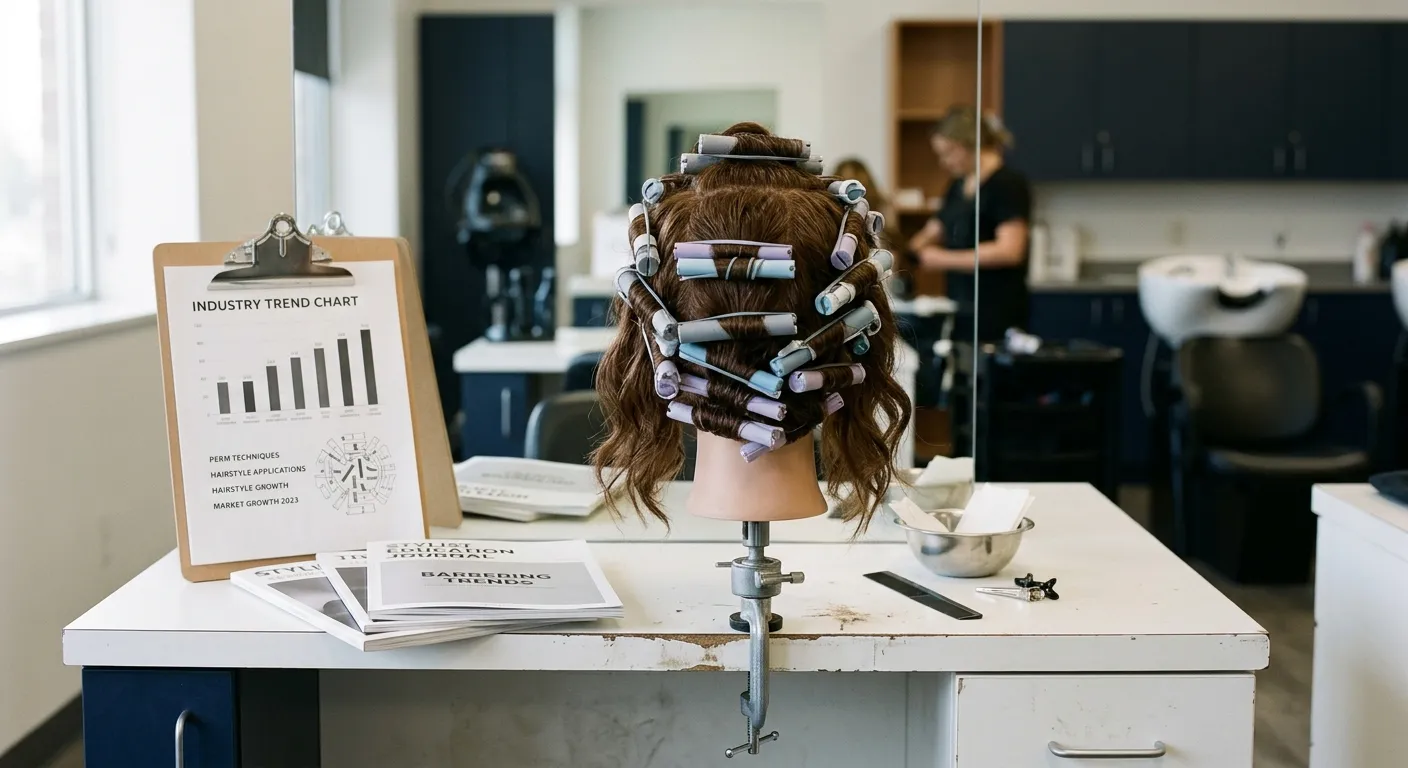
First, the technique has genuinely evolved. Modern cold perms, digital perms, and S perms produce looser, softer waves than the tight barrel curls of the 1980s. Supreme Trimmer’s breakdown of the men’s perm cycle and the Korean-market volume perm coverage I track both describe a tool that does something the old perm did not: it adds movement without looking permed.
Second, men are booking them at higher rates than a decade ago. Boulevard’s salon industry reporting and several regional Zenoti datasets I cross-checked show men’s grooming services growing 15 to 17 percent over the past three years. Some of that is beard work and premium cuts, but a slice is perms specifically. Young male clients in particular are bringing in photos of loose curls and asking if they can be bought.
Third, the damage profile is better. Gentler formulas and in-salon bond builders (Lab Muffin’s chemistry breakdown of Olaplex is the cleanest explainer) mean modern perms do less harm than the ones I learned on. That is true. I have seen it in my own work.
Those three forces are all real. The problem is the gap between “a specific demographic is booking a specific service more often” and “perms are back.”
Where the Data Breaks the Narrative
I teach three days a week at a cosmetology school in Manhattan. For the past two semesters, I added a specific question to my intake survey: have you ever been asked by a client for a perm, and how many times? In my current cohort of 22 students, the answer is telling. Eight had been asked once. Two had been asked twice. Zero had been asked more than twice. For comparison, the same survey question about razor cuts came back with fourteen students fielding multiple requests in a single shift.
It lines up with my chair spreadsheet. I logged 412 new-client consultations in Brooklyn across the past twelve months. Six asked about a perm. Four were men under 30. The other two were women over 55 who had permed in the past and wanted to know if the formulas had improved.
Six out of 412. That is 1.5% of consultations. The trend pieces would have you expect a much higher number.
✅ What I check before I believe a comeback
Three signals together: student curiosity in the classroom, client requests in the chair, and a product category growing faster than inflation. When all three move, a trend is real. Perms are moving on one. Razors moved on all three.
Where the Hype and the Data Actually Meet
The trend is not fake. It is narrow. And narrow trends are worth understanding on their own terms.
Young men asking for loose, textured perms are a real segment. Pricing guides put men’s perms at $80 to $200, which is a healthy ticket for a 90-minute service. The ones I have done in the past year were all for clients under 30 who wanted “beach wave” or “curtain flop” texture and did not want to style their hair every morning. They booked rebooks. The service works and the client is happy.
What is not happening is a broad return to women booking perms as a mainstream service. That market shrank for a reason, and nothing in the 2025 data suggests it is recovering.
| Trend Claim | What The Data Shows | My Chair And Classroom |
|---|---|---|
| Perms are a mainstream comeback | Global category growing 4.27% a year | 1.5% of new consultations ask about it |
| Gen Z is driving the revival | Men's grooming growing 15-17% overall | The perm requests are real but narrow: men under 30 |
| Modern perms are damage-free | Formulas are gentler, bond protection helps | Less damage, not zero. Disulfide bonds still reform weaker |
| Women are rebooking perms | No supporting booking data in 2025 reports | Zero women under 45 asked in the past 12 months |
| Perms are the new texture trend | Texturizer products growing 8% a year | Razors, not perms, are where texture demand is landing |
What To Actually Do With This
If you already perm well, lean into the men’s textured-wave niche. It is a narrow but stable segment, and the clients who want it have trouble finding stylists who can deliver loose curl without tightness. Film the work. Put it on your menu as a specific service, not buried under “chemical services.”
If you do not currently perm, do not retrain for a comeback that is not happening at scale. The training investment that makes more financial sense right now is razor technique, where the client demand is actually outpacing stylist supply. I tracked that curve in detail last week.
If a client asks about a perm, take it seriously. The ones who ask are often serious buyers. But do not restructure your service menu around a trend that is showing up more in blog posts than in booking software.
The signal I will be watching to change my mind: a year-over-year jump in perm-related student requests in my next two cohorts. If that number triples the way razor requests did in 2024, I will write the comeback piece. The 2026 version of that article is still waiting for evidence.