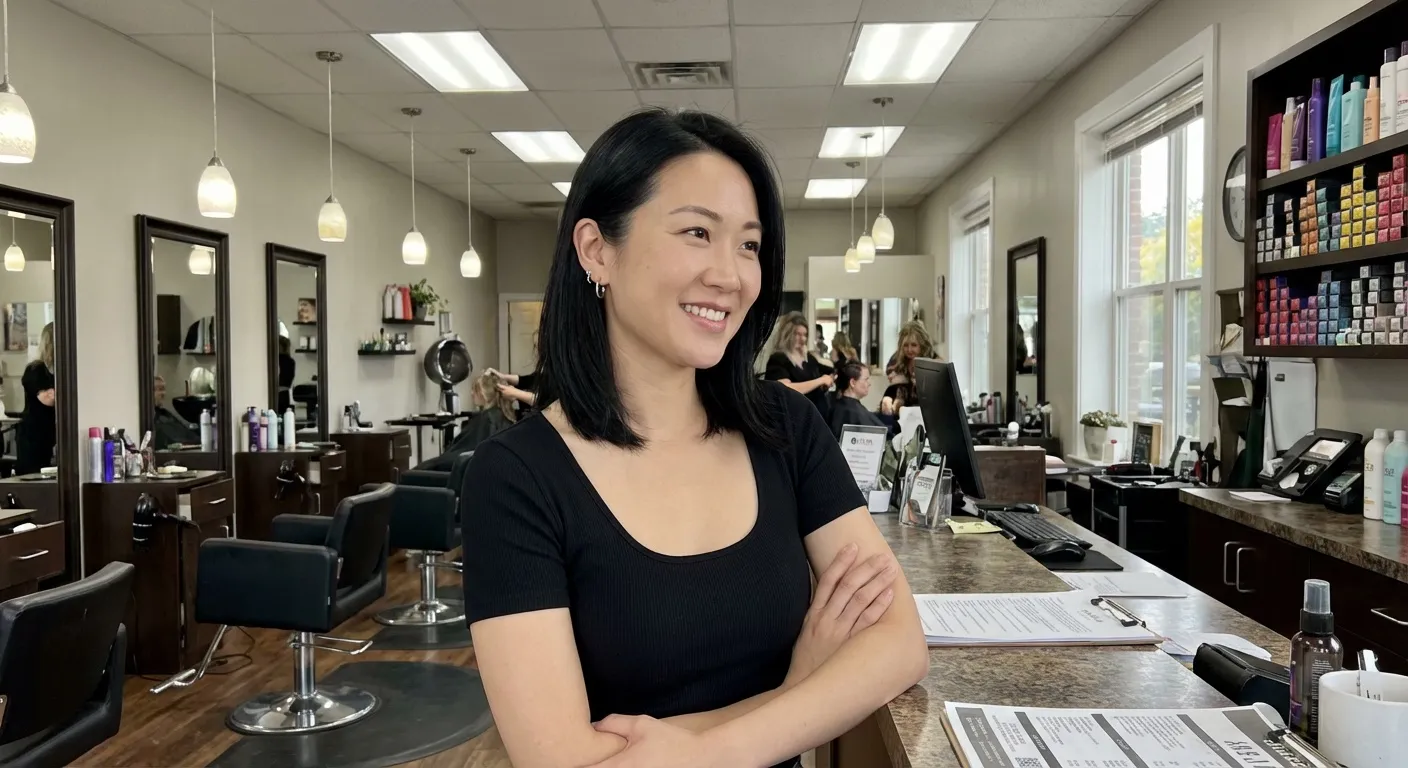
For the first four years I owned my salon, the retail shelf was an afterthought. Products sat on a rack near the front desk. Nobody dusted them. Nobody talked about them. When a client asked “What should I use at home?” my stylists would vaguely point toward the shelf and say “We have some stuff over there.”
Retail made up about 6% of my revenue. I figured that was normal. Then I looked at the actual margins and realized I’d been ignoring the most profitable square footage in my salon.
Salon retail margins vs service margins
The average salon profit margin on services is about 8.2%, according to Boulevard’s industry data. That factors in labor, rent, product cost, and overhead. After everyone gets paid, eight cents of every service dollar stays with the business.
Retail flips that ratio. Product margins in salons typically run 42 to 48%, with some lines pushing above 50%, according to Quark Booker’s margin analysis. Sell a $28 bottle of shampoo and you keep $13 to $14. That same $28 earned through services would net you about $2.30. Meanwhile, your back bar may be bleeding money on the product you’re using in-service, which makes retail margins even more important to capture.
Most salons leave this on the table. Zolmi’s industry research puts average salon retail at 12% of total revenue. High-performing salons push that to 15 to 20%. The gap between 12% and 20% on a $300,000 salon is $24,000 in additional revenue, most of it profit.
What my retail looked like before
My salon was doing about $290,000 a year when I decided to take retail seriously. Six percent retail meant roughly $17,400 in product sales. At a 45% margin, that was about $7,800 in profit. Not bad. Not great. And definitely not what the shelf could produce.
The problems were predictable. Products weren’t organized by use case. Stylists didn’t mention products during the service. There were no testers. The display was in a low-traffic corner. And I had too many SKUs from three different lines, which made the shelf look cluttered instead of curated.
Three ways to increase salon retail sales
The stylist names the product during the service. This was the single biggest lever. When my stylist says “I’m using this heat protectant before I blow-dry, it’s the one that keeps your color from fading,” the client is already sold. They felt it work. They smelled it. They saw the result in the mirror.
Vagaro’s retail strategy research found that training staff to discuss products during the service can increase retail revenue by $15 per client on average. That’s not upselling. That’s education. The client was going to buy something at Target anyway. You’re redirecting that spend to a product that actually works for their hair, from someone they trust.
I cut the SKU count in half. I went from three product lines down to one primary line and a small secondary range for curly and textured hair. Fewer choices made it easier for stylists to recommend confidently and easier for clients to decide. The shelf went from 60 products to 28. Sales went up.
I moved the display to the checkout path. The old shelf was off to the side. The new one sits between the styling stations and the register. Every client walks past it. A Point of Purchase Advertising International study found that over 70% of purchasing decisions happen in-store at the point of sale. If the product is in the client’s sightline while they’re feeling good about their hair, the timing is right.
Product category breakdown by sales
The numbers after twelve months
I made these changes gradually over two months. Moved the shelf, trained the team, simplified the product range. Here’s what happened over the following year.
| Metric | Before | After 12 months |
|---|---|---|
| Retail as % of revenue | 6% | 14% |
| Monthly retail revenue | ~$1,450 | ~$3,380 |
| Average products sold per client | 0.3 | 0.7 |
| Annual retail profit (at 45% margin) | ~$7,800 | ~$18,250 |
The jump from 6% to 14% didn’t come from pushing product. It came from removing friction. When stylists know the line, when products are visible, when the recommendation happens naturally during the service instead of awkwardly at checkout, the client buys because they want to.
🧮 Revenue per square foot
My retail display takes up about 12 square feet. At $3,380 per month in revenue, that shelf generates $282 per square foot per month. My styling stations, which occupy about 40 square feet each, generate roughly $500 per month each before expenses. Per square foot, the retail shelf outperforms a styling chair on margin.
Common salon retail mistakes to avoid
Too many options. Clients standing in front of 60 products with no guidance will buy nothing. Curate the shelf. Feature four or five hero products. Rotate seasonally.
Expecting the front desk to sell. The stylist has the relationship and the context. “This is what I used on your hair today” is ten times more effective than “Would you like to add a product?”
Ignoring inventory turn. If a product has been on the shelf for 90 days without selling, it’s taking space from something that would. Suplery’s inventory research recommends tracking sell-through rates monthly and pulling anything that isn’t moving. Dead stock ties up cash you could spend on what actually sells. A quarterly supply closet audit catches these slow movers before they become write-offs.
No testers. Clients want to smell it, feel the texture, see the packaging up close. An Appointy study found that product sampling directly correlates with purchase rates. Open one bottle. Put it on the counter. Let the product do the work.
Start with what you already have
You don’t need a new product line to improve retail. Start by counting how many products each stylist recommends per week. If the number is close to zero, that’s your first fix. Give each stylist a goal of one recommendation per client. Not a hard sell. A mention. “This is what I used on you today. Grab one if you want.”
Track monthly. Watch the number climb. You can also extend the retail relationship after the appointment with an aftercare text that recommends the products you used. The retail shelf is the one part of your salon that generates revenue without requiring another hour of labor. The product is already there. The client is already in the chair. The margin is already built in. You just have to connect them.