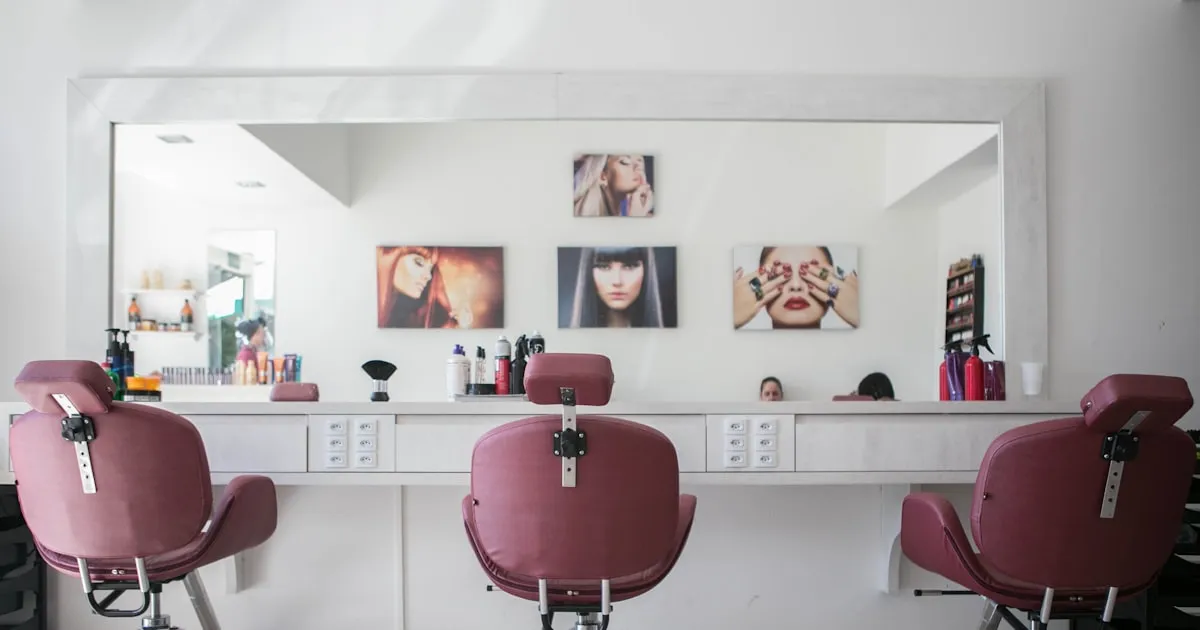
A typical salon menu starts lean. A few cuts, a few colors, a blowout, maybe a treatment or two. Then someone asks for balayage, so it gets added. A keratin smoothing treatment trends on Instagram, so that goes up too. A stylist joins who specializes in extensions, so three new extension services appear. Five years later, the menu has 30 to 40 services, and no one has checked whether each one actually makes money.
According to Boulevard’s salon industry data, the average salon net profit margin sits around 8%. At that margin, a single underpriced or underperforming service category can wipe out a month of profit without anyone noticing. The math hides inside a bloated menu.
The 80/20 problem on your menu
The Pareto principle applies to salon menus with uncomfortable precision. In most businesses, roughly 20% of products generate 80% of revenue. Salons are no different. A handful of core services fill the schedule. The rest occupy menu real estate without pulling their weight.
Pull up your booking data from the past six months. Sort services by total revenue generated. The pattern will be familiar: women’s cuts, single-process color, partial highlights, and blowouts will likely account for the bulk of the income. The bottom third of the menu probably accounts for less than 5% of total bookings.
Those low-volume services still carry costs. They require product inventory, staff training, and booking time. If a stylist performs a service twice a month, proficiency drops, service time stretches, and the already thin margin gets thinner.
Revenue per hour is the real ranking
A flat service list sorts by category. A profitability audit sorts by revenue per hour. The difference matters because the salon’s only finite resource is chair time.
Consider five common services at a mid-range salon where the stylist earns 45% commission and overhead runs roughly $10 per chair hour, consistent with Salon Today’s cost benchmarks.
| Service | Price | Duration | Product cost | Labor (45%) | Overhead | Profit | Revenue/hr |
|---|---|---|---|---|---|---|---|
| Women’s cut | $65 | 45 min | $1.50 | $29.25 | $7.50 | $26.75 | $86.67 |
| Blowout | $45 | 30 min | $2.00 | $20.25 | $5.00 | $17.75 | $90.00 |
| Single-process color | $120 | 60 min | $8.09 | $54.00 | $10.00 | $47.91 | $120.00 |
| Partial highlights | $175 | 90 min | $3.20 | $78.75 | $15.00 | $78.05 | $116.67 |
| Balayage | $250 | 180 min | $9.50 | $112.50 | $30.00 | $98.00 | $83.33 |
Product costs are drawn from SalonScale’s wholesale color data, and average service pricing from StyleSeat’s 2025 pricing guide.
The balayage brings in the highest total dollar amount per ticket. But it earns $83.33 per hour of chair time. A single-process color earns $120 per hour. A blowout earns $90 per hour in a fraction of the time.
Revenue per chair hour
This does not mean balayage is a bad service. It means a three-hour balayage priced at $250 underperforms a one-hour color at $120 when measured against the clock. The service either needs a price adjustment or a clear strategic reason to stay at its current rate.
How to run a menu audit
The process takes about an hour with booking software that tracks service-level data. Here is the framework.
Step 1: Export six months of service data. Pull every service booked, including the price charged, the stylist who performed it, the duration, and the product used. Most modern booking platforms can generate this report.
Step 2: Calculate revenue per hour for each service. Divide the average price by the average duration in hours. This gives the gross revenue rate. Then subtract product cost, labor cost, and your overhead allocation to get profit per hour.
Step 3: Rank every service by three metrics. Booking volume (how often it gets booked), profit per hour (how much money it makes per unit of chair time), and client overlap (how many clients book only that service versus combining it with others).
Step 4: Flag the bottom performers. Any service that falls in the bottom quartile on all three metrics is a candidate for removal or repricing.
✅ The overlap test
Before cutting a low-volume service, check how many clients who book it also book other services. A $40 deep conditioning treatment booked 10 times a month might seem like dead weight. But if eight of those clients also book a $175 highlight the same visit, the treatment is a retention tool, not a standalone revenue line. Context matters.
Four signs a service should come off the menu
Booked fewer than five times per month across the entire team. Low volume means low proficiency. A service performed rarely takes longer, uses more product (due to hesitation and waste), and carries higher error risk. VISH data shows that 25 to 40% of salon color product is wasted, and infrequent services push waste toward the higher end of that range.
Revenue per hour falls below your break-even rate. Every salon has a break-even cost per chair hour. If overhead plus labor plus product on a particular service exceeds the revenue it brings in per hour, the salon loses money every time someone books it. Knowing your cost per minute makes this calculation straightforward.
Requires inventory you stock for no other purpose. A specialty keratin treatment that needs a dedicated product line sitting on the shelf is a carrying cost. If that product costs $200 and the service gets booked three times a quarter, the inventory is dead capital.
No one on the team wants to perform it. If a service lingers on the menu because it was popular two years ago but no current stylist is trained or enthusiastic about it, the quality will reflect that. Bad service is worse than no service.
What to do instead of deleting services outright
Removing a service from the menu is the nuclear option. There are intermediate steps.
Reprice it. If the service has loyal clients but a thin margin, raise the price. A three-hour balayage at $250 that earns $83/hr becomes a $325 service earning $108/hr. Run the numbers before assuming clients will leave. Research from SalonIQ shows that 72% of salons adjust prices annually, and the ones who do it consistently see 15% higher revenue over time.
Restructure the time. Some services take too long because they were never properly scoped. A stylist spending 30 minutes on a blowout that the salon charges $45 for is earning $90/hr. A stylist who routinely takes 50 minutes on the same blowout drops to $54/hr. Tighten the service protocol, and the margin recovers.
Bundle it. A low-performing standalone service can become a high-performing add-on. A $25 gloss that rarely gets booked on its own can be bundled into a color package at a higher total ticket. The service stays on the menu, the average ticket climbs, and the chair time is already allocated.
Sunset it with notice. If the service needs to go, tell clients in advance. Give 60 days’ notice. Offer an alternative. A client who booked a discontinued treatment once a quarter will usually accept a substitute. One who learns about it at the front desk will not.
A leaner menu books faster
There is a client-facing benefit to trimming the menu that has nothing to do with margins. Mangomint’s research on salon menus found that long, undifferentiated service lists confuse clients and slow down booking decisions. A focused menu with clear categories and fewer options reduces friction. Clients book faster. Staff quote prices with more confidence. New clients feel less overwhelmed.
A salon offering 15 well-priced, well-executed services will outperform one offering 35 services where half are booked sporadically and priced by gut.
The audit that pays for itself
Pull up the booking data. Run the revenue-per-hour calculation on every service. Rank them. The bottom of that list will contain services that cost the business money, occupy staff training time, require product inventory, and contribute almost nothing to the monthly number.
Most salon owners add services to the menu and never subtract them. The menu grows like a closet that never gets cleaned. A quarterly audit takes one hour. The margin improvement from cutting or repricing even two or three underperformers can reach $500 to $1,000 a month, depending on volume. That is the kind of return that knowing your numbers makes possible.