Nail piercings are back, and this time they’re walking off the runway and onto real salon menus. For most of the last decade, the idea of drilling a clean hole through an acrylic tip and threading a tiny gold hoop through it was a Y2K footnote, something your aunt remembered from a 2002 press set. Then Grace Ling and Kim Shui put dangling chains and initial charms on models at New York Fashion Week Spring/Summer 2026, and my DMs filled up within the week. Three of my clients have already booked piercing add-ons for April, and two more sent me screenshots asking if I could do something similar to what Kylie Jenner wore to Coachella.
This is the loudest nail jewelry moment since rhinestones broke in 2022. And unlike most runway trends, this one travels cleanly from the editorial to the neighborhood salon. The technique is teachable, the hardware is cheap, and the upcharge writes itself.
What’s Actually Changing at the Chair
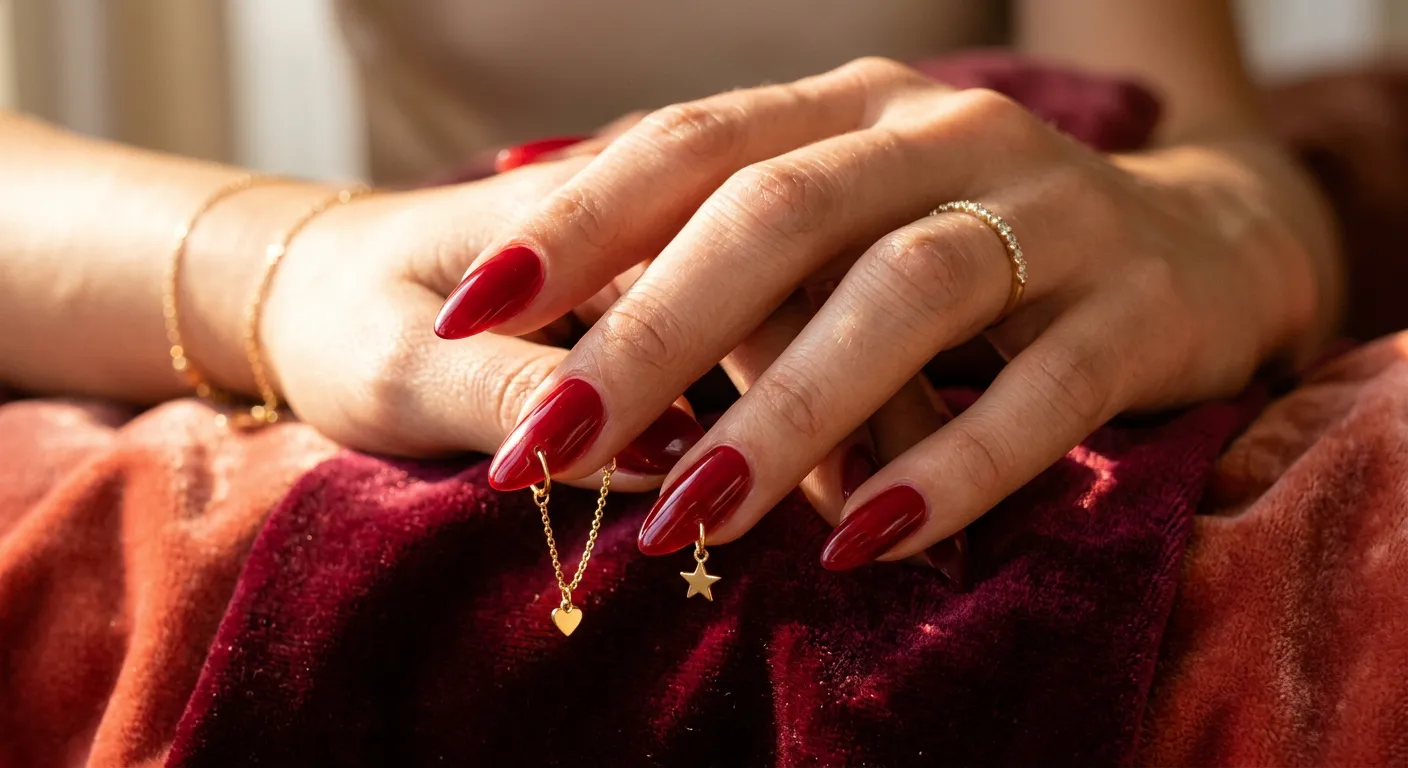
Piercings on nails are not new. The tooling has existed in nail tech supply catalogs for years. What’s new is the styling vocabulary. The 2026 version moves. A hoop through the free edge, a thin chain looped between two fingers, a charm that dangles and catches the light when a client turns her hand. At Grace Ling’s “Future Relics” collection, nail artist Michelle Humonde experimented with dangling charms and pierced tips. At Kim Shui, Sojin Oh punched holes through gel nail strips and threaded chains with “K” initial charms.
That range is wide because pricing hasn’t standardized yet, which is exactly the opportunity. When the technique is new and named, clients don’t have a mental benchmark, so the salon sets the floor. Marie Claire called the nail gem manicure trend “spring and summer’s hottest manicure trend,” and it keeps climbing. The pierced version is the maximalist end of the same spectrum.
How Piercings Fit into a 2026 Salon Menu
The business case is more interesting than the styling case. Nail salons in 2026 are operating against an average transaction value of about $106, with a $20 target for add-ons and retail per visit. Add-ons are where margin lives. A piercing is a perfect add-on: low material cost, high perceived value, and it stacks on top of any existing service without disrupting your schedule much. Ten minutes of work, properly priced, can clear what another ten minutes of standard polish application earns in an hour.
Per-nail pricing by nail art category
Those are midpoints from the pricing data salons are actually quoting right now. Basic gem placement has been commoditized. Clients know a rhinestone costs pennies and assume the labor is minimal. Piercing doesn’t carry that baggage. The drilling step reads as skilled, the hardware reads as jewelry, and the removal reads as aftercare. Boulevard’s nail salon pricing guide notes that deluxe nail art with 3D elements, gems, and charms runs $30 to $45 per design in a market-rate salon. A pierced set with two dangles on accent nails comes in at the top of that range without feeling like a stretch.
The other advantage is that pierced nails photograph well. Dangle charms catch motion in short-form video. Clients who book a piercing set are almost guaranteed to post it, which functions as free acquisition for the salon tag. That visual payoff is why the trend is moving faster than its technical complexity would predict.
How the Trend Got Here
Early 2000s: The First Wave
Pierced nails appeared on Y2K press-on sets and in early 2000s nail magazines. Technique was rudimentary and often damaged the nail plate. The trend faded as acrylic art shifted toward flat embellishments.
2022: Rhinestones Break Mainstream
Hailey Bieber's glazed donut era overlapped with the return of nail embellishment. Rhinestones, pearls, and flat charms reappeared on salon menus. 3D elements were still niche.
2024: 3D Nail Art Escalates
Nail techs began layering charms, bows, and hardware. Supply companies started stocking nail-specific piercing bits and drills. The technique matured quietly in the background while gems dominated the visible trend cycle.
Fall 2025: Runway Validation
Nail piercings and dangling charms appeared at Grace Ling and Kim Shui for New York Fashion Week Spring/Summer 2026. The styling framed piercing as editorial rather than subcultural.
Spring 2026: Menu Integration
Pricing guides begin listing nail piercing as an add-on. Salons in Los Angeles, New York, and Miami report the first wave of client requests. TikTok and Instagram amplify with Coachella adjacent content and celebrity manicurist posts.
The pattern here is faster than brow lamination or chrome nails took to mature. The tooling was already in place when the runway validation hit, so the gap between editorial moment and menu integration collapsed to a single season. That’s partly why I’m watching it closely. When a trend moves from NYFW to a booking request in under six months, the salons that have a price and a process ready capture the margin.
The Part That Worries Me
I’d be lying if I didn’t say the technical risk concerns me. A piercing done well is clean, durable, and sits on the free edge where the nail bed isn’t involved. A piercing done poorly cracks the tip, loosens the enhancement, or punches too low and damages the nail plate itself. The rule every instructor I trust repeats is the same: no piercing on the natural nail, no piercing on the pink, only on the free edge of an enhancement. That is non-negotiable. The nail drill has to stay perpendicular, the tech’s hand has to be under the client’s finger for support, and the hole needs to be positioned far enough back from the tip to leave structural margin.
⚠️ If you haven't practiced, don't charge yet
Start on practice tips. Drill through a dozen before you drill on a paying client. The technique is simple when you know it and ruinous when you don’t. A cracked tip on a $90 set turns a celebration post into a complaint.
That’s where the upsell math can break down. If a $35 piercing add-on results in a broken nail two weeks later, the repair appointment eats the margin and then some. The salons getting this right are treating the technique like any other skill: they practice it before they price it, and they set clear removal expectations with clients. Piercings need to come out professionally, same as any enhancement hardware, which is itself a small return appointment fee worth building into the initial quote.
Where This Lands
The honest read is that pierced nails and dangle charms have cleared the runway bar but haven’t yet hit early majority. Most of the bookings I’m seeing are from clients who follow nail art accounts closely, not from my regulars who just want a clean gel set. That’s the early-adopter band, and it could expand into the mainstream the way rhinestones did or settle into a permanent niche. Either outcome is workable if your pricing system can handle custom add-ons without slowing down your booking flow.
What I’m confident about is the shape of the opportunity for salons that move now. The upcharge is real, the technique is teachable, and the visual payoff builds your social feed while it lifts your average ticket. Compare that to a trend like quiet luxury nails, where the entire conversation is about how to charge for something that looks like nothing. Pierced nails flip that problem. They look like something, and clients already expect to pay extra for something that looks like jewelry.
This could go either way as a mainstream trend. What it won’t do, for the next eighteen months at least, is disappear from the fashion editorial conversation. That’s long enough to build a rate, train a process, and keep the accent finger booked.