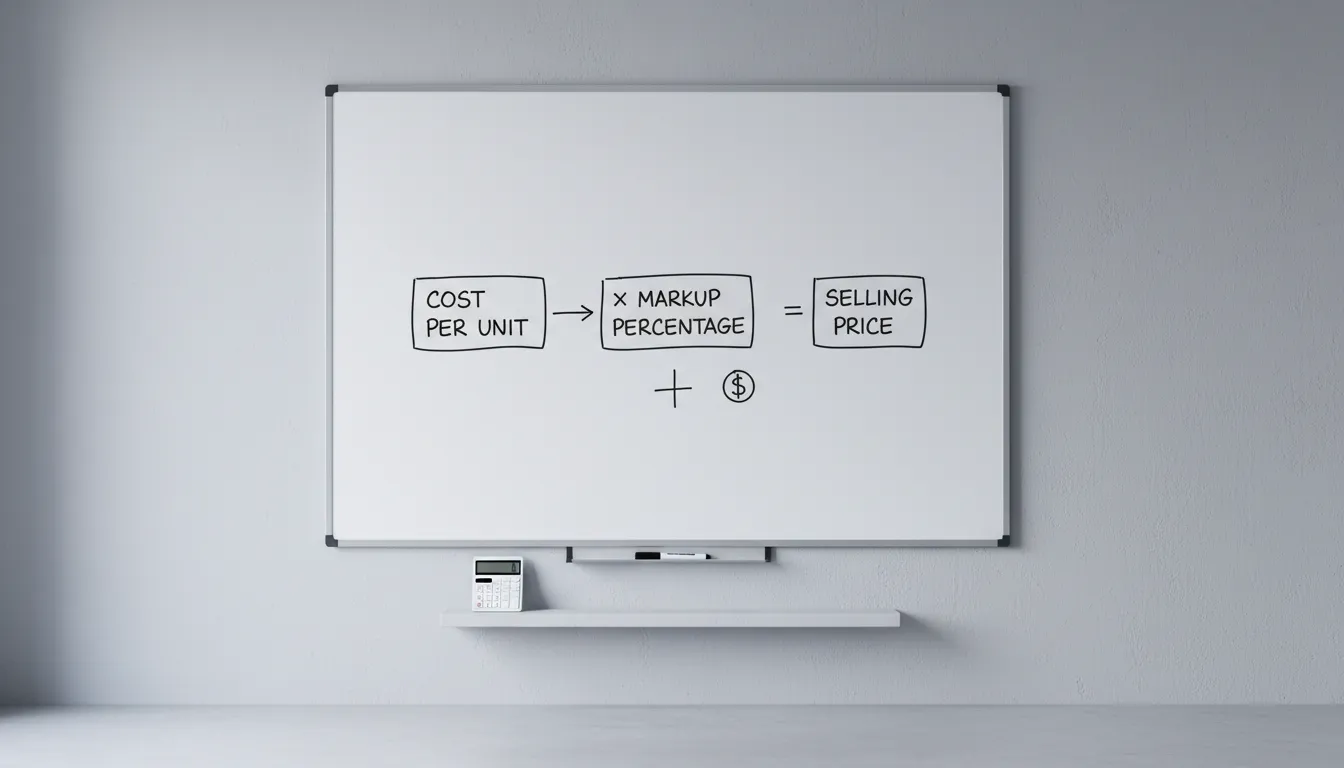
Most salon owners set prices by looking at the salon down the street. They find the local range, land somewhere in the middle, and call it done. The problem is not the research. The problem is what that process measures: what competitors charge, not what services cost to deliver.
If a competitor is undercharging, copying them just means two salons losing money instead of one.
Why Copying Competitor Prices Doesn’t Work
Competitor pricing tells you what the market tolerates. It tells you nothing about whether that price covers your costs. A salon across town may operate with one fewer employee, lower rent in a cheaper zip code, or a supplier deal on color products that cuts their COGS by 30%. Their price floor is not your price floor.
The Boulevard industry benchmarks put the average salon net profit margin at 8%. That is not a target. For many owners, that number lands closer to 5% or less, because prices were set by feel rather than formula. Understanding your core financial numbers is the prerequisite for every pricing conversation that follows.
The only pricing method that actually works starts from costs and works forward. It asks: given my overhead, my product spend, my realistic booking rate, and the margin I need to keep the business alive — what is the minimum this service can cost?
That number is your price floor. Set below it and you are paying to work. Set above it and you can price strategically based on positioning, demand, and what the market will bear. If the chair is full but the bank account is not, the diagnosis almost always starts here.
The Salon Pricing Formula: A Three-Phase Framework
The framework has three phases. Each phase adds one variable.
Phase 1: Find your cost per working minute. Phase 2: Price each service using cost per minute plus product cost plus margin. Phase 3: Stress-test against real service examples.
Here is the math behind each phase.
Phase 1: Your cost per working minute
Your cost per working minute is the overhead burden your business places on every minute a client is in the chair. To calculate it, you need two numbers: your total monthly fixed overhead, and your total monthly billable minutes. For color services specifically, the per-minute cost breakdown goes deeper — but the core formula below applies to any service.
Monthly fixed overhead includes rent, utilities, insurance, software, equipment payments, and any other cost that runs regardless of whether you see a client. For a solo stylist in a mid-market city, that number typically falls between $2,500 and $5,000 per month. A three-chair salon paying $3,000 in rent with two employees could run $12,000 to $20,000 in monthly overhead. If you have not listed every fixed line item, do it now before this formula will work.
Monthly billable minutes is not the number of minutes you are at the salon. It is the minutes you have available to take clients, multiplied by your realistic booking rate. A stylist working 5 days a week, 8 hours a day has 9,600 available minutes per month (5 days × 8 hours × 60 minutes × 5 weeks, roughly 22 working days = 10,560 minutes). Industry benchmarks from Boulevard put typical stylist utilization between 70 and 85%. At 75%, that 10,560 becomes 7,920 billable minutes per month.
🧮 Cost per working minute
Monthly overhead: $4,000
Available minutes/month: 10,560 (22 days × 8 hrs × 60 min)
Booking rate: 75%
Billable minutes: 7,920
Cost per minute: $4,000 ÷ 7,920 = $0.51
Every minute a client is in your chair costs $0.51 just to keep the lights on and the lease paid. A 60-minute service costs $30.60 in overhead alone before you touch a product.
Phase 2: The service pricing formula
With cost per minute in hand, pricing any service becomes a four-variable calculation:
Service price = (cost per minute × service minutes) + product cost + labor cost + profit margin
For commission-based salons, labor cost is built into your overhead (it is part of your monthly fixed and variable costs). For solo owner-operators, labor cost is the number you are paying yourself, which most owners forget to include. If your business is not covering a salary equivalent to what you would pay a hired stylist, the business is not actually profitable — you are just subsidizing it with your own time.
Product cost for color services typically runs 10 to 20% of the service price. SalonScale data puts average product cost for a color service between $6 and $15 depending on the service type, with waste adding another $1 to $4 per session. For dry services like cuts, product cost is minimal — a few dollars for product and clips.
Profit margin of 10 to 15% is a healthy target for a well-run salon. Dojo Business benchmarks show that top-performing salons hold net margins of 10 to 17%. Build this into the price, not as an afterthought.
The formula, condensed:
🧮 Full service pricing formula
Price floor = ((overhead/min × service minutes) + product cost + labor cost) ÷ (1 − target margin)
At 12% margin: divide your total cost by 0.88 to get the price that returns a 12% profit on every service.
Phase 3: Three worked examples
Here is what the formula produces for three common services, using the $0.51 cost per minute calculated above, a solo owner-operator paying herself $40/hr ($0.67/min), and a 12% target margin.
| Cost item | Calculation | Amount |
|---|---|---|
| Overhead | 45 min × $0.51/min | $22.95 |
| Labor (owner) | 45 min × $0.67/min | $30.15 |
| Product cost | Shampoo, gloss, clips | $4.00 |
| Total cost before margin | $57.10 | |
| Price floor (÷ 0.88) | At 12% margin | $64.89 |
| Rounded market price | National avg is $56–$69 | $65 |
| Cost item | Calculation | Amount |
|---|---|---|
| Overhead | 180 min × $0.51/min | $91.80 |
| Labor (owner) | 180 min × $0.67/min | $120.60 |
| Product cost | Lightener, toner, 2 bowls + waste | $22.00 |
| Total cost before margin | $234.40 | |
| Price floor (÷ 0.88) | At 12% margin | $266.36 |
| Rounded market price | Reflect real time cost | $275 |
| Cost item | Calculation | Amount |
|---|---|---|
| Overhead | 240 min × $0.51/min | $122.40 |
| Labor (owner) | 240 min × $0.67/min | $160.80 |
| Product cost | Wefts, bonds, color match | $180.00 |
| Total cost before margin | $463.20 | |
| Price floor (÷ 0.88) | At 12% margin | $526.36 |
| Rounded market price | Minimum viable floor | $530 |
The balayage number surprises most owners. A three-hour balayage priced at $200 leaves the stylist with a negative labor margin after overhead. Market pricing for balayage runs $150 to $400 nationally. The formula does not set the ceiling. It sets the floor. If a market supports $300, take it. The formula just prevents owners from charging $200 and calling it profitable.
The extensions example shows why product cost must be tracked precisely. An estimate of “about $100 in product” on a $350 extension install is often $180 to $200 when measured. Underestimating product cost by $80 on a service that takes four hours turns a supposedly profitable service into one that loses money after overhead. If you are pricing extensions, read the detailed extensions pricing breakdown for the product cost math specific to that service.
Plug Your Own Numbers In
The calculator below runs this formula with your actual inputs. Change the overhead, the booking rate, or the service time and the floor price updates instantly.
Salon Service Pricing Calculator
For a more detailed breakdown by service type, the service pricing calculator walks through each cost component and lets you compare services side by side.
What Happens After You Have Your Number
Running this formula often reveals two things. The first is that some services on the menu are priced below their floor. The second is that the floor is lower than feared for simple services, and much higher than expected for long services. Balayage and extensions almost always need a price correction upward.
Once the math is done, the next question is execution. Raising prices on existing clients requires a different approach than launching new pricing on a menu. The practical guide to raising your salon prices covers how to communicate changes without losing your best clients. If certain services still feel underperforming even after repricing, tiered pricing for salon services can let you capture different price points within the same service category without restructuring your whole menu.
The formula does not guarantee clients will accept the result. Markets cap what services can charge. But owners who do not know their floor have no way to distinguish between a service that is underpriced and one that is appropriately priced for a difficult market. The formula makes that distinction visible.
A pricing model built on competitor rates is a pricing model built on someone else’s unknown cost structure. Build it on yours.