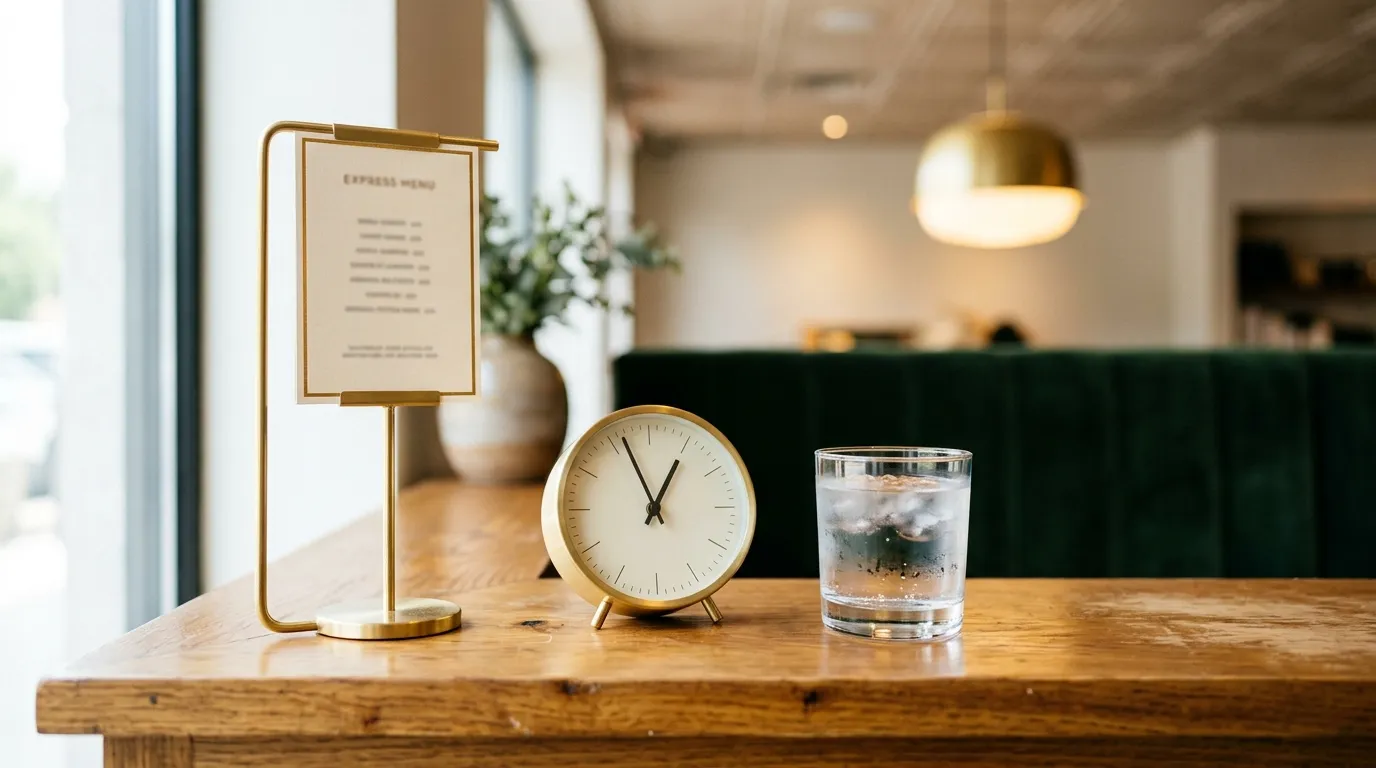
A regular texted me on a Wednesday at 11:40. “Any chance I can get in before my 1 o’clock? Even a trim. Ten minutes of you is better than none of me.” My front desk offered her 3:15. She declined politely, and the gap between her ask and my answer was forty minutes of empty chair.
I went back through two months of the book that night. Versions of that same request, over and over: clients with real money and forty minutes, holding a menu built for people with an hour and a half. The service menu had an answer for every budget and no answer for the clock. That was the week I started building ours as a separate express service menu, and it changed what the middle of my week looks like.
What a salon express service menu is
A salon express service menu is a separate short list, three to five services, all 30 minutes or under, all fixed price, booked into its own lane in the schedule. It is a second menu for a different client moment: the lunch break, the gap between school pickup and a meeting, the 4:50 before a dinner. A “mini” column bolted onto the main menu is a weaker thing entirely.
The distinction matters because most salon mini service menus fail the way mine almost failed. Owners look at a slow Tuesday afternoon and think, “We should fill it,” then shave time off existing services and shave price off to match. What that produces is a discounted version of your real work, and clients price it accordingly.
Hotels do this differently, and I spent five years watching them do it. Room service carries a full menu and a shorter late-night card. Spa menus at every property I worked in separated the 90-minute ritual from the 25-minute refresher, priced as its own product. Nobody at a hotel spa calls the 25-minute facial “half a facial.” It carries its own name, duration, and price.
The market already validates the format. Drybar was built on a single express-logic service: no cuts, no color, one fixed-price blowout. That narrow menu took the brand to a reported $70 million in annual revenue and a $255 million trademark acquisition. Face Foundrie runs a whole “Mini Facials” tier of 20-minute services and markets it in the exact language of the clock-poor client: “Walk in during your lunch break, walk out looking like you just got back from vacation.” Spa Sway in Austin charges $129 for a 25-minute express facial and markets it squarely to lunch breaks and pre-event prep. Positioned with intent, speed is a premium.
Which services belong on an express facial menu or express tier
Here is the filter I use before anything goes on the express list. Every service must pass all four tests:
One skill, no chemistry. A blowout, a gloss, a brow shape, a beard lineup, a mini facial. The service cannot require color processing, lifting, or a develop-and-check loop. Processing time is what blows up 30-minute appointments.
Fixed finish. The client leaves finished, dry, and camera-ready. No wet finishes, no “come back in six weeks,” no home program required before she sees results.
One operator, one station. No assistant runs, no shared bowls, no two-chair choreography.
Identical every time. The express menu is a promise of repeatable precision. If the service varies client to client, it needs the consultation of a full appointment, and that consultation does not fit in 30 minutes.
Blowouts qualify. Glosses qualify. Bang trims, neck cleanups, brow shaping, express facials, hand or foot rituals during a pedicure spa lane, cuff fixes and quick sets. What did not qualify in my salon: any color with developer, any cut that needs a full consultation, keratin of any kind, and, to my own disappointment, my signature blowout with the treatment and the scalp massage. My own flagship does not fit my own express menu. That stung for a day. The 30-minute version became a different product with a different name, because a rushed copy of the flagship would devalue both.
That naming work is where most salon owners get lazy. “Mini facial,” “express cut,” “quick blowout” all sound like lesser versions, and a lesser version can only ever be priced as one. Name the express tier after what the client gets: the finish line, the lunch hour, the between. The card I designed has three lines, each with a duration and a number, and not one of them contains the word “mini.”
| Element | What it looked like |
|---|---|
| Source | Trimmed-down versions of full services |
| Names | 'Mini facial', 'quick blowout', 'express cut' |
| Pricing | Roughly half the full service price |
| Booking | Any open slot, slotted in like any service |
| Client frame | 'The cheap fast one' |
| Stylist frame | Interruption, rushed work |
| Element | What it looked like |
|---|---|
| Source | Designed for the clock: three fixed products |
| Names | 'The Lunch Break', 'The Reset', 'The Between' |
| Pricing | Priced per minute above the full menu rate |
| Booking | Dedicated 30-minute lanes: 11:30, 12:00, 12:30, 5:00 |
| Client frame | 'The product for people with 40 minutes' |
| Stylist frame | A precision set, same respect as a full service |
The left column is the version that quietly failed. Clients loved the price and treated the appointments as casual, drifting in five minutes late, because the menu itself never said the time was the point.
Pricing the speed without cheapening the full menu
Now the uncomfortable part. When I costed our first express services honestly, the 30-minute slot earned less per minute than a blowout on the full menu. Same chair, cheaper ticket, worse math. I had built a discount and labeled it a menu.
The fix was to price the speed as its own value. A client who must be out the door in 30 minutes is buying certainty, and certainty is worth more than time. It is the same logic airlines use: the flexible fare and the nonrefundable fare can occupy the identical seat, and the guaranteed window costs more.
So I ran the numbers until the express slot out-earned its neighbors. If your full-menu blowout runs $65 for 60 minutes, that is $1.08 per chair-minute. Price a 30-minute express version at $45: $1.50 per minute. That is a 38 percent per-minute premium, and it is defensible because the client is buying the guarantee that at minute 31 she is walking. Here is what that looks like across a lane:
| Slot | Service | Revenue per hour |
|---|---|---|
| 11:30 | Empty | $0 |
| 12:00 | Empty | $0 |
| 12:30 | Empty | $0 |
| 11:30-1:30 total | Two dead lunchtime hours | $0 per hour |
| Slot | Service | Revenue per hour |
|---|---|---|
| 11:30 | The Lunch Break, $45 / 30 min | $90 per hour |
| 12:00 | The Reset, $40 / 30 min | $80 per hour |
| 12:30 | The Lunch Break, $45 / 30 min | $90 per hour |
| 11:30-1:30 total | Three express bookings | $86 per hour |
Two rules keep this pricing honest. First, the express menu never appears beside the full menu with a line through a higher price. Side-by-side, the client anchors on your full service and reads the express tier as markdown, which drags the whole menu down. The express card lives on its own: a small second card, its own page on the site, its own category in online booking. The anchor structure of your main menu only works when nothing sits under it whispering “same thing, cheaper.”
Second, the express menu buys convenience and holds quality constant. The products are the same. The stylist is a stylist, not a junior. The finish standard is identical. The client accepts a premium for time because she is accepting the same you, inside a shorter window. The moment an express service visibly cuts corners, it becomes the discount the whole salon gets measured by. If a treatment cannot hold quality at 30 minutes, it stays off the express menu; that is what the add-on menu is for.
Scheduling lunchtime salon services so they do not wreck the day
The menu design was the easy half. The schedule was where express bookings either become a system or become chaos, because a 30-minute service that runs long wrecks two appointments instead of one.
I built four rules, and I would not bend any of them again.
Express services live in lanes. They book into specific slots: 11:30, 12:00, 12:30, and a 5:00 before evening plans. They cannot book into a 45-minute gap between color clients, however tempting the hole looks. A 30-minute promise inside a full-menu day becomes a delay for the client after it.
Fifteen-minute buffers, non-negotiable. Every express lane is booked 30 plus 15. The buffer absorbs the client who arrives at 11:34 and the checkout that runs long. On the days it is unused, it is front-desk breathing room, and it protects the 1:00 full service from inheriting the express client’s lateness.
Booked, never walked in. Walk-in express traffic defeats the entire purpose, because the walk-in cannot be buffered. Express slots are bookable online under their own category, and my front desk can hold one for a regular who texts at 11:40, which is precisely how the client from my opening story gets booked now. If your waitlist sits under your calendar, the freed 12:30 slot goes to it automatically. Lutily’s waitlist handles that recovery while the front desk stays with the client in the chair.
Three late strikes. The express client who arrives ten minutes late gets the service in the remaining time or gets moved. I say it kindly, and I say it at booking: “The 30-minute promise is the product, so we hold it for the next guest too.” The structure keeps its value only when the structure holds.
One more scheduling lesson, learned the hard way: do not build the express lanes around your best stylist’s color clients. My first month, I parked all four lanes on my senior colorist’s book. Her color clients started running late into their own afternoons, and she was the one who flagged it. The lanes belong on the stylist whose day has natural flex, or on rotating coverage, not on the person whose full-menu day you would least like to disturb.
What changed in the chair
A year in, the weekday middle is a different room. The 11:30 to 1:30 stretch books itself, mostly with clients who were previously invisible to the schedule: teachers on their free period, women who work from home three blocks away, the regulars who kept saying “I can never get to you anymore.”
The upstream effect surprised me more. Express clients convert. A woman who comes in for a 30-minute Reset meets the room, meets a stylist, experiences the finish standard. Roughly a third of them have booked something from the full menu within two months. A fifth of my express clients are former clients who had drifted away, back in the chair on the clock they actually have. A discount could never have bought that traffic, because a discount teaches clients your work is worth less. The express menu taught them it was worth scheduling around.
If the middle of your week has quiet hours, look at the clock the way a hotel looks at an empty room: a perishable product, priced on purpose. Design the menu for the client who has forty minutes and full permission to spend them with you.