A client sat down at my checkout station last fall, took one look at the tip screen my front desk was holding out, and said quietly, “Is 25% really the lowest option?” She was not upset. She was asking. The lowest number on the screen that day was 22%. I had set those defaults myself, six months earlier, in about ninety seconds. I had not thought about them since.
I took the tablet back, smiled, told her to write in whatever felt right. She tipped 20%. She also did not rebook on her way out.
That was the week I started treating our salon tip menu like a menu.
The moment I realized the tip screen was a menu
For years I thought of the tip screen as a settings toggle. Three numbers, chosen once, forgotten forever. The hair services had a menu. The retail shelf had pricing. The tip prompt was just a number field that asked for money on the way out.
Restaurants figured this out a decade ago. The check presenter, the receipt suggestions, the prefilled tip line on the slip. All of it is menu design. A study of 500 coffee shop customers found that moving the displayed options from 15/18/20 to 20/25/30 lifted the average tip from 16.2% to 21.7%. Same customers. Same service. Different menu.
The catch is what happens after.
Why the high-anchor salon tip menu backfires
When I first learned about the anchoring research, I did the obvious thing. I pushed our defaults from 18/20/25 to 20/25/30. Average tip percentage went up about two points in the first month. I thought I had cracked it.
Then rebooking rates dipped. Clients were smiling less at the desk. A few had quietly switched to “custom” and tipped below our old 18%. One regular of five years told my receptionist, “I love Nadia, but the checkout feels greedy now.”
I had the research on my side and I was still losing something harder to measure. A 2025 study of higher default tip levels showed exactly what I was seeing: higher defaults raise the tip in the short term and lower repatronage in the long term. People feel the pressure. They pay it once. Then they rebook somewhere that feels kinder. Pew Research puts the mood in hard numbers: 72% of Americans say they are being asked to tip in more places than five years ago, and 40% oppose suggested amounts on screens.
The salon tip menu I use now
I rebuilt the prompt the same way I rebuilt our service descriptions a year earlier. I stopped thinking about the highest number and started thinking about the experience of reading the card. What does the client see first? What feels like respect? What feels like a shove?
Here is what our tip presentation looked like before and after:
| Element | What we displayed |
|---|---|
| Default options | 20% / 25% / 30% |
| Order on screen | Highest-first, preselected at 25% |
| Custom option | Small grey text, bottom of screen |
| Label above options | 'Please add gratuity' |
| Receipt line | 'Tip: $___' |
| Context for client | None |
| Element | What we displayed |
|---|---|
| Default options | 18% / 20% / 22% |
| Order on screen | Low-to-high, no preselection |
| Custom option | Same weight as the three defaults |
| Label above options | 'Gratuity goes directly to your stylist. Any amount welcome.' |
| Receipt line | Printed card on counter, not on screen |
| Context for client | Handwritten 'thank you' card at checkout |
The numbers came down. The average tip did not. It dropped from 22.4% to 21.1% in the first month, then climbed back to 22.0% by month three, and has sat there since. We lost a point of short-term lift and gained back something I had not realized we were leaking: the mood of the checkout.
💡 The psychological lever I was missing
Anchoring works. It just does not work alone. A high anchor with no context reads as a demand. A moderate anchor with context reads as information. The same 22% tip feels different when the client chose it calmly than when she chose it because the 18% button was hidden in grey. What she remembers on the way home is the feeling, not the number.
How I designed each piece of the menu
Every change on the right side of that table came from a specific hospitality memory or a specific research finding.
The numbers. Our prices sit above the neighborhood average, so our tip base is already higher in dollars. A 20% tip on our $145 color is $29, more than a 25% tip on a $95 color down the street. I do not need the defaults to do heavy lifting. They need to be a fair range a well-served client would land on anyway.
The order. Low-to-high reads as a menu. High-to-low reads as a sales pitch. Restaurants do not lead their wine list with the $200 bottle. They lead with the $38 pour that lets the rest of the list exist without rushing past you.
The label. “Please add gratuity” is a request. “Gratuity goes directly to your stylist. Any amount welcome.” is a sentence. It tells the client where the money goes. It tells her no amount is wrong. Our custom-amount usage went up about eight percentage points after we added it. That is not a loss. That is clients exhaling.
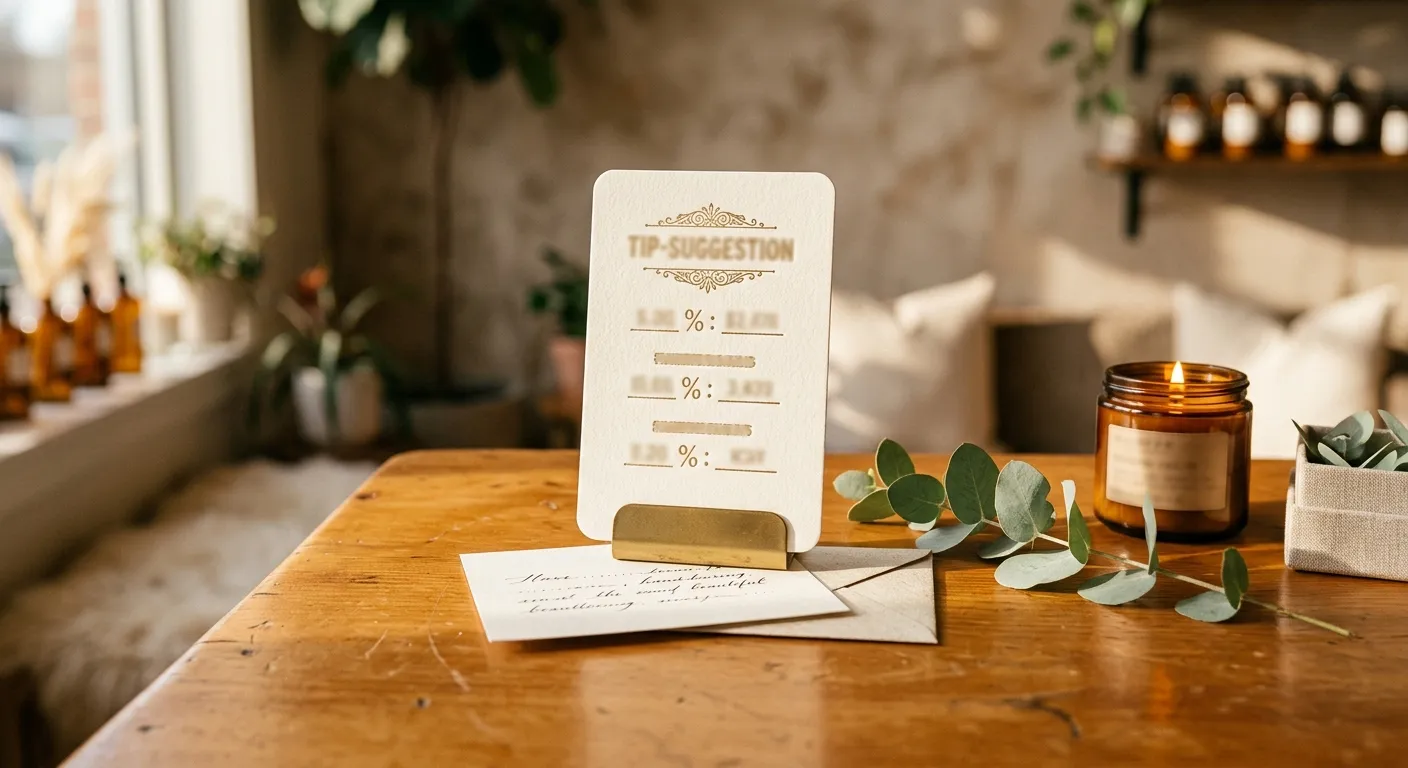
The card on the counter. The screen still exists, but it no longer carries the whole weight of the moment. Next to the card reader sits a small cream card with three lines, styled like a hotel check-in note: “20% is the standard here. More or less is always appreciated. Thank you for trusting us with your hair.” My staff does not read it aloud. It reads itself.
The thank-you note. Handwritten, one per client, folded under the receipt. Takes my front desk forty seconds. It is the last thing the client touches before she leaves, and the detail three clients have mentioned to me by name in the last month.
What clients do differently now
The tip average is steady. Rebooking is up four points year over year. Custom-amount tips, which I used to dread, are now a healthy portion of our checkouts and run within two points of our defaults either way. When a client writes in $30 on a $145 service, she is not underperforming a suggestion. She is choosing a number she feels good about.
Kara wrote about why tipping shouldn’t replace pricing, and she is right. But tipping is still part of the checkout, and the checkout is still part of the service. If your service menu is doing the work of selling the experience, your tip menu has to do the work of ending it well.
Look at your tip prompt this week. Read what it says above the buttons. Notice which number is preselected. Hold the tablet the way your client holds it and ask yourself what you would feel if the host at your favorite restaurant handed it to you with that screen showing. If the answer is “pressured,” the numbers are not the problem. The menu is.