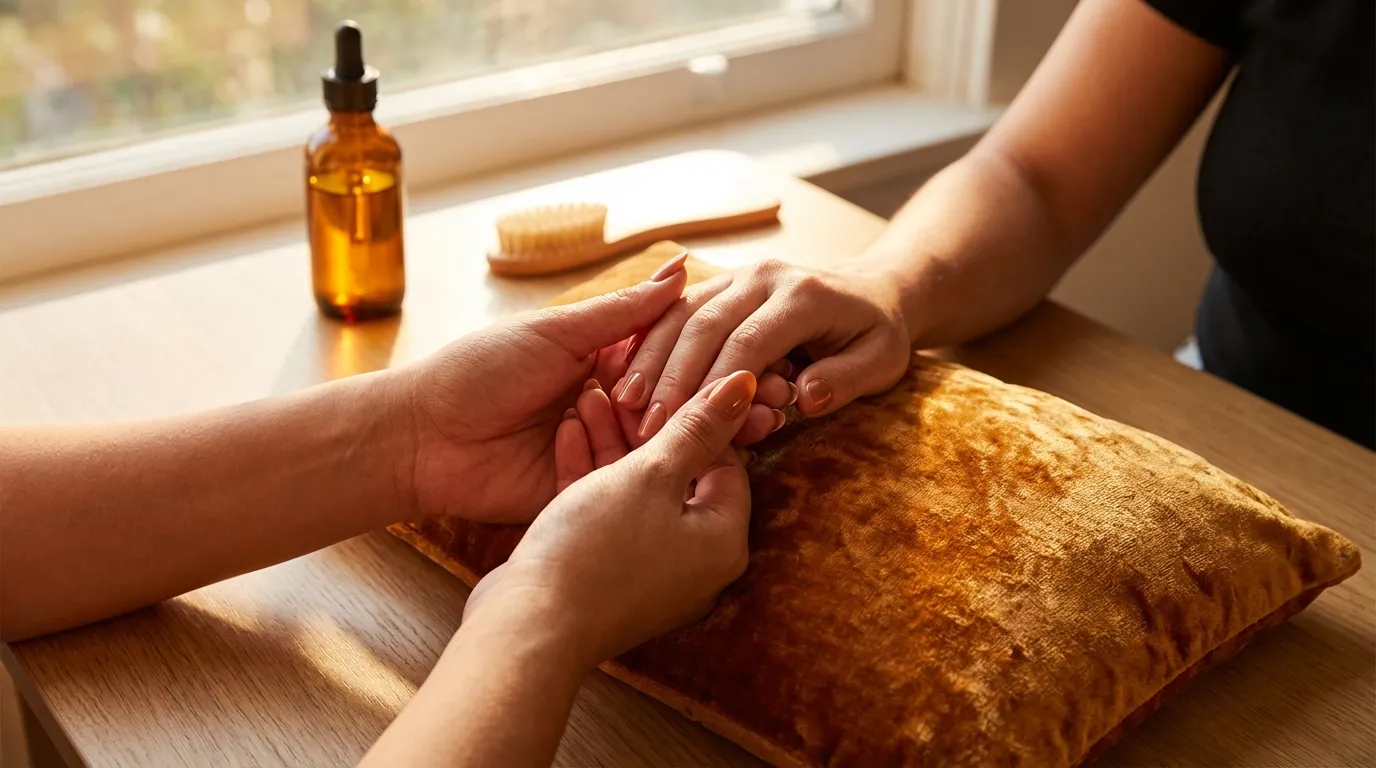
Her cuticles were raw when she first came in, bitten down to the quick, skin cracked and peeling around every nail. She apologized before I even touched her hand. “I know they’re bad.” She said it the way people say it when they’ve been told before.
That was three years ago. She comes every two weeks now. Her cuticles are smooth. She stopped biting sometime during the first year, though she never mentioned it and I never asked. I noticed because I was the one holding her hands.
Eight years of this work and the thing nobody prepares you for is the hands themselves. Not the nails, not the design, not the color. The hands. You hold hundreds of them. You learn to read them the way a nurse reads a face.
Dry knuckles in January, calluses from gardening in March, a tremor that wasn’t there six months ago. The wedding ring that appears. The wedding ring that disappears. Hands that grip the table edge during the filing because they can’t stand being still, and hands that go slack within thirty seconds because the touch puts them somewhere else entirely.
A Zenoti survey found that 38% of wellness clients consider their provider a personal friend. I believe that number is low. What happens between a nail tech and a regular client is something closer than friendship and harder to name. You know things about a person’s body that their partner doesn’t notice. The tiny scar on the left ring finger. The way one thumbnail grows with a slight ridge from an old injury. The skin that gets drier in the weeks before she tells you she’s going through something. You hold the evidence of someone’s life in your palms for an hour every two weeks, and over months and years, that accumulates into a kind of knowledge that conversation alone can’t build.
Touch does something specific. Research published in eLife showed that physical contact, even non-romantic touch, lowers cortisol and raises oxytocin. The clients who say they feel calmer when they leave aren’t imagining it. The biochemistry is real. But what interests me more is the other direction: what the touch teaches the person doing the touching. What my hands learn about their hands.
I had a client last fall, a painter, whose right index finger had a permanent callus from holding a brush. She never told me she was an artist. I noticed the callus, asked about it, and she lit up. She brought photos of her work the next appointment. Now she picks nail colors to complement whatever series she’s working on. Amber and ochre for the desert landscapes. Cool slate for the abstracts. That conversation started because I was holding her hand and felt something hard where the skin should have been soft.
Dazed ran a piece about robot manicures last year and quoted nail artist Karma Eliades: “I’m literally holding their hand for one to two hours. People bare their souls to their nail techs and build relationships that last years.” The robots are coming for the polish application. They can scan a nail bed and apply lacquer inside the lines. They’re not coming for this.
I think about the first client sometimes. The one with the bitten cuticles. Whatever changed for her, it happened somewhere between my table and the rest of her life. I didn’t fix it. I didn’t even talk about it. I held her hands every two weeks and did careful, quiet work on them, and somewhere in that repetition, something shifted. She stopped hurting her own skin.
That’s what hands remember. Not the gel shade or the nail shape. The pressure of someone holding still because they trust you. The slow accumulation of being held by someone who is paying close attention.
If you are building a salon where this kind of connection can happen, the small details matter. A cancellation policy that works protects the time you need with each client. And knowing your numbers means you can keep offering the slow, careful work that makes people come back.