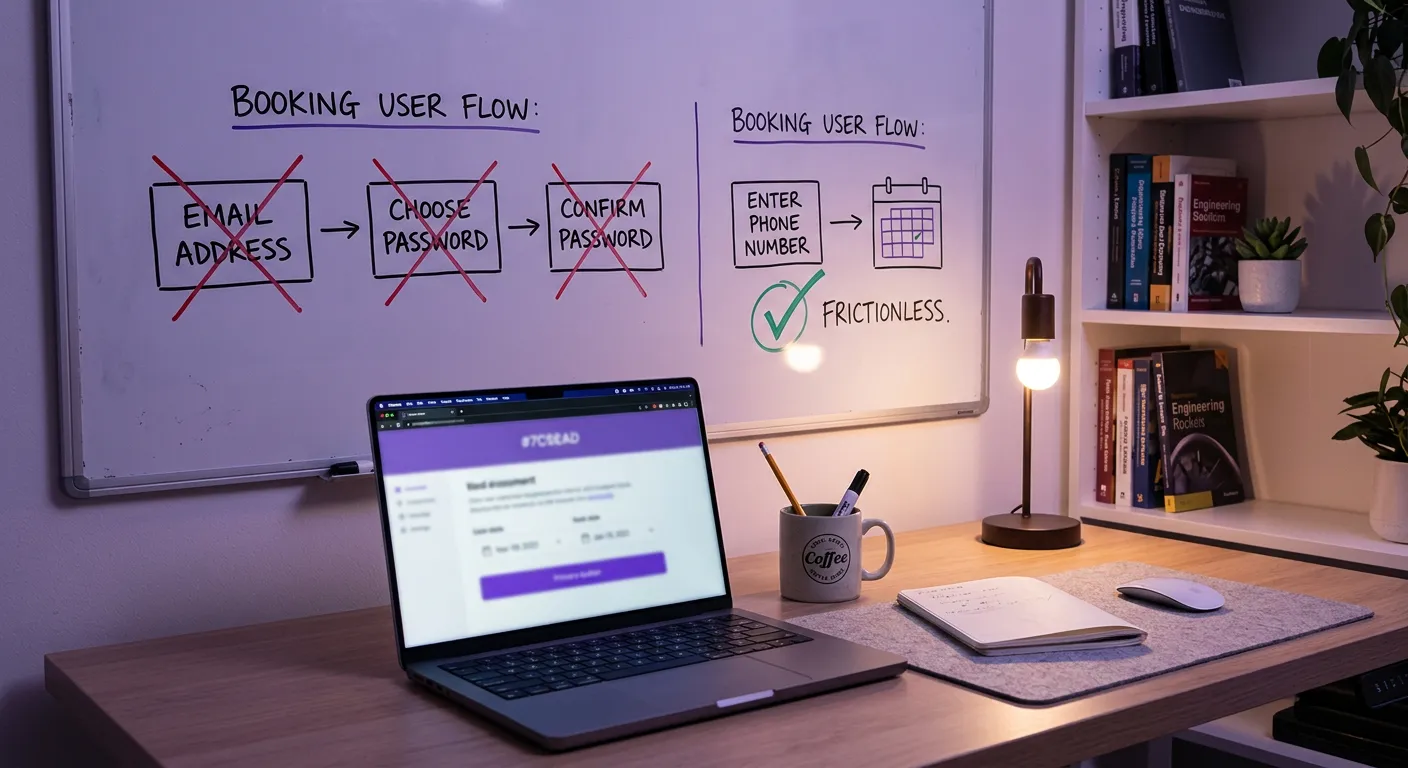
The first version of the Lutily booking flow had an account creation step. Email field, password field, confirm password. Three extra form fields between “pick a time” and “book it.” Every other platform we looked at did it that way. It was the default.
It also turned out to be the single biggest reason people abandoned the booking flow.
We had two weeks of usage data from early test salons. The numbers were clear: roughly half of the people who started the booking flow and then dropped out did so at the account creation step. Not the service selection step, not the calendar, not the payment step. The three fields asking for an email and a password.
Reducing salon online booking friction: three options
We had three paths on the table. Each had defenders.
The first was to keep account creation but move it after the booking confirmation. The booking completes, the client gets a confirmation screen with a “create an account to manage your appointments” prompt. This is the pattern most SaaS booking tools use. It captures the email for marketing and gives the client a dashboard. The downside: asking for a password after someone already booked feels like homework. Most people skip it, and the ones who don’t often type a password they forget by their next visit.
The second was to add a “continue as guest” button to the existing flow. Account creation stays visible but becomes optional. This is the hotel booking model. It reduces friction for people who notice the button. People who don’t notice it still bounce at the password field.
The third was to drop accounts entirely. No email field, no password field, no guest toggle. Just a phone number. The phone number was already required for appointment reminders. Removing the account step meant removing a redundancy, not removing useful information.
Why we chose phone-only
A Zenoti 2025 survey found that 69% of salon and spa customers have skipped booking an appointment because it was too difficult to get through. For regulars, the number jumped to 71%. The same survey found that 52% of appointment bookings happen between 5 PM and 9 AM when the front desk is closed. People book haircuts on their phone at 10 PM on a weeknight. They are not creating accounts at 10 PM. They are tapping through as fast as their thumbs move.
The decision came down to a simple question: does the account creation step earn its place in the booking flow? For Lutily, the answer was no.
Phone numbers serve the same purpose that email addresses serve in other booking flows. They identify the client for reminders, confirmations, and rebooking. They do not require password managers, inbox checks, or “forgot your password” flows. A client types their number, gets a four-digit code, and the booking confirms. That is the entire loop.
💡 What clients actually get
Clients who want to manage their appointments, check waitlist status, or view booking history can sign into the client account page using their phone number. No password. The account exists if they want it. It is not a prerequisite for booking.
What salon booking without login costs
There is a real tradeoff. Without an email field, we do not capture an email address at booking time. That means no email marketing list from the booking flow, no automated “come back” email campaigns tied to first-visit data. For a SaaS company, that is not a small thing to give up.
But the alternative was capturing email addresses from fewer people. A smaller list of emails, from a smaller pool of completed bookings, because half the clients never got past the sign-up screen. The math did not work in favor of the account step.
Research on booking abandonment has found that self-scheduling drops no-show rates by around 29%. That finding assumes the booking actually completes. If the booking flow itself causes drop-off at the account step, the no-show reduction never gets a chance to happen. The client who would have booked, shown up, and become a regular never became a client at all. They left at the password field.
What we would do differently
If we could go back, we would never have built the account creation step in the first place. We built it because every other platform had one. That is not a reason. That is an assumption we should have questioned before we wrote any code.
The lesson applies beyond account creation. Every field in a booking flow costs conversions. Name, phone, service, time slot. Those four fields are non-negotiable. Everything else needs to earn its way in. Email did not. Password definitely did not.
Salons using Lutily get more completed bookings because there are fewer steps between “I want this appointment” and “I have this appointment.” The account creation step was the longest one. We removed it. Booking features that reduce friction compound over months. This one compounds the most because it touches every single booking. Fewer booking steps also means fewer no-shows. The no-show cost calculator shows the math on what a single recovered slot is worth.