$179. That is the break-even price for a two-hour balayage when the stylist targets $55 an hour, spends $25 on color and toner, and carries $44 of the salon’s monthly overhead per appointment. A salon charging $165 is $14 short on every one of those services before profit is even counted.
Most salon owners never run this calculation. They price from the salon down the street, from what the last client was willing to pay, from what feels fair. The industry average net profit margin sits at 8%, according to Boulevard’s 2025 benchmarks. Eight cents per dollar after the bills are paid. Owners who work sixty-hour weeks are the ones discovering the number personally.
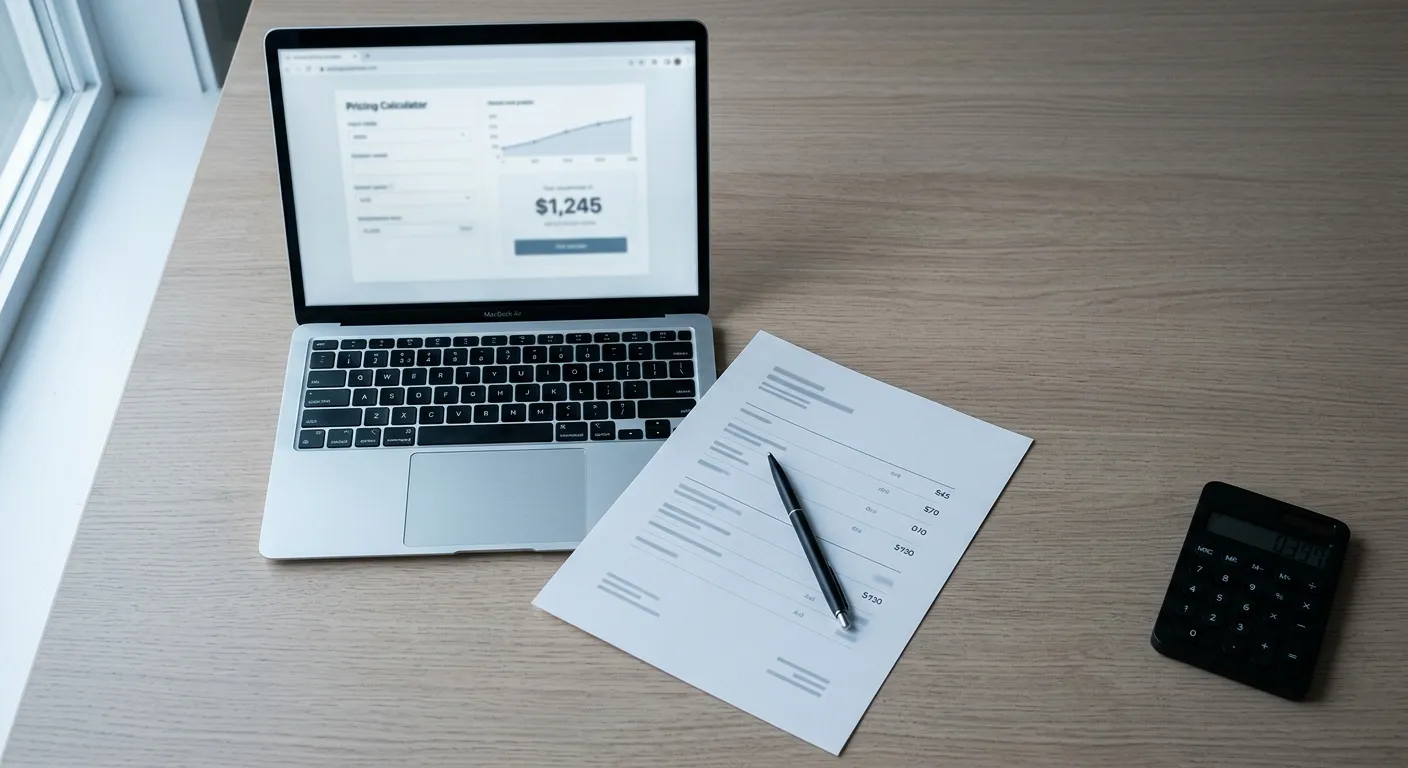
A salon pricing calculator collapses this calculation into six inputs. Enter supply cost, service time, target hourly rate, monthly overhead, clients per week, and a profit margin. The output is a minimum price, a recommended range, and a revenue projection. Here is how to work through each input and turn the result into a published price list that fixes the services the menu currently gives away.
The inputs the salon pricing calculator needs
The beauty service pricing calculator asks for six numbers. Each one maps to a line in the math.
| Input | What it covers | Example |
|---|---|---|
| Supply cost per service | Product actually consumed: color, toner, foils, gloves | $25 |
| Time per service | Chair-to-door minutes, including consultation and cleanup | 120 min |
| Desired hourly rate | What the stylist or owner needs to earn per hour | $55 |
| Monthly overhead | Rent, insurance, software, marketing, supplies | $3,800 |
| Clients per week | Realistic bookings, not the salon’s capacity | 20 |
| Desired profit margin | Net margin target for the business | 15% |
The six numbers look simple. Getting each one right is where undercharging starts and where it gets fixed.
How to price salon services: set the target hourly rate first
Supply cost is the input owners know best and the one that matters least. Most color services consume between $3 and $18 in product, even on premium color lines. A balayage with toner and a bond treatment runs to the top of that range. Product is a single-digit percentage of the ticket on most services. It is never the reason a service loses money.
Time is where the mistakes start. Owners price the minutes of application and forget the consultation, the cleanup, the stretch between clients. A service that runs ten minutes past the estimate on the menu is eating the hourly rate the price was built on.
The target hourly rate is the number most owners have never written down, and it is the one the calculator treats as a floor. A Professional Beauty Association analysis of salon suite pricing found that independent beauty professionals using strategic, cost-based pricing earn 32% higher annual income than those pricing on ad-hoc methods. The hourly rate is the foundation of that strategy. It converts “I deserve to make more” into a number the price list has to deliver.
For the balayage example: $55 an hour times two hours is $110 in labor. Add $25 in product. The service is at $135 before it touches a single dollar of overhead.
Monthly overhead and clients per week: the layer nobody counts
Overhead is the layer most price lists never see, because it is a monthly total, not a per-service number. To convert it, the calculator divides monthly overhead by monthly appointments. That requires the fifth input: clients per week.
The formula is simple. Monthly overhead divided by (clients per week multiplied by 4.33 weeks). For a salon with $3,800 in monthly overhead and 20 clients per week, every appointment carries $43.88 in overhead. A SalonScale breakdown of a $1M salon found $12,000 in monthly overhead before payroll and product, roughly $480 a day just to unlock the doors. That salon has to sell $480 every day before a single service earns anything. The price list is what sells that $480.
🧮 Overhead per appointment
Monthly overhead: $3,800
Clients per week: 20
Weeks per month: 4.33
$3,800 / (20 x 4.33) = $43.88 per appointment
The balayage now has its full cost: $110 labor, $25 product, $43.88 overhead. Total: $178.88. That is the minimum price to break even, and it is $14 above the $165 the menu currently charges.
Where the $178.88 balayage cost goes
Set the profit margin, then read the calculator output
The last input is the profit margin. The 8% industry average is the floor nobody should aim at. Top-performing salons hold net margins of 10% to 15%, and the margin is the only input that turns a price into a growing business instead of a paycheck exchange.
To apply it, divide the break-even cost by one minus the margin. At a 15% margin, the balayage goes from $178.88 to $210.45.
🧮 Price at target margin
Break-even: $178.88
Desired margin: 15%
$178.88 / (1 - 0.15) = $210.45
That is the corrected number. The same calculation run for every service produces the shape of the problem, which is never evenly distributed.
Your minimum service price
Run the calculator with your own numbers before building the menu. The tool also returns a price per minute and a revenue projection across a week, which shows which services earn the chair and which ones just fill it. A deeper walk-through of the per-minute math lives in the color service cost per minute breakdown.
The salon price list formula: from output to published menu
The calculator output is a cost floor and a recommended price. The price list formula turns those into a menu: round the recommended price to a clean ending, keep every service above its break-even, and update all three places clients see prices, the website, the booking flow, and the in-salon menu.
Here is what the corrected list looks like for a small salon running the same inputs.
| Service | Current price | Break-even | At 15% margin |
|---|---|---|---|
| Balayage | $165 | $179 | $210 |
| Partial highlight | $95 | $125 | $147 |
| Single-process color | $85 | $109 | $128 |
| Blowout | $50 | $75 | $89 |
The blowout is the leak. It carries the same $43.88 overhead as the balayage but only thirty minutes of labor, so it needs $75 just to break even and $89 to hit margin. A $50 blowout loses money on every single one. This is the pattern in most menus: the high-frequency, short service is the one being subsidized by everything else. If $89 feels high for a blowout in your market, the lever is the clients-per-week input. More booked clients spread the same overhead across more appointments. A break-even client count framework shows exactly how that trade-off works.
Short services are not the only offenders. SalonScale’s cost analysis calculates that a stylist undercharging by $20 per client, seeing four clients a day, leaks $2,000 a month from a single chair, and $16,000 a month across eight stylists. That leak is invisible on a schedule that looks full. It only shows up in the margin.
Publish the corrected list and communicate the change
A corrected price list that never ships fixes nothing. Update the menu, then tell existing clients before the change lands. A client who books at the old price after the new one goes live is the same leak, just wearing a different date.
The pricing math behind the corrected list is worth reviewing before you publish. The full service pricing formula covers the fixed-cost side, and the calculate salon service prices walk-through shows the same method applied to services with no booking history. Knowing your numbers before you touch the menu is what separates a price increase from a price guess. The calculator is where all three meet: inputs in, floor out, menu updated.
Once the menu is live, clients book against the corrected prices, and the services that were losing money stop subsidizing the ones that were not. The balayage at $210 instead of $165, the blowout at $89 instead of $50. Every appointment now clears its break-even and contributes its margin.
The salon pricing calculator turns a six-input session into a price list that covers costs, pays the target hourly rate, and hits the margin. The salon that runs it knows why each number is on the menu. The salon that does not keeps pricing from memory, and the 8% industry margin is what that memory costs.