When I ran a hotel front desk in my twenties, we had a rule about quoting room rates. You said the number once, clearly, after describing the room. You never followed it with “but” or “I know that’s a lot” or “we do have something cheaper.” You stated the rate, paused, and waited.
My manager called it “the confident pause.” She said most people accept the first price they hear if the person saying it doesn’t flinch. The flinch is what creates doubt.
I spent five years at that front desk before beauty school. I forgot most of the operational details within a year of leaving. But I never forgot the confident pause, because ten years later I caught myself flinching at my own prices.
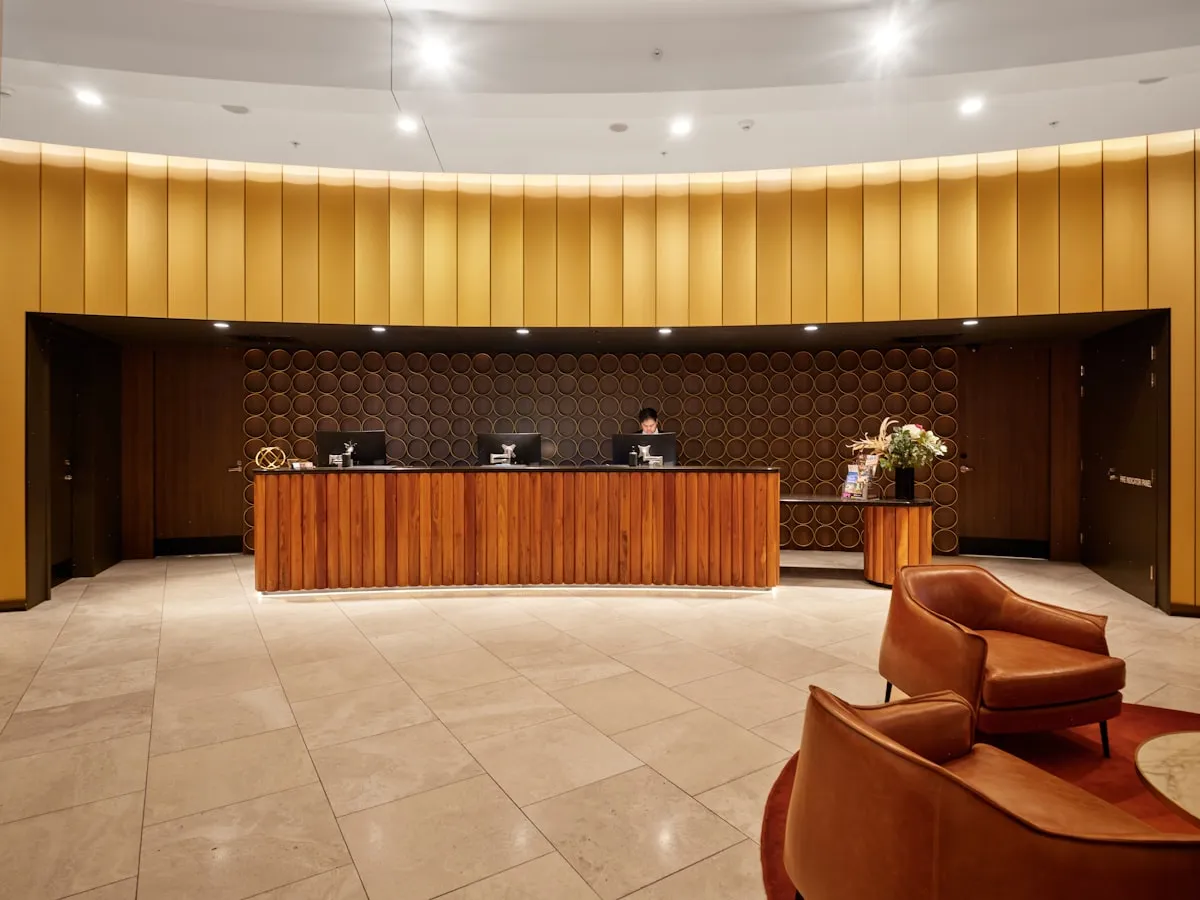
What hotels train that salons skip
Hotel chains spend real money teaching front desk agents how to present a rate. Frontline Performance Group reports that hotels using structured rate-quotation training see 3 to 6 percent RevPAR growth, with top performers hitting 10 percent. For a 300-room hotel, that translates to $300,000 to $400,000 in annual incremental revenue from changing how staff say the number.
The training follows a pattern. Describe the value first. State the price second. Never lead with cost. A front desk agent does not say “the room is $249.” She says “I have a king room on the twelfth floor with a lake view, and tonight that’s $249.” The value comes before the number.
Salons do the opposite. We quote prices like we’re confessing something. “A cut is $95.” Full stop, flat tone, sometimes with an apologetic half-smile. Or worse: “A cut is $95, but that includes a blowout.” The “but” undermines the whole sentence. It tells the client the price needs justifying before she even had a chance to react.
The three hotel rules I brought to my salon
I adapted three principles from hotel rate-quotation training. None of them cost anything. All of them changed how clients respond at checkout.
Value before price. When a client asks what a service costs, describe what she gets before you state the number. “Our signature color includes a custom formulation consultation, a treatment to protect your hair during processing, and a finishing gloss. That’s $185.” The client hears the experience first and the number second. The number arrives in context rather than in a vacuum.
The incremental frame. Hotels quote upgrades as a difference, not a total. “For just $30 more per night, I can move you to the corner suite.” Not “$279 per night for the suite.” I started doing the same thing with add-on services. “For $25 more, I can add a bond-repair treatment that will keep your color lasting two extra weeks.” The gap feels small. The total would feel larger.
No softening language. No “just,” no “only,” no “but,” no apology. The price is the price. When my team says it clearly and waits, clients almost always nod and move on. When they hedge, clients hesitate. Research from Cornell’s School of Hotel Administration found that customer familiarity with a pricing practice is the strongest predictor of perceived fairness. Confidence creates familiarity. Hesitation creates suspicion.
💡 The hotel translation
Hotel front desks say: “I have a king room overlooking the lake. Tonight that’s $249.” I trained my team to say: “Your balayage includes a custom gloss and a restorative treatment. That’s $245.” Value first. Number second. No flinch.
What changes when you stop flinching
I retrained my team on price language two years ago. No scripts. Just three rules: describe the service before you say the cost, state the number once without softening it, and wait.
The shift showed up at checkout first. Clients stopped asking “is that the total?” because the number had already been framed. They stopped requesting discounts because nobody had signaled that the price was negotiable. The energy around money changed from tense to neutral.
| Moment | Language | Effect |
|---|---|---|
| Client asks price | "A cut is $95." | Flat, transactional, invites comparison |
| Suggesting an add-on | "Do you want a treatment? It's $35." | Positions as optional expense |
| Checkout total | "So your total today is $185... we do accept all cards." | Apologetic, defensive |
| Moment | Language | Effect |
|---|---|---|
| Client asks price | "Our precision cut includes a consultation and style finish. That's $95." | Price arrives after value |
| Suggesting an add-on | "For $35 more, I can add a treatment that keeps your color lasting two extra weeks." | Incremental frame, outcome language |
| Checkout total | "Your visit today is $185. Would you like to rebook for six weeks out?" | Confident, forward-moving |
The GlossGenius pricing guide estimates that salons can expect around 10 percent client attrition after a price increase. My experience tells me most of that 10 percent leaves because of how the increase was communicated, not because of the number itself. Phorest’s retention data found that price ranks below service quality, stylist relationship, and convenience as a reason clients leave. The delivery matters more than the dollar amount.
If you have not reviewed your pricing math recently, do that first. A confident delivery on broken numbers is still broken numbers. But if your prices are sound and you are still stumbling over them at the chair, the missing piece is the pause you have never practiced.
Start with one sentence
You do not need to overhaul your checkout process. Pick one service you quote regularly and rewrite the sentence. Move the value before the number. Drop the softening words. Practice saying it out loud until you can do it without your pitch rising at the end like a question.
Then try it with your next three clients and notice what happens. Not to their reaction. To yours. The first time you state a price and simply wait, something shifts in your chest. You stop bracing for pushback and start expecting acceptance.
That is what my hotel manager was teaching me twenty years ago at the front desk. Not a sales technique. A posture. Say the number like it belongs to you, and the person across the desk will believe it does.
If your service pricing already supports the number you are quoting, the only thing left is to say it like you mean it.