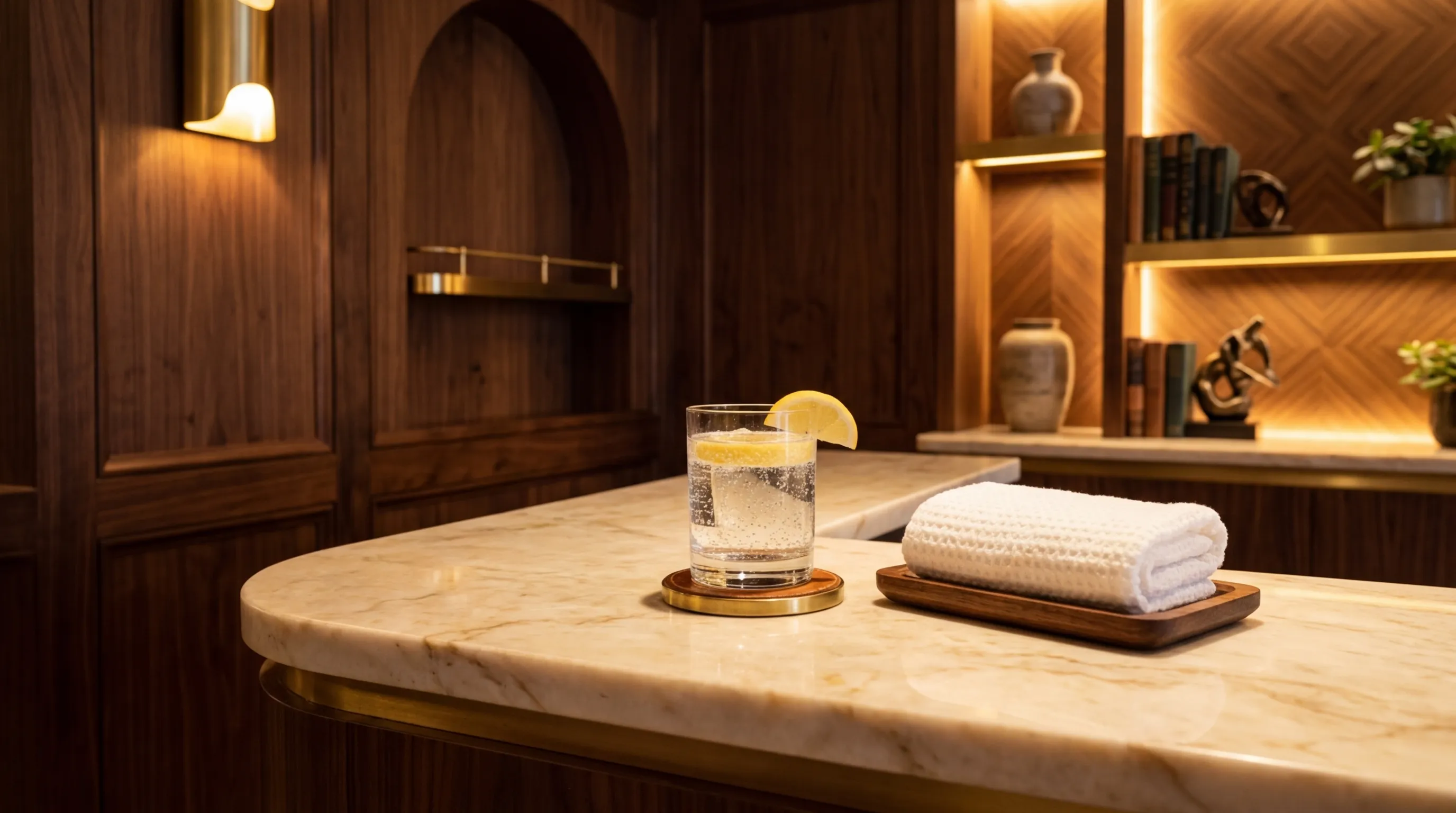
Check into any decent hotel and something small happens before you reach your room. A cold towel pressed into your hands. A glass of cucumber water set on the counter while the front desk pulls up your reservation. A chocolate on the pillow. A handwritten card with your name on it.
None of these cost the hotel more than a dollar or two. But they change how you feel about the $289 you just agreed to pay.
I managed hotel front desks for five years before beauty school. I watched this play out thousands of times. A guest walks in tired, annoyed from travel, already second-guessing whether they should have booked the cheaper place down the block. Then someone hands them a cold glass of sparkling water with a lemon wedge. The shoulders drop. The wallet opens.
The reciprocity trigger hotels bank on
There is a name for what that cold towel does. Psychologists call it the reciprocity principle. When someone gives you something without asking for anything in return, you feel a pull to give back. Research compiled by InsideBE found that a surprise gift led customers to spend 11% more on average. The gift does not need to be expensive. It needs to be unexpected, personal, and offered before the transaction begins.
Hotels have engineered this into every check-in. The welcome amenity is not generosity. It is architecture. A PhocusWire analysis of gift psychology in hospitality found that perceived value matters more than actual cost. A warm towel that costs the hotel $0.30 can shift a guest’s entire perception of the property. The guest does not think “that towel was cheap.” The guest thinks “they noticed me.”
Hotel upselling data from Oaky shows that properties with welcome-moment touchpoints see guests spend roughly 20% more on in-stay services. Room upgrades, spa bookings, late checkouts. The guest who received the cold towel is more likely to say yes to the $85 massage offer two hours later.
Why most salons skip this
Salons talk about “client experience” constantly, but most of the effort goes into the service itself. The cut, the color, the technique. The minutes before the service starts are treated as dead time. The client sits in a waiting area, scrolls her phone, maybe gets a “have a seat, she’ll be right with you.”
That gap between arrival and chair is the most emotionally loaded moment of the visit. MioSalon research found that a new client forms a judgment about your business in seven seconds. Seven. Before your shears touch a strand of hair, she has already decided what kind of place this is.
Hotels know this. Salons don’t act on it.
💡 The hotel-to-salon translation
Hotel move: A welcome drink and warm towel at check-in before the guest reaches their room. Salon move: A beverage offered by name (“Your usual oat milk latte, Sarah?”) and a warm neck wrap placed before the consultation starts. Why it works: The gesture signals “you are a guest here, not a transaction.” Reciprocity makes the client more receptive to add-ons, retail, and rebooking. It costs under $2 per visit.
What happened when I added a welcome moment
I started small. I bought a Nespresso machine and a set of ceramic mugs. No paper cups. I stocked sparkling water in glass bottles. I trained my front desk to offer the drink before asking the client to sit down. The script changed from “can I get you something?” to “I have your cappuccino ready. Do you still take oat milk?”
The name matters. The specificity matters. It tells the client you remember her.
Within six weeks I noticed something I was not tracking on purpose. Add-on service acceptance climbed. Clients who received the welcome drink were more likely to say yes when their stylist suggested a gloss treatment or a deep-conditioning add-on. I did not run a controlled experiment. I do not have a spreadsheet with a P-value. But I went from hearing “no thanks” on add-ons three times a day to hearing it maybe once.
Then I added the warm towel. A small rolled towel, slightly damp, heated in a towel warmer. Placed on the client’s neck after she sat in the chair, before the consultation. My cost: a $40 towel warmer from Amazon and a stack of hand towels I already owned.
The reaction was immediate. Clients physically relaxed. One regular told me it made her feel like she was at a spa, not a hair appointment. That comment alone told me I had shifted her perception of value. Same service, same price, different frame.
The math on a welcome moment
A cappuccino pod costs $0.55. Oat milk, maybe $0.20 per pour. A sparkling water in a glass bottle runs about $1.00. Towel laundering adds cents. Call it $1.50 per client on the high end.
If that $1.50 gesture makes even one in five clients accept a $25 add-on they would have declined, you are looking at $5 in add-on revenue for every $1.50 spent. Scale that across 25 clients a week, and the welcome moment generates an extra $650 a month from add-ons alone. That ignores the retention effect, the referrals, and the five-star reviews that mention “the little touches.”
Start noticing before you start spending
Next time you walk into a hotel, a restaurant, or any business where you feel immediately welcome, pay attention. Something happened in the first thirty seconds. Someone gave you something you did not ask for. Something small, personal, free.
Then walk into your own salon on Monday morning and stand at the door. What does a client experience in her first thirty seconds? If the answer is “she waits,” you have your opening.
The Nespresso machine is $150. Deciding that the appointment starts at the front door, before the chair, costs nothing.