The first time I watched a turndown attendant work a room, I was twenty-three and training at a small luxury hotel in Chicago. It was seven in the evening. The guest was downstairs at dinner. The attendant moved through the suite in under four minutes. She dimmed the bedside lamp. She folded the duvet back at a precise forty-five-degree angle. She set a carafe of water and a single wrapped chocolate on the nightstand, and a handwritten card on the pillow that read, in cursive, “Sleep well, Ms. Henderson. We’re glad you’re here.”
Then she left. The guest never saw her. That was the point. What the guest saw, an hour later, was a room that had been thinking about her while she was gone.
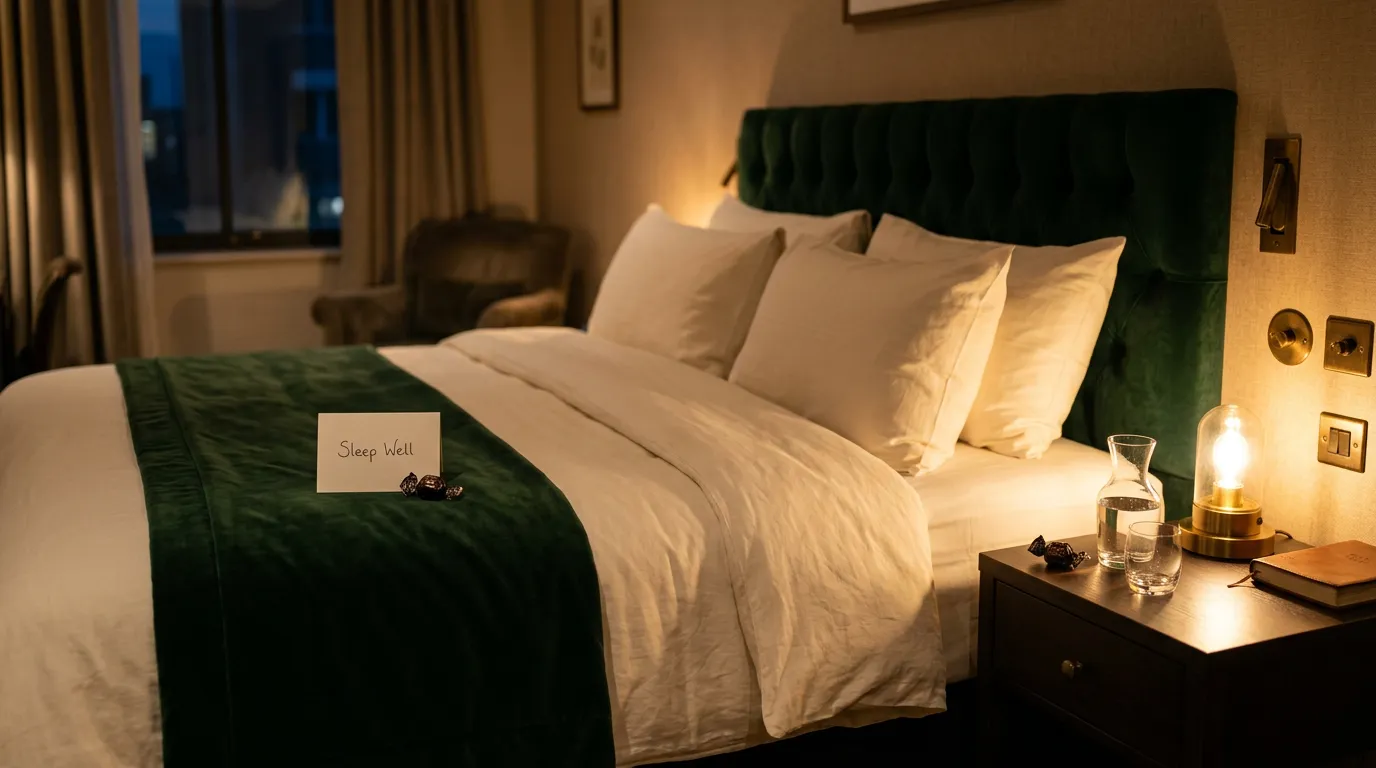
Turndown service is one of the most operationally pointless things hotels do. The guest could pull back her own covers. She does not need a chocolate. She already has water in the minibar. And yet a 2025 American Hotel & Lodging Association analysis found that guests who received nighttime preparations reported a 24% higher satisfaction rate than guests who did not. The ritual works because it signals that the guest is being held in the staff’s mind even in her absence.
I thought about that card on the pillow for ten years before I understood what to do with it in a salon.
The rebooking problem nobody names honestly
The industry average hair salon rebooking rate sits around 40%, according to Boulevard’s 2025 salon benchmarks. For upscale salons, the target is 60% or higher, per Simple Salon’s retention research. Mine was running at 47% when I started paying attention.
My stylists were using the script every consultant recommends. “Would you like to book your next appointment while you’re here?” The client said yes or no. If yes, we pulled up the calendar. If no, she paid and left. The question was polite and logistically correct. It also sounded exactly like what it was: a closing move.
A Nick Mirabella coaching breakdown names the underlying issue plainly. When a client is still in your chair, hair fresh, feeling good, she is at peak motivation to book again. The moment she steps outside, that motivation drops.
The problem is not that salons fail to ask. The problem is when and how they ask. By checkout, the cape is off. The card is out. The client has already mentally left. The rebooking question arrives as a transaction.
Why salons copied the wrong hotel moment
Most salon rebooking advice is built around check-in energy. The warm greeting. The cold beverage. The coat taken at the door. I wrote about that gesture in the salon welcome experience. Check-in is where the sale opens. Turndown is where the sale closes, and almost no one is paying attention to it.
The turndown attendant is not trying to sell anything. She is demonstrating that the hotel is still thinking about you after the transaction is done. She is building the next booking by refusing to treat the current one as complete.
In a salon, the equivalent moment is not checkout. It is the final five minutes of the service, while the client is still in the chair, still looking at the mirror, still feeling the version of herself the appointment just produced. That is when the next appointment should be named.
✅ The hospitality translation
Hotels do not ask “would you like turndown tonight?” They do it, without asking, while the guest is at dinner. I stopped asking clients “do you want to book your next appointment?” and started saying “I want to protect this haircut for you. Let’s put your next appointment on the calendar while your hair is still exactly like this.”
The rebooking script I actually use now
I stopped asking a yes or no question at the register and started narrating forward from the chair. The script has three moves, and I teach it to every stylist on my team.
At the ninety percent mark of the service, while the client is still looking in the mirror: “This is holding really well. For the gloss to keep this shine, I want to see you back in six weeks. I’m looking at the week of June 2nd. Do mornings or afternoons work better for you?”
At the sink, I reinforce the why: “After seven weeks, the tone shifts warm and we have to do more work to bring it back. Six weeks keeps it easy.”
At the front desk, the appointment already exists. Checkout becomes “Here’s your confirmation. See you June 2nd.”
Notice what changed. I never asked if she wanted to rebook. I told her what the service needed to stay the way it was at that moment, then offered two options inside a window I’d already chosen. A Meevo rebooking script breakdown calls this “offering a suggestion instead of a yes-or-no question.” It works because it assumes continuity. The client is not deciding whether to come back. She is deciding which day to come back.
| Moment | What I said | What the client heard |
|---|---|---|
| Final chair minutes | Let me know when you're ready to head up front. | The appointment is ending. |
| At the register | Would you like to book your next appointment? | I am asking if we are doing this again. |
| After a no | No problem, we'll see you whenever. | This was fine but not protected. |
| Moment | What I said | What the client heard |
|---|---|---|
| Final chair minutes | I want to protect this color for you. Let's get the next one on the calendar while your hair is like this. | She is still thinking about my hair after today. |
| At the register | See you June 2nd. I'll send a reminder the Monday before. | I am already on her schedule. |
| After hesitation | Let me block two options and you can confirm by Friday. | She is holding space for me specifically. |
What happened when I stopped selling the rebook
Our rebooking rate moved from 47% to 71% over about seven months. I did not run promotions. I did not add an incentive. I changed the sentence and the moment.
What I noticed first was not the numbers. It was how checkout started to feel. The register used to have a subtle negotiation in the air, the micro-tension of “am I about to ask for another sale.” That tension is gone. By the time a client reaches the front, the next appointment is already part of the relationship.
My stylists feel it too. Two of them told me independently that they stopped dreading the rebook moment. It used to feel like asking a favor. Now it feels like an extension of the care they already delivered in the chair.
A Mindbody checkout analysis puts it plainly: rebooking at checkout is the most reliable form of retention, but the conversation has to start long before the counter. This piece on rebooking before they leave goes deeper into the numbers.
The lesson I keep returning to is that the best service moves almost never look like selling. The turndown attendant was not trying to get the guest to book another night. She was being thorough about the night the guest was already in. The rebooking ritual works the same way. You are not asking for the next appointment. You are finishing the current one properly, and the next appointment is part of what finishing it properly means.
Next time you check into a hotel, don’t just enjoy the turndown. Watch what it’s actually doing. Then walk into your salon tomorrow and ask yourself where your turndown moment is. If you can’t find it, that’s the one you build next.