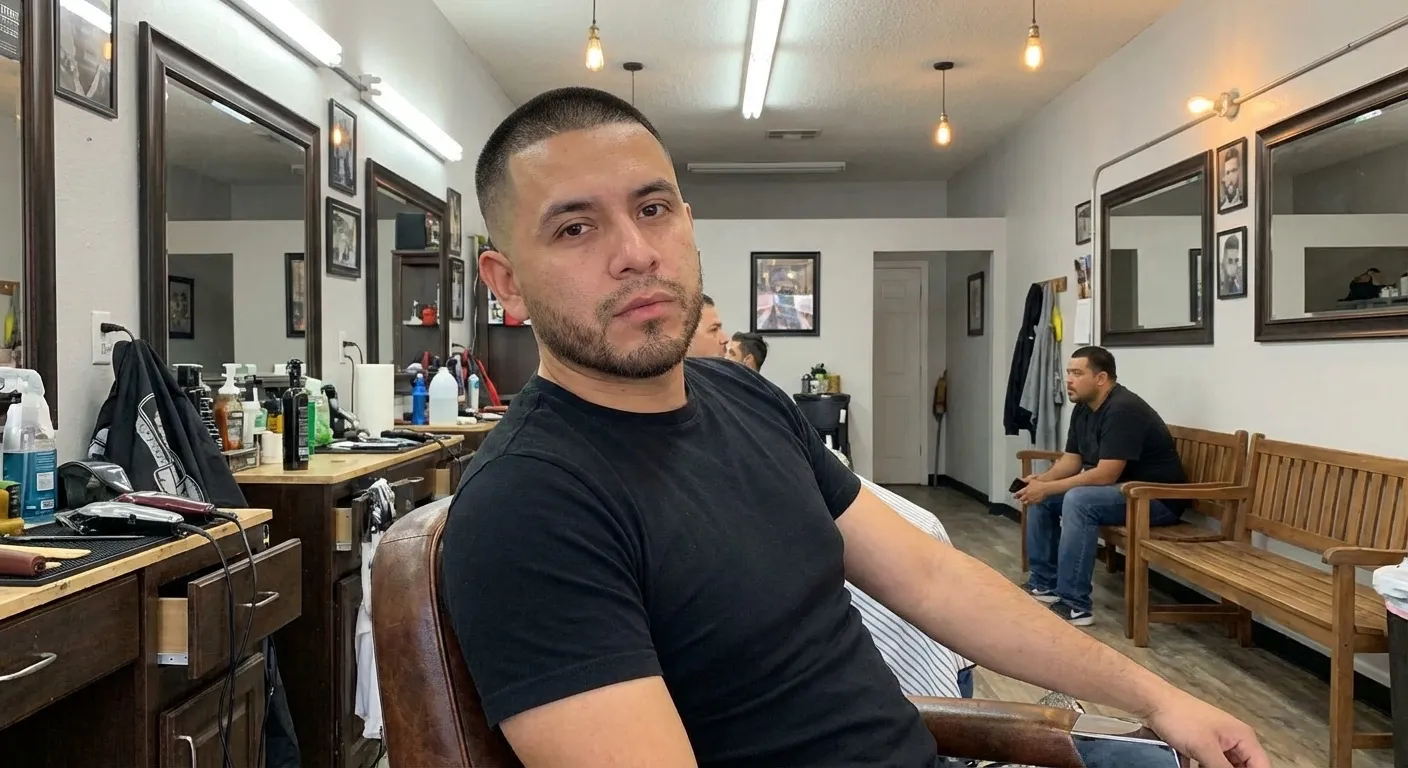
My first year solo, I was the barber, the receptionist, the bookkeeper, the social media manager, and the janitor. I answered booking DMs between clients. I texted reminders at midnight. I tracked revenue in a Notes app on my phone. It worked until it didn’t.
By month ten, I was cutting 8 clients a day and spending another 2-3 hours on everything that wasn’t cutting. The non-cutting hours were eating my evenings and my weekends. I was fully booked but barely keeping up with the admin side of running a business.
A Time Etc survey of entrepreneurs found that more than a third of the average work week goes to administrative tasks. For solo operators, that percentage is often higher because there’s nobody to hand things off to. Executives report spending 16 hours per week on manual admin work. That’s two full days.
I didn’t have 16 hours to spare. So I started eliminating, automating, and delegating. Here’s what changed.
Step one: eliminate tasks that don’t need doing
Before I automated anything, I killed tasks that shouldn’t exist.
I stopped sending individual confirmation texts. I stopped manually posting appointment times on my Instagram story. I stopped hand-writing receipts. I stopped maintaining a paper calendar and a digital one simultaneously.
Most solo barbers are doing double work without realizing it. Writing the appointment in a notebook and then entering it in the phone. Texting a client to confirm and then texting again to remind. Check your week honestly. If you’re doing anything twice, one version needs to go.
✅ The elimination audit
Write down every non-cutting task you did last week. For each one, ask: would anything bad happen if I stopped doing this entirely? If the answer is no, stop. If the answer is “clients would miss appointments,” that’s an automation problem, not a you problem.
Step two: automate booking, reminders, and follow-ups
Three systems changed my business:
Online booking. This was the biggest single time-saver. Before online booking, I was fielding 15-20 DMs and texts per day about availability. Each one required a back-and-forth conversation. “When are you free?” “What about Thursday?” “Actually, can we do Friday?” Multiply that by 15 and you’ve burned an hour just scheduling.
Mangomint’s barbershop data shows that 77% of barbershop appointments are now booked online. The remaining 23% come from walk-ins, phone calls, and in-person scheduling. The industry has already shifted. If you’re still booking through DMs, you’re doing the work that software should handle.
Online booking also captures clients when you can’t. Industry data shows 46% of bookings happen when salons are closed. That’s nearly half your potential appointments coming in at 10 PM or 6 AM, times when you’re not answering texts. An online booking page works at midnight. You don’t.
How barbershop appointments are booked
Source: Mangomint barbershop booking statistics
Automated reminders. Before I set up automated SMS reminders, my no-show rate was around 18%. I’d have one or two empty slots a day from people who forgot or just didn’t show. Each no-show at $50 is $50 gone.
Vocaly AI’s salon research found that automated reminder systems cut no-shows from 15-30% down to about 5%. My numbers matched. After switching to automated texts 24 hours and 2 hours before each appointment, no-shows dropped to about 4%. On 40 appointments per week, that’s roughly 5-6 recovered appointments per week. At $50 each, that’s $250-300 per week I was leaving on the table. If you haven’t done the math on what every no-show actually costs you, run the numbers through the no-show cost calculator — it’s probably worse than you think.
Automated follow-ups. After every appointment, my system sends a thank-you text. Three weeks later, it sends a rebooking nudge with a link to my calendar. I don’t write these. I don’t send these. They happen on their own.
Salon SMS research from Sakari found that automated follow-up texts convert about 17% of recipients into bookings. For 40 clients per week, that’s 6-7 who rebook from a text rather than from me picking up my phone.
How many hours salon automation actually saves
I tracked my time for one week before automation and one week after. The difference was stark.
| Task | Before (hours/week) | After (hours/week) |
|---|---|---|
| Responding to booking requests | 5.5 | 0.5 |
| Sending reminders | 2.0 | 0 |
| Following up with past clients | 2.5 | 0 |
| Rescheduling no-shows | 1.5 | 0.5 |
| Tracking revenue manually | 1.0 | 0 |
| Total admin | 12.5 | 1.0 |
That’s 11.5 hours per week returned to me. Some of those hours went back into cutting hair. Some went into rest. Both made me more money.
Salesforce reports that 74% of employees using automation say it helps them work faster. For a solo operator, “working faster” means finishing the business side of your day in minutes instead of hours.
Where my reclaimed hours went
Step three: delegate what you can’t automate
Some tasks need a human, but that human doesn’t need to be you.
I hired a friend’s daughter to do my social media. $200 a month. She takes photos I send her, writes captions, and posts three times a week. My Instagram engagement actually went up because she’s more consistent than I ever was.
I use a bookkeeper for $150 a month. She reconciles my accounts and sends me a monthly P&L. Before her, I was spending four hours a month on spreadsheets and still getting it wrong.
Gallup research found that leaders who delegate generate 33% more revenue than those who don’t. For a solo barber, delegation doesn’t mean hiring a full-time employee. It means paying someone $200 a month to handle the work that distracts you from cutting hair.
🧮 The delegation math
Say you cut hair at $50/hour. Every hour you spend on admin instead of cutting costs you $50 in potential revenue. Paying someone $25/hour to handle admin frees you to earn $50/hour. You net $25/hour on every delegated task. Five hours of delegation per week = $6,500 more per year.
What salon automation unlocks for solo owners
The point of systems isn’t efficiency for its own sake. The point is that your business can function without you being involved in every single transaction.
When I got COVID last spring, I was down for a week. Before automation, that would have meant 40 missed texts, 10 angry no-shows, and a month of rebuilding momentum. Instead, my booking page stayed open. Clients who needed to reschedule did it themselves. Reminders still went out. The follow-up texts still fired. I lost a week of cutting revenue, but I didn’t lose a single client.
That’s the difference between having a job and having a business. A job needs you in the chair every day. A business has systems that keep running when you step away. Both make money. Only one of them scales.
Beauty businesses using digital booking systems report 35% higher customer retention rates compared to those relying on traditional methods. That retention advantage compounds month after month. After a year, the gap between a systemized operation and a manual one isn’t 35%. It’s the difference between a growing business and a stalled one.
Start with online booking. Add automated reminders. Set up follow-up texts. Each one takes an afternoon to configure and saves you hundreds of hours per year. These same systems also help convert walk-ins into regulars by keeping you in touch after that first visit. Your job is to cut hair. Let the systems handle the rest.