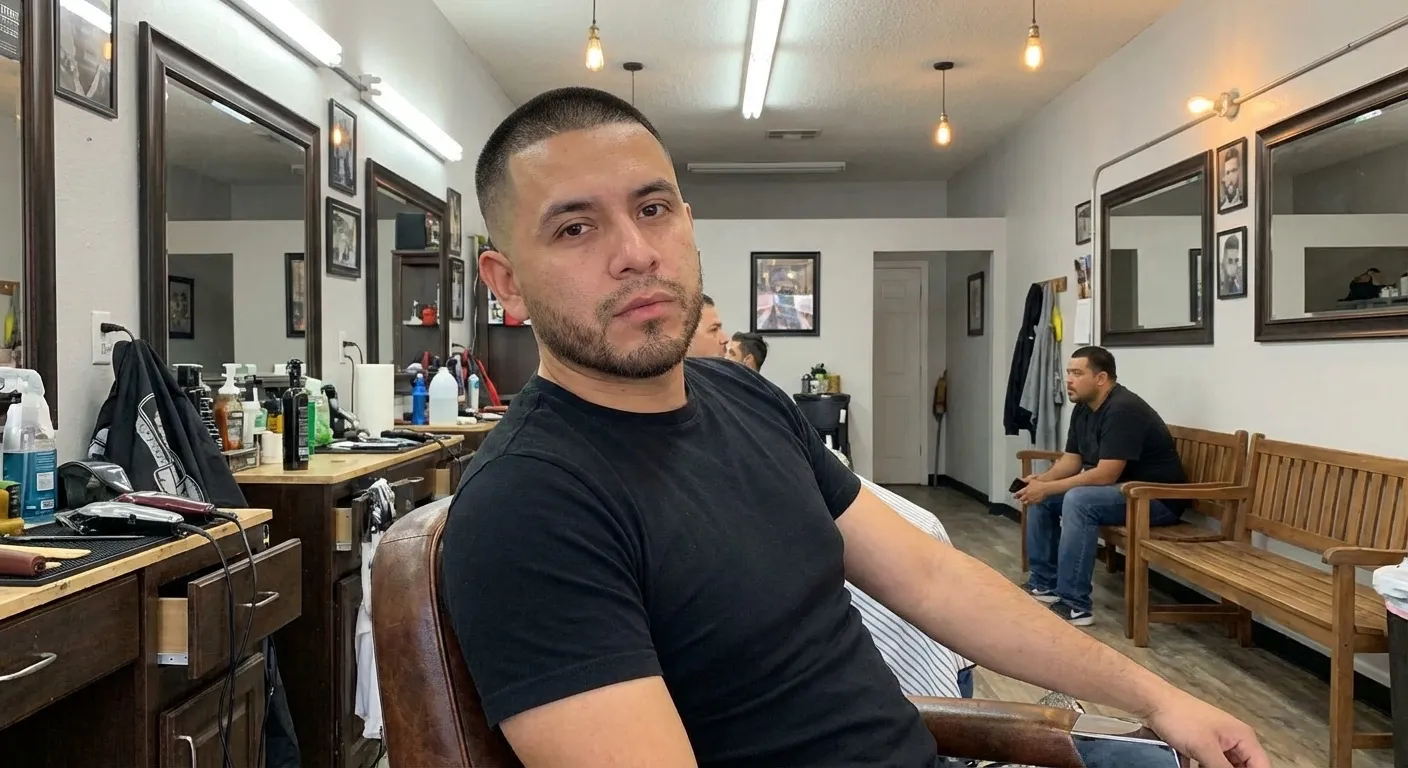
A buddy of mine cuts hair in Hialeah. Good barber. Charges $30. He works six days a week, does 10-12 clients a day, and clears about $1,800 weekly before booth rent. Another guy I know in Brickell charges $85. He works five days, does 6 clients a day, and clears about $2,550. Same city. Same clippers. Wildly different businesses.
The difference is positioning. One chose budget. One chose premium. Both are doing fine. The barbers who struggle are the ones stuck at $40-45, too expensive for the price shoppers and too cheap for the clients who associate price with quality.
That national average of $43 is where most barbers cluster. It feels safe. But safe is a trap when 154,925 shops are all fighting for the same middle ground.
Why mid-range barber pricing fails
Pricing communicates something before a client ever sits in your chair. A $25 cut says “quick and affordable.” A $75 cut says “this person is worth the trip.” A $43 cut says nothing at all.
The men’s grooming market hit roughly $65 billion globally in 2025, growing at about 6.4% per year. That growth isn’t evenly distributed. It’s concentrated at two ends: budget chains scaling on volume and premium independents scaling on experience. The middle is where margins get squeezed.
BusinessDojo’s barbershop profitability analysis shows that premium barbershops charging $60-100 per service create superior margin opportunities compared to shops charging $20-40 for the same work. The gap between those two tiers runs deeper than revenue. The type of client you attract, how often they return, and how much they spend beyond the cut itself all shift when you move up the pricing ladder.
Weekly gross revenue by positioning
Budget works if you commit to it
I’m not here to trash the $25 cut. Budget positioning is a legitimate strategy. It works when you have volume, speed, and low overhead. The barbers I know who charge $25-30 make real money because they’ve optimized for throughput. Fifteen-minute cuts. Minimal conversation. Walk-ins only. They run their chair like a machine.
But budget requires discipline. You can’t charge $25 and also spend twenty minutes on each client. You can’t charge $25 and complain about the quality of clients you attract. The price sets the expectation. If you choose budget, own it fully. Move fast, stack appointments, and keep your overhead brutal.
Premium works if you build the frame
Premium is the opposite game. Fewer clients, more time per service, higher expectations. You’re selling the full experience: the atmosphere, the conversation, the feeling of walking out sharper than you walked in.
PwC’s consumer research found that 43% of consumers will pay more for greater convenience, and 42% will pay more for a friendly, welcoming experience. In barbering, that translates to real things: online booking with no phone tag, a clean and styled shop, a barber who remembers your name and your last conversation, a hot towel at the end.
Premium clients also spend more per visit. Boulevard’s salon industry data reports that loyal clients spend 67% more than first-time visitors. When your average ticket is already $75, that loyalty multiplier matters. A regular who adds a beard trim and buys a product turns a $75 visit into $110. Over a year, that one client is worth over $2,800 if they come every three weeks.
🧮 Premium client lifetime value
$75 base cut + $20 beard + $15 product = $110 per visit. Every 3 weeks = 17 visits/year. Annual value per regular client: $1,870 on the cut alone, $3,740 if they add a beard trim each time. One premium regular is worth four budget walk-ins.
How I went from $40 to $55 to $70
My own pricing journey wasn’t instant. I started at $40, like everyone. When I specialized in fades, I bumped to $55. The bump felt huge at the time. I lost about 15% of my clients, mostly price-sensitive walk-ins.
Six months later, I went to $70 for my signature fade and $90 for the combo with beard work. This time I lost almost nobody because the clients who stayed through the first increase were there for me, not for the price.
GlossGenius pricing research suggests that a 10% price increase typically leads to roughly 10% client loss. My experience confirms this at the lower end but not at the top. Once clients see you as their barber, the relationship absorbs price increases that would send a walk-in to the shop next door.
The key is to increase before you’re fully booked. If you wait until every slot is taken, you’ve already left months of higher revenue on the table. For a full walkthrough on communicating increases, see how to raise your prices without losing clients. I wrote about the fully booked trap separately — being maxed out at a low price is one of the worst positions a solo barber can be in.
What you need to justify premium barber prices
Going premium is more than raising prices. You need the frame to justify it. Here’s what I built over six months:
| Element | What it costs | What it does |
|---|---|---|
| Online booking | $30-50/mo | Eliminates phone calls, looks professional |
| Branded products on shelf | $200-400 initial stock | Clients associate you with quality, retail margin is 70-80% |
| Clean, styled workspace | $500-1,000 one-time | First impression before you touch clippers |
| Hot towel finish | ~$2 per client | Turns a cut into an experience |
| Consistent social content | Free (time investment) | Portfolio that justifies the price before they walk in |
None of this is expensive. The hot towel costs two dollars. The booking software is less than one client per month. But stacked together, these details create a perception that the $75 you’re charging is a fair trade.
What premium clients value most (PwC data)
Barber retail sales: the margin most shops ignore
Here’s a number that surprised me. The most profitable barbershops make 25-30% of their revenue from retail product sales. Retail products carry gross margins of 70-80%, far higher than the margin on a service where your time is the cost.
At $40 a cut, selling a $20 pomade doesn’t move the needle much. But at $75 a cut, you’ve already established that your client cares about their appearance. Recommending a product feels natural, not pushy. Premium positioning gives you permission to sell.
I started keeping three products at my station: a matte paste, a sea salt spray, and a beard oil. Nothing fancy. Each one costs me $6-8 wholesale and sells for $18-22. I sell maybe 8-10 products a week. That’s an extra $100-150 in pure margin, every week, without adding a single minute to my schedule. If you want to go deeper on this, there’s a full breakdown on how to turn your retail shelf into revenue.
Pick your lane and build for it
The question is simple: do you want more clients at a lower price, or fewer clients at a higher price? Both can work. Neither works if you’re in between.
If budget is your lane, optimize for speed. Get your cut time under twenty minutes. Run walk-ins. Keep overhead minimal. Stack volume.
If premium is your lane, optimize for experience. Specialize. Invest in your space and your brand. Book by appointment. Make every client feel like they’re your only one.
The U.S. barbershop market grew at a revenue CAGR of 9.8% between 2020 and 2025. There’s enough money flowing into this industry for both strategies to thrive. The only strategy that doesn’t work is hoping the middle will hold.